Key takeaways:
- A good construction website is clear and has the information a client needs.
- Portfolios and testimonials help visitors feel confident about the services you offer.
- Informative and engaging content about you and the industry draws in clients.
Let’s face it: making a professional website can be tricky. Especially if you’re in the construction industry, you value planning and building with the intention that it will last. Creating a website can feel like a whole other thing. You wonder which tools to use, what to put where, and how to make it look good. Oftentimes, you end up just not making one at all.
So, if you’ve been putting off building a website for your building construction business, this guide will address your concerns. In this article, we’ll walk you through how to build one and the important elements to remember.
What makes a great construction company website design?
Effective construction websites often share a few key elements. Keeping these in mind can help you create a professional website for your construction business.
- Straightforward layout: An easy-to-navigate website helps visitors find what they need fast.
- Clear CTA: A strong, easy-to-understand call-to-action (CTA) guides users to the next step, often leading to conversion.
- Portfolio section: A good website showcases completed construction projects to prove the quality of your work, eventually building customer trust.
- Service description: A good website gives comprehensive information and details about all the services that you provide.
- Contact details: Make it easy for visitors to reach you by listing your phone number, email, and location.
- Testimonials: A view of other customers’ experiences while working with you adds credibility and encourages new customers to reach out.
5 best construction website examples
Seeing real examples will take your understanding further. We gathered five solid website designs from real construction companies that we think look good and support business growth.
1. Jerdon Construction
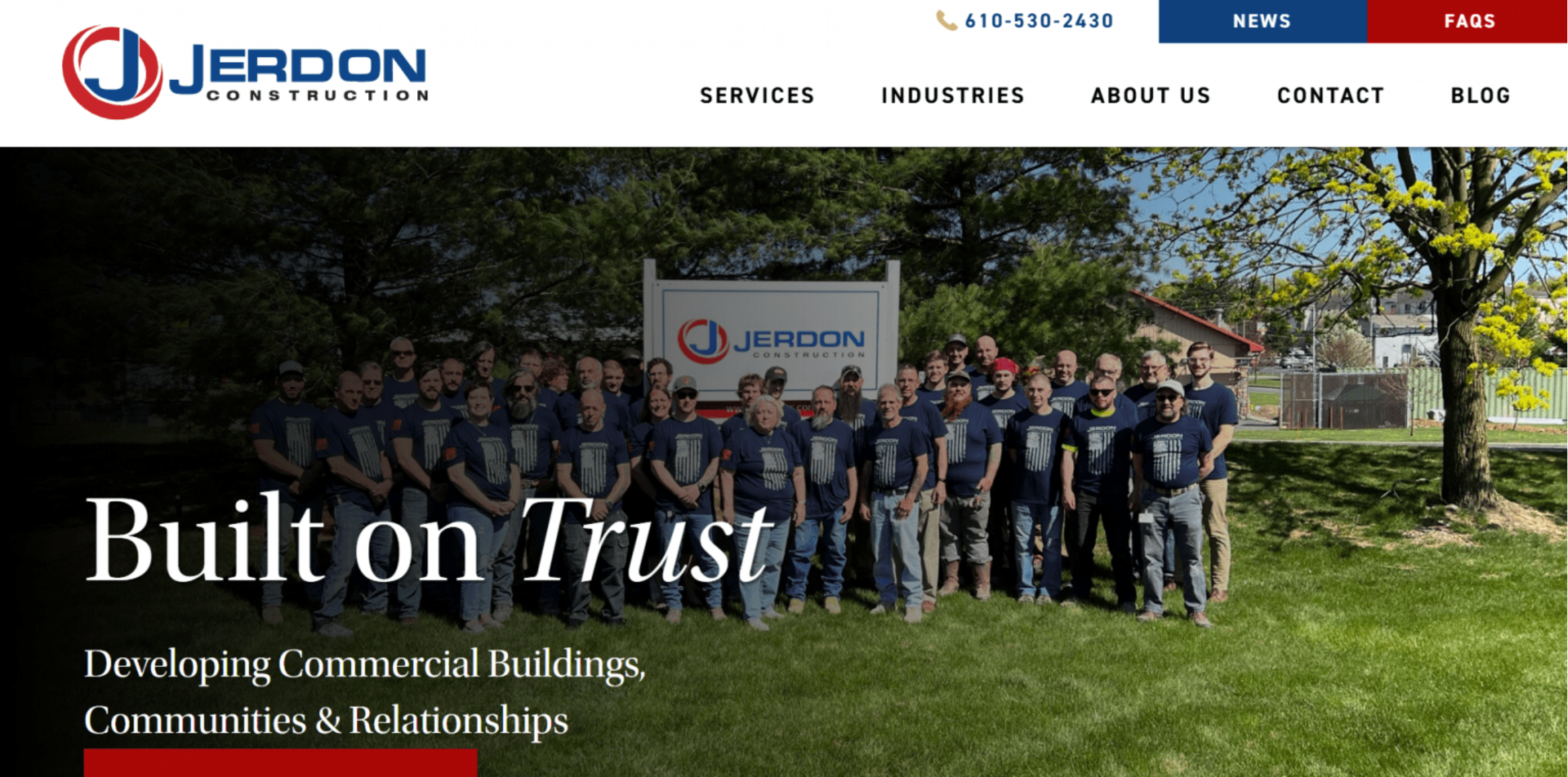
Jerdon Construction focuses on commercial construction, and its website shows that clearly from the start. The home page immediately tells you what they do, with buttons to learn more about their services, contact them, and read blogs on current construction trends.
As you scroll, you’ll see the types of buildings they work on, like healthcare centers, restaurants, schools, and more.
Then comes encouraging testimony from past clients. This is an effective way of encouraging visitors to decide and take action. They also place clear CTAs like “Join Our Team” and “Contact Us” in places that guide users without overwhelming them.
Overall, the website keeps things simple and focused. This makes it easy for visitors to understand what Jerdon Construction does and how to get in touch.
2. Edifis
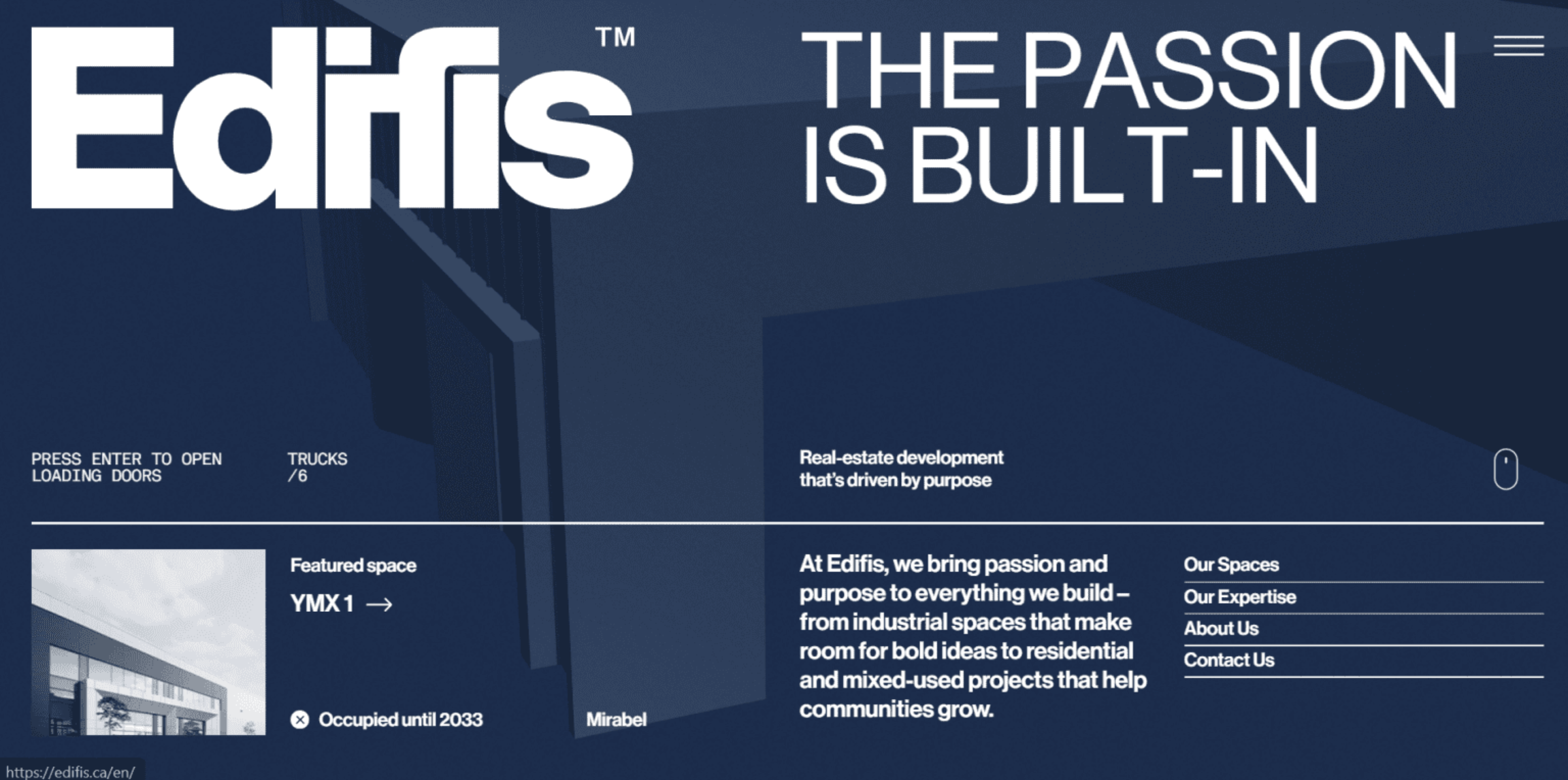
Edifis is a construction company that provides innovative solutions. And from their home page, you’ll see their passion for bold ideas.
The website features industrial projects with visual stats like size, completion date, and location details. They also provide clear buttons that lead you to an in-depth description of the company’s services, contact details, and more.
As you scroll, multiple customer testimonials appear. This reinforces satisfaction and reliability.
Overall, Edifis’ website uses a clean layout, high-quality visuals, and clear CTAs like “Contact Us” buttons and newsletter signups to engage visitors.
3. McDonald Building Co.
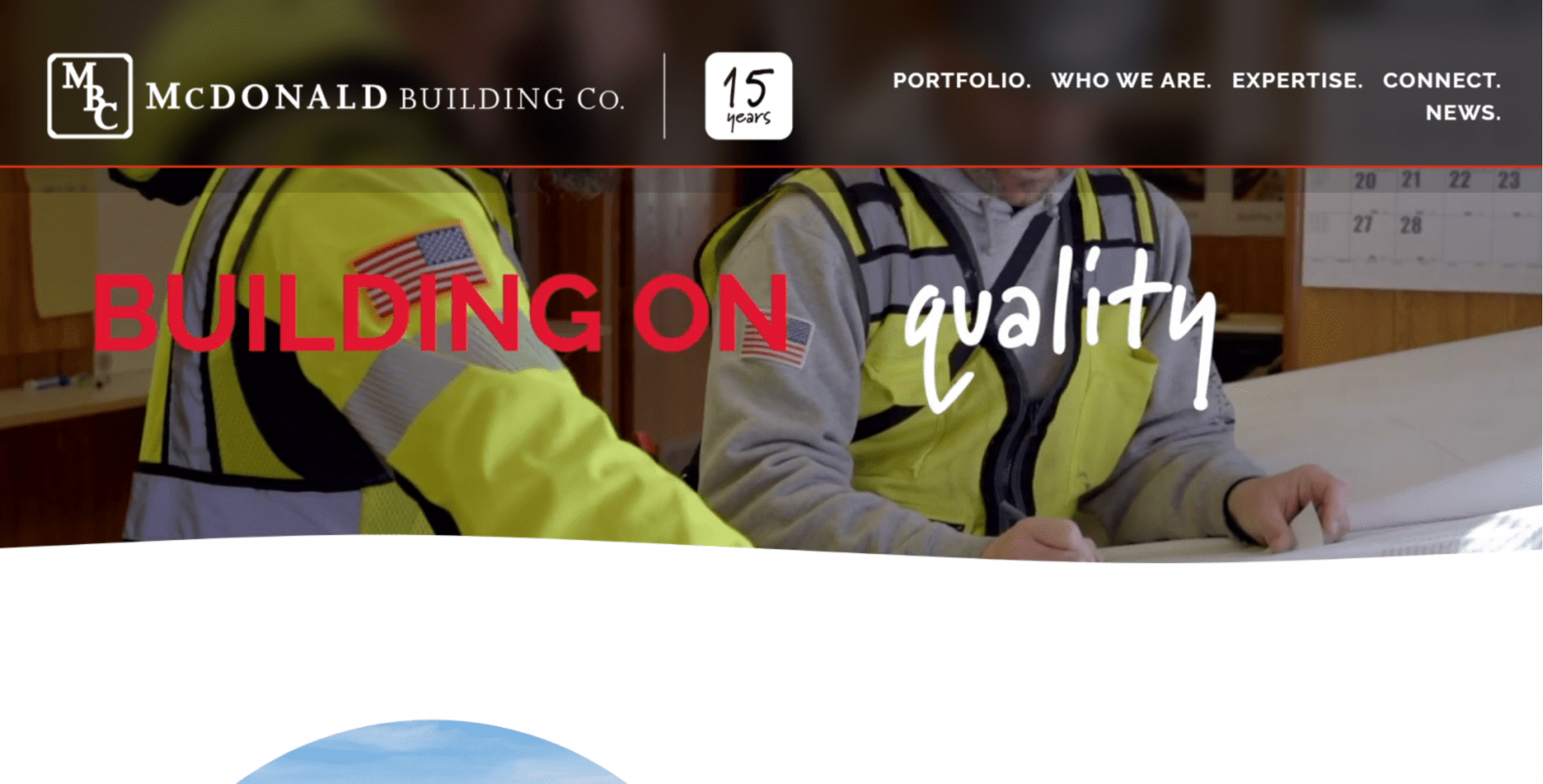
From the start, you’ll be able to read about the company and its purpose. They highlight their “Our relationships are founded on trust” section, which highlights their reliability. The “Come Build With Us” section also welcomes visitors, which sets a collaborative tone.
Then, the website strategically places a quote from a client praising their flexibility and expertise.
Here’s a unique feature: The site introduces “Batman, our beloved Drone,” which they use weekly to track progress and improve transparency. While this already passes as a portfolio for their ongoing projects, the site also offers a separate portfolio page for their past projects.
Lastly, clear CTAs appear under key sections, along with a signup form at the very bottom of the page.
4. Weitz
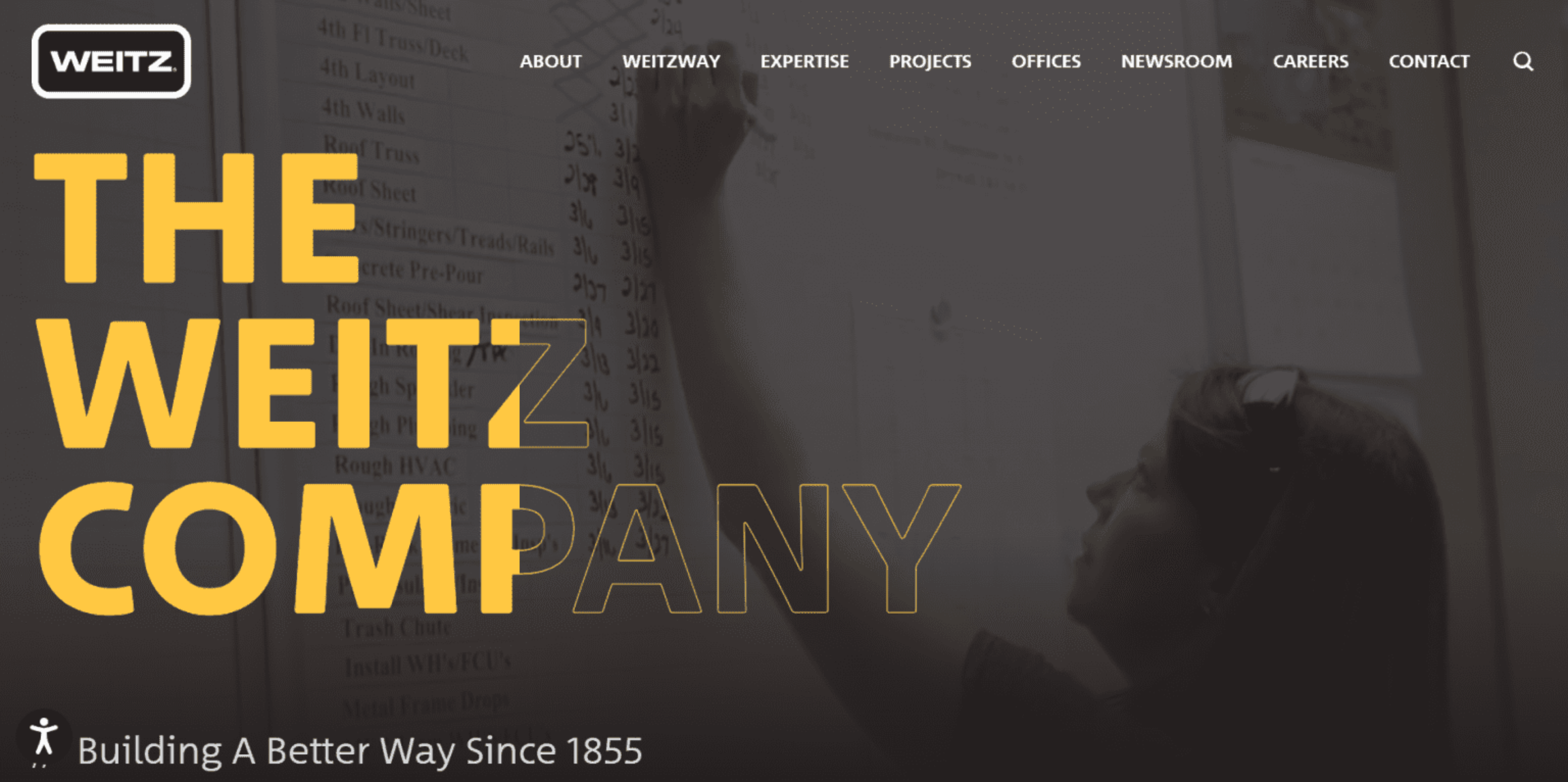
Since 1855, Weitz has been a full-service construction firm offering contracting, designing, and construction management services. Their website captures this information clearly, with sections that highlight their experiences.
The site’s homepage and top navigation buttons guide visitors to their service offerings, portfolio, and contact details.
Their Product Line section showcases their completed infrastructure projects. Using high-quality pictures, the website demonstrates the company’s commitment to quality craftsmanship.
They also build trust through featured client testimonials, which showcase Weitz’s professionalism and collaboration. Weitz backs this up with rankings, safety stats, and decades of experience.
Weitz provides an easy-to-scroll website with strong messaging that reflects their commitment to delivering quality results.
5. Skanska
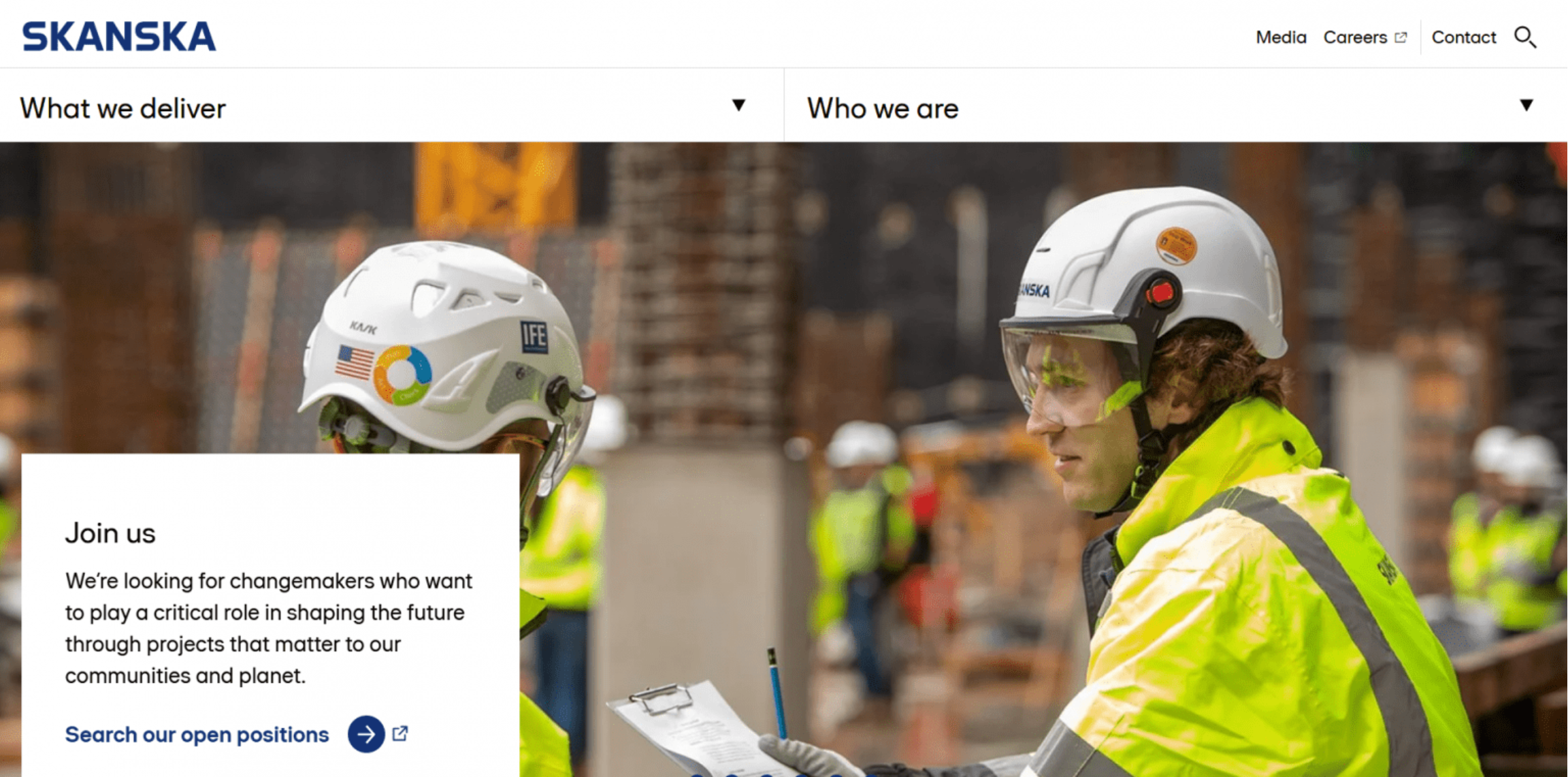
Skanska effectively communicates its passion for sustainable construction through its website. While many websites lead with project portfolios, they use a straightforward layout that highlights news about the company, sustainability efforts, and global projects.
At the top of the homepage, you’ll find links to Skanska’s past projects, values, and capabilities.
Further down, the site includes a clear list of contact information. This makes it easy for clients, partners, or job seekers to reach out.
How to make a construction website
To create a construction website, follow these steps:
- Secure a domain name, web hosting service, and a website builder from a reliable provider.
- Design and customize your website.
- Create a sitemap.
- Craft high-quality and useful content.
- Do a dry run, then publish your website.
When you align your website’s purpose with your audience’s needs, you ensure that you provide relevant and valuable content. This enhances the user experience and increases the likelihood of achieving your online goals.
Let’s break these steps down.
Step 1: Secure a domain name, web hosting service, and a website builder from a reliable provider
For your domain name, choose one that reflects your brand and is easy to remember. A memorable domain name can significantly impact your website’s success. Use our AI Domain Name Generator to help you generate a unique domain name based on your prompts.
Aside from a domain name, you also need web hosting. Web hosting provides you with the server infrastructure and resources necessary for your site to be accessible to everyone online.
That’s why it’s important to choose a reliable web hosting provider to keep your site accessible at all times and avoid lost sales. Selecting one that includes a built-in website builder makes managing your website easier from the start.
We have scalable and affordable web hosting plans to accommodate your growing website.
You can also avail of our AI-powered website builder that includes a domain and hosting, unmetered bandwidth, and an SSL certificate.
Step 2: Design and customize your website
After you’ve chosen a user-friendly website builder, you can start shaping your website. It’s also important to ensure that it’s mobile-responsive since mobile devices account for around 65.49% of website traffic globally. You don’t want to miss out on potential traffic and conversions if your site is not optimized for mobile devices.
See how to get started with the Network Solutions AI Website Builder through this brief walkthrough.
When it comes to creating your website, select a website design that matches your niche.
Here are some tips to help you choose a theme that aligns with your construction business:
- Choose industry-specific themes: Construction themes often have built-in features and layouts tailored to showcase construction projects and services.
- Optimize for lead generation: Your theme should be easy to navigate whenever users want to lodge inquiries or fill out forms.
- Prioritize responsive design: Possible clients browse websites on smartphones and tablets, so your site must look and function well on all screen sizes. Most website templates nowadays are mobile-friendly already, so be sure to choose one that adapts seamlessly to different devices.
- Choose a lightweight theme: A theme that’s “too heavy” means it has a lot of unnecessary features, large images, or complex code that can slow down your website. Choose a lightweight theme that loads quickly to improve user experience and reduce bounce rates. A faster site also benefits your search engine rankings, as search engines prefer sites that load efficiently.
- Match it with your brand: Adjust the colors, themes, and fonts to align with your branding. Include your brand’s logo as well, for a consistent and professional appearance.
- Ensure user-friendly navigation: Prioritize seamless navigation with an intuitive menu structure to help visitors find the information they need.
- See reviews and ratings for that theme: Read reviews and ratings from other users who have used the theme to get valuable insights on its performance and ease of use.
Focus also on the elements that shape how visitors experience your website. Construction clients often make decisions based on what they can see, so a strong visual presentation is essential. Use clear, high-resolution photos to highlight workmanship, show before-and-after progress, or document completed builds.
Pay attention to user experience as well. A clean layout, readable text, and consistent spacing help people browse comfortably. Make sure important actions (e.g., viewing your portfolio or requesting a quote) are always easy to find on both mobile and desktop.
For your website-building, explore our Website Builder with customizable, industry-appropriate website templates.
Don’t have the time to design it yourself? You can work with our professional website design services, and we’ll get it done for you.
Step 3: Create a sitemap
A sitemap is the backbone of your website’s organization. It highlights your website’s structure and how pages connect. It’s a key component for both effective SEO and a positive user experience. To learn more about sitemaps, explore a separate article on A Beginner’s Guide To Navigating XML and HTML Sitemaps.
When structuring your website’s navigation, consider these key sections that align with a good construction website:
- Home: The welcoming point that offers an overview of your services and expertise
- About us: Introduces your company’s history, mission, and the team behind your projects
- Services: Detail the range of construction services you provide, such as residential, commercial, and any other specialties
- Portfolio: Showcases your completed projects with high-quality images and descriptions
- Testimonials: Feature satisfied clients’ feedback and reviews to establish your credibility
- Contact: Provide essential contact information, including a contact form, phone number, and location
When visitors effortlessly find what they need, chances are they’ll stay and explore your services and contact you.
With a clear sitemap, you can deliver a great user experience and improve your search engine rankings.
Step 4: Craft high-quality and useful content
Informative and engaging content draws in clients and showcases your expertise. When visitors find valuable information, they’re more likely to stay on your site and eventually get in touch.
Here are the various types of content that you may consider for your construction website:
- Project descriptions: Detail your past and current projects, highlighting your skills, quality, and project outcomes.
- Blog posts: Share construction tips, industry insights, and news. These establish your authority and provide fresh content that search engines love.
- Case studies: Showcase your success stories. Describe the challenges your clients faced and how your brand or offerings solved them. Explain the steps you took and the results achieved. Prospective clients may have similar issues and relate to these stories; they will then see you as the solution to their own challenges.
- Frequently asked questions (FAQs): Address common queries prospective clients might have. This demonstrates your transparency and willingness to assist.
Additionally, images and videos are valuable assets for a construction website. When uploading photos, use high-resolution images to showcase completed projects or before-and-after photos. Ensure they capture the details and quality of your work.
Use videos to create walkthroughs of your projects, interviews with team members, or time-lapse videos of construction processes.
User-generated content (UGC) is another content type that adds authenticity to your website. About 31% of consumers say advertisements featuring UGC are more memorable than traditional ads without. So, humanize your business and add a personal touch to your projects.
Step 5: Do a dry run, then publish your website
Before going live, run a final website test. Check for any broken links, ensure mobile-friendliness, and verify cross-browser compatibility. This step ensures your website functions seamlessly.
Finally, publish your website and promote it through your social media accounts and email newsletters.
For more details, check out our simplified guide on how to build a website (guide, FAQs, tips etc).
Why your construction company needs a website
A well-crafted website can take your construction company to new heights. These are top five game-changing motivators for building your company’s website:
- Online visibility: Your website acts as your virtual storefront, allowing potential customers to find you anywhere in the world with just a few clicks. Without a website, it will be difficult for people to reach you and find more information about you.
- Credibility: A professionally designed website adds a layer of credibility to your construction business. When clients and partners visit your website, they see a company that’s invested in its image and reputation. It’s a signal that you take your business seriously.
- 24/7 availability: Your website is always open for business, even when your physical office is closed. Potential clients can browse your services, view past projects, and request quotes anytime. This accessibility leads to more inquiries and deals outside regular working hours.
- Marketing and branding: A construction website is a powerful marketing tool to showcase your work, share client testimonials, and highlight your expertise to win clients.
- Competitive advantage: Many construction companies are already online, so if you aren’t, you miss out on a significant competitive advantage.
Start building your construction business website today
Construction company websites require a significant amount of planning and brainstorming. But it doesn’t have to be complex, just clear. Now that you know how to create one, it’ll be easy. Thanks to website builders, you don’t need coding experience to create your website.
Ready to bring your building construction business online? Build your website now.