


Key takeaways:
- A good business name starts with a clear process.
- The best names are clear, memorable, and easy to use across your brand.
- Before you decide, check availability, test your finalists, and secure your domain early.
Choosing a business name is one of the first big decisions you make when starting a new business. It affects how you register your business and how customers remember you. Especially once you start building your website, making marketing materials, and establishing your brand presence.
A strong business name can help your small business look more credible and easier to trust. But choosing too quickly without doing the right checks can create problems later, from brand confusion to domain issues that may force you to start over.
But this doesn’t have to be complicated. If you’re wondering how to come up with a business name, the process can be simple: define what your business stands for, brainstorm options, shortlist your best ideas, validate them, and then decide with confidence.
You don’t need the perfect idea right away. Just have a clear process for choosing a business name you can actually use and build on. Let’s use this guide to get you started.
Disclaimer: The sample business name ideas provided herein are generic in nature and only meant for inspiration. We cannot guarantee the uniqueness of each example, and any close similarity to actual businesses is purely coincidental.
Find the perfect domain
Ready to register a domain name? Check domain availability and get started with Network Solutions today.
Step 1: Define what your brand stands for before you name it
Before you brainstorm name ideas, get clear on what your brand stands for. This doesn’t need to be a big branding exercise, but a little clarity here helps you choose a name that fits your business idea, speaks to your target audience, and highlights what makes you unique.
Start with a few basics:
- Your mission
- Your brand values
- Your promise to customers
- Your tone or personality
- Your unique selling point
This gives you a stronger starting point for naming. A good-sounding business name won’t mean much if it doesn’t match the kind of experience you want people to expect from your brand.
You should also think about your target market in plain language. Who are your potential customers? What do they care about? What kind of name would feel clear, credible, or memorable to them? A name that makes sense to you but misses your target audience will be harder to build around.
Finally, check whether the name is future-proof. A name tied too closely to one service, one city, or one stage of your business can feel limiting later. If your business grows or changes, your name should still fit.
Getting clear on what your brand identity is makes the rest of the naming process faster and more focused.
Step 2: Brainstorm business name ideas using repeatable methods
Once you know what your brand stands for, it is time to brainstorm business name ideas. Start by building a simple word bank. Write down relevant keywords tied to your product, the benefit you offer, the feeling you want customers to associate with your brand, your customer type, and your location (if that matters).
This step is about generating volume quickly. Don’t wait for one perfect idea. Mix and match words, test different naming styles, and aim for at least 20 to 30 name ideas before you start narrowing anything down.
You can start with these kinds of name ideas:
- Descriptive names
- Benefit-based names
- Metaphor or evocative names
- Founder names or initials
- Made up words and blends
- Category plus modifier combinations
- Light pop culture inspiration
- Location-based names
Descriptive names
These tell people what the business does in a clear, direct way. They are often the easiest for new customers to understand right away. This style can work especially well for service-based businesses that want clarity over cleverness.
Examples:
- Bright Path Bookkeeping
- Coastal Home Cleaning
Benefit-based names
These focus on the result customers want, not just the service itself. They help frame your business around value, which can make the name feel more customer-focused. This approach works well when the outcome is a big part of what makes your offer appealing.
Examples:
- Steady Books
- Easy Nest Organizing
Metaphor or evocative names
These suggest a feeling, image, or mood instead of describing the business literally. They can feel more distinctive and brandable than straightforward names. This style works best when the connection still feels intentional and not too abstract.
Examples:
- Blue Lantern Studio
- North Bloom
Founder names or initials
Using your own name can work well for a service business, consulting brand, or creative practice. It can make the brand feel more personal and closely tied to your reputation. This option is especially useful if you are selling your expertise, style, or point of view.
Examples:
- Ramirez Design Co.
- J.T. Creative
Made-up words and blends
Made-up words can help your brand stand out, especially when they still sound natural and easy to remember. They give you more room to create something distinctive that does not feel too tied to one category. Just make sure the name is still easy to pronounce, spell, and trust.
Examples:
- Glowza
- Printora
Category plus modifier combinations
This is a simple formula that can lead to strong, clear, catchy names. It works by pairing an industry word with something more expressive, modern, or specific. That balance can make the name feel both understandable and more original.
- Kindred Tax
- Wild Mint Marketing
Light pop culture inspiration
Pop culture can spark ideas for tone, mood, or style, but use it carefully. A witty reference or pun can make a name more playful and memorable when it feels original enough to stand on its own. Avoid anything too close to existing characters, titles, franchises, or branded terms that could raise infringement issues.
Examples:
- The Codfather
- Game of Scones
Location-based names
If location is central to your identity, this can be a useful route. It can help your business feel rooted in a community or tell where you serve customers. Just make sure it will still fit if the business grows beyond one area.
Examples:
- Brooklyn Pet Club
- Desert Trail Fitness
To brainstorm business names faster, try combining two lists. Put descriptive words in one column and nouns, categories, or benefits in another, then test different combinations. That gives you more range and helps you generate business name ideas without overthinking every option.
Here are a few rules of thumb for a catchy business name:
- Keep it short
- Make it easy to say
- Make it easy to spell
- Avoid names that sound too generic
- Avoid names that are too close to competitors
At this stage, quantity matters. The more range you create, the easier it is to spot the catchy names that actually fit your brand.
Step 3: Use AI tools and generators for inspiration
AI tools can be useful when you want to generate more business name ideas quickly. They’re especially great if you already know your industry, target audience, brand vibe, and a few relevant keywords, but need help turning those into stronger name ideas.
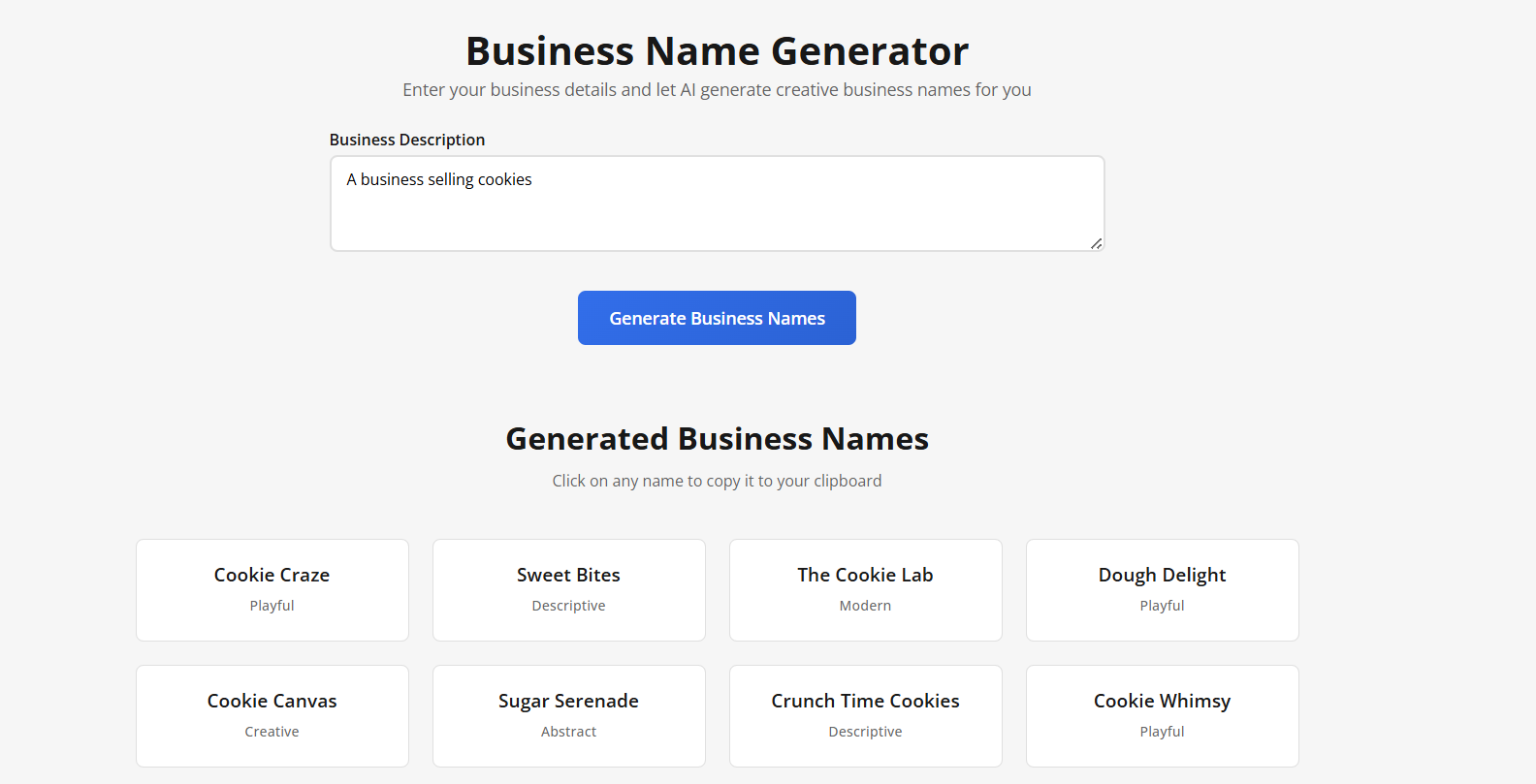
The key is to use them for inspiration, not decision-making. A business name generator or brand name generator can spark ideas, show patterns, and help you explore directions you may not have considered on your own. But the final choice still needs your judgment.
To get better results, be specific with your prompts. Include your industry, brand tone, keywords, audience, and simple constraints like word count or syllables.
Here are some sample prompts:
- Generate 20 business name ideas for a modern pet grooming brand. Use words related to trust, comfort, and care.
- Suggest short brand name ideas for a bookkeeping business aimed at freelancers. Keep them to two words max.
- Create business name ideas for a skincare brand that feel clean, natural, and premium, and avoid anything hard to pronounce.
If you want to spark ideas and explore web address options at the same time, our AI Domain Name Generator can be a useful tool. Just be sure to filter the results before adding anything to your shortlist. Remove names that are hard to say, too generic, or too close to competitors.
This keeps AI in the right role: helpful for momentum, but not responsible for the final call.
Step 4: Shortlist your best options with a simple scoring checklist
Once you have a longer list of business name ideas, the next step is to narrow it down. Start by picking 10 to 20 options that feel the most promising, then score them until you are left with 3 to 5 finalists.
A simple scoring checklist can make this part feel much less subjective. Instead of relying only on instinct, rate each name from 1 to 5 based on the qualities that matter most. Take a look at this sample criteria:
Criteria | What to ask |
|---|---|
Easy to say and spell | Does it make sense when someone hears it once? |
Memorable | Does it leave a lasting impression? |
Fits your brand and voice | Does it sound aligned with the kind of brand you want to build? |
Growth-ready | Is it future-proof, or will it feel too narrow if the business expands? |
Visual potential | Could it work well in a logo, on packaging, or on a website? |
This gives you a more practical way to compare options. A compelling name can’t just sound good in the moment. It should support brand recognition, feel consistent with your identity, and still make sense as your business grows.
It also helps to watch for red flags while you score. Be careful with names that have confusing spellings, negative meanings, or a generic feel. If something sounds too similar to another brand or doesn’t feel like a good brand fit, it is probably not one of your strongest finalists.
Step 5: Check availability (domain, socials, and search results) before you commit
Once you have a few strong finalists, check availability before you get too attached. This step helps you avoid surprise conflicts, confusion, and rework later.
- Do a quick Google search: Search your business name exactly as written, then try a few close variations. Look for businesses already using it, especially in your industry or region. This helps you catch obvious conflicts early.
- Check domain availability: Look for a matching domain name using a domain name search tool, ideally a .com if it is available. If the exact match is taken, see whether a close variation still feels clean, clear, and easy to remember. The goal is to find a domain that still fits your business name without making it harder to type or trust.
- Review social handles: Check the main platforms you plan to use and see whether your name is available in a consistent format. You don’t need every handle on every platform, but the closer your social names are to your matching domain, the easier it is for people to find and recognize your brand.
- Double-check spelling and overlap: Make sure the exact wording is not already in use somewhere that could still cause confusion. Even if a name looks available at first glance, similar names can create problems later if they are too close in spelling, sound, or industry.
If the perfect domain isn’t available, focus on what is usable. A good option still matches your brand closely, feels professional, and doesn’t create extra friction for customers trying to find you online.
Step 6: Understand the legal side
Before you commit to a business name, it helps to understand the legal side. This is where many people get confused, because one name can show up in a few different ways depending on how you register your business and how you use it publicly.
No need to get deep into legal theory, just know enough to spot potential conflicts early and understand what each type of name actually does:
- Entity name
- Trademark
- DBA
- Domain name
Entity name
Your entity name is the official name you register with the state when you form your business. This is the legal name tied to your LLC, corporation, or other business structure. It handles your formal registration, but it is not always the same name your customers will see in your branding.
Trademark
A trademark helps protect the brand name you use in the market. If a name is trademarked, that can provide legal protection and stronger exclusive rights, especially if it is registered at the federal level through the United States Patent and Trademark Office (USPTO). A domain or state registration alone does not give you the same level of protection.
If you want more info, you can read further on how to trademark a business name in 2026 (costs, steps, and timeline).
DBA
A DBA, or “doing business as,” is the name you use publicly if it is different from your legal entity name. For example, your company might be registered under one name, but your storefront or website could use a simpler brand name. Not every business needs a DBA, but it is useful when your public-facing name and legal name are not the same.
Domain name
Your domain name is your web address. It matters for how people find you online and how consistent your brand feels, but it does not automatically give you ownership of the name in a legal sense. That is why it is smart to search early and compare your domain choice with existing brands, entity names, and trademarks.
Term | What it means | Who it’s for | What it does not do |
|---|---|---|---|
Entity name | The official name you register with the state when you form your business. | State registration and legal formation | It’s not automatically your brand name or trademark. |
Trademark | A name, word, or phrase that helps protect your brand in the market. | Brand protection and legal rights | It doesn’t replace business registration or domain registration. |
DBA | A “doing business as” name used publicly if it differs from your legal entity name. | Customers and public-facing branding | It doesn’t create a separate business entity by itself. |
Domain name | Your web address online. | Website visitors and online brand consistency | It doesn’t automatically give you legal ownership or trademark rights. |
For example, you might register Sunrise Wellness LLC as your entity name with the state, but use Sunrise Skin Studio as your public-facing brand through a DBA.
If that brand becomes central to your business, you might apply for a trademark to help protect the name and strengthen your rights to use it in the market. Then, to make the brand easy to find online, you could register sunriseskinstudio.com as your domain name. These all relate to the same business, but each one serves a different purpose.
To reduce potential conflicts, do a few checks before you move forward. Search your state business records, look through the trademark office database, and compare what is already in use in your category. That early review can save you from avoidable problems later.
Disclaimer: This is meant to help you understand the basics, not provide legal advice. If you’re unsure whether a name could create conflicts or whether you need broader legal protection, it’s worth speaking with a qualified professional before you register your business.
Step 7: Test your finalists with real people
Even after you narrow your list, it is normal to still feel unsure. Testing helps you get outside your own head and see how your business name lands with real people before you commit.
- Ask 5 to 10 people in your target audience: Show them your finalists and ask what they think each name means or what kind of business they expect it to be. Their answers can quickly show whether a name feels clear, relevant, or misleading.
- Run a quick poll: Ask friends, peers, or people in relevant communities to vote on your shortlist. It’s not full market research, but it can still help you spot which names feel stronger, more memorable, or easier to trust.
- Try the phone test: Say the name out loud once and ask someone to repeat it or spell it back later. If they struggle to remember it, say it, or write it correctly, that’s useful feedback.
If you have the budget, focus groups and more formal market research can give you deeper insight. But for most small businesses, a few quick checks like these are enough to reduce second-guessing and help you choose with more confidence.
Step 8: Lock it in and launch consistently everywhere
Once you choose a name, the next step is to use it consistently. A good business name only starts building recognition when people see the same version across your website, social profiles, and marketing materials.
Start by securing the domain you plan to use and claiming the social handles that matter most to your business. Then make sure your business name appears the same way everywhere customers will find you. Even small differences can make your brand feel less clear or harder to remember.
This is also a good time to start aligning your logo design and visual identity with the name you chose. You can use our free logo maker when you register your domain name with us for a seamless process.
When your name, visuals, and messaging all point in the same direction, your brand feels more polished, more consistent, and easier to trust.
Frequently asked questions
Start with emotion — your name should make people feel something. Combine creative techniques like word association, metaphors, or rhymes, then enhance your process with AI brainstorming or a business name generator.
Avoid names that are misleading, too similar to competitors, or include restricted words (like “Government” or “Bank”). Check your state’s business registry for prohibited terms.
It’s optional. Some businesses include “LLC” for transparency, but others leave it off to keep branding clean. From a legal standpoint, it’s not required for logos or marketing. Legally, your entity name must include the designation; your DBA doesn’t have to.
Yes, ideally! Matching names strengthens brand consistency and makes it easier for customers to find you online. Always test domain availability during the naming stage
Yes, if they operate in different states or industries — but it’s risky. Trademark registration grants exclusive national rights. Always check business name availability and trademark status.
-Search domain availability
-Check USPTO trademarks
-Look up state business databases
-Verify social media handles for consistency
Create a name you can build on
A good business name comes from a clear process. Define your brand, brainstorm widely, narrow your list, run the right checks, and choose the name that fits best.
Every household name started somewhere. Yours can be a good example of how the right name supports brand recognition and helps you break through over time.
As you move from ideas to launch, it helps to have tools that support the process. Our domain registrations include marketing apps and free tools such as a business name generator and slogan generator, which can help you refine your brand.
Since domain names are only available until someone else registers them, securing the right one early can save you from having to adjust later. No need to build your website right away. Launch a coming soon page first using our marketing app and give customers something to look forward to.
Find the perfect domain
Ready to register a domain name? Check domain availability and get started with Network Solutions today.