



Key takeaways:
- New TLDs typically move through sunrise, landrush, and general availability (GA), with each phase opening registration to different groups.
- Launch phases help protect trademark rights, manage demand, and create a more structured path for businesses, domain investors, and resellers to register domains.
- Registration rules, pricing, competition, and eligibility requirements can vary by launch phase and TLD, so reviewing the launch schedule early can help you plan when to register.
When a new top-level domain (TLD) launches, it doesn’t become available to everyone at once. Instead, new gTLDs typically move through a series of launch phases that determine who can register a domain and when.
Understanding these phases can help website owners, domain investors, and resellers prepare for upcoming releases and know when they may be eligible to register a domain. If you need a broader overview first, see our guide to new TLDs in the market.
In this guide, we’ll explain why new TLDs launch in phases and break down the three primary stages: sunrise, landrush, and general availability (GA). You’ll also learn how the Internet Corporation for Assigned Names and Numbers (ICANN) requirements and trademark protection mechanisms influence the registration process, and what to expect at each stage.
Find the perfect domain
Ready to register a domain name? Check domain availability and get started with Network Solutions today.
Why new TLDs launch in phases
New TLDs launch in phases to control how domain names enter the market and give different groups a fair opportunity to register them. For businesses, these phases can affect when they can secure a brand-related domain, how much they may need to pay, and how much competition they may face.
The phased approach mainly helps:
- Protect brands: Allows eligible trademark holders to apply for matching domains before wider registration begins. This adds a layer of trademark protection and can reduce the risk of cybersquatting or brand misuse. Businesses can also strengthen their wider strategy by following brand name protection best practices.
- Manage high demand: Helps registries handle strong interest in popular domain names without opening registration to everyone at the same time.
- Support different pricing structures: Allows registries to apply different pricing structures during launch stages, particularly when demand is high or access is limited.
- Give others a fair chance: Opens registration to broader groups once priority registration periods have ended.
For businesses, domain investors, and resellers, understanding these phases can make it easier to plan registration timing and anticipate potential competition and costs.
Turn your idea into the perfect domain
ell us about your business or idea, and our AI Domain Name Generator will suggest names you can register today.

What are the TLD launch phases?
New TLDs generally move through three main launch phases: sunrise, landrush, and general availability. Each phase determines who can register domains, what requirements apply, and how much competition to expect. Understanding the differences helps trademark holders, businesses, domain investors, and resellers choose the right time to act.
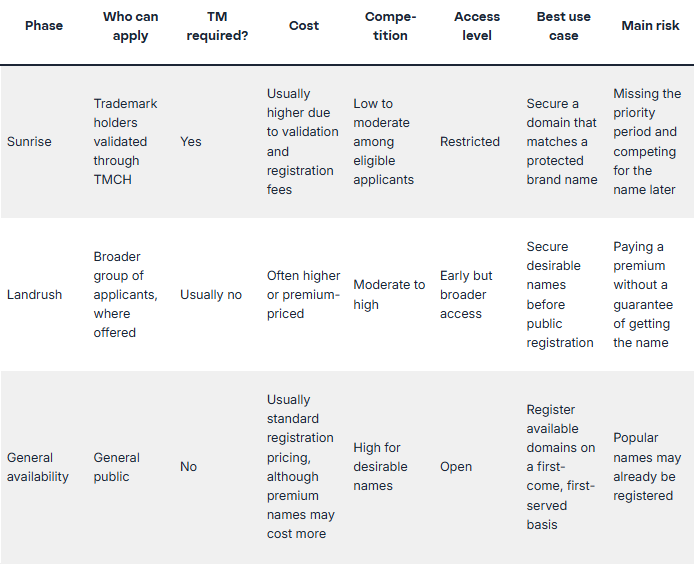
ICANN requires new gTLD registries to provide a sunrise period for eligible trademark holders, while landrush or similar early-access periods are optional and vary by registry. GA then opens registration more broadly to the public, typically on a first-come, first-served basis.
Sunrise
The sunrise period is the mandatory first phase of new gTLD launches. It is an eligibility process designed to give qualified trademark holders an early opportunity to register domain names that match their validated trademarks before broader registration begins. To participate, trademark rights generally need to be validated through the Trademark Clearinghouse (TMCH). A separate sunrise fee applies in addition to any applicable registration costs.
Registries can run one of two sunrise types:
- Start-date sunrise: Allows eligible domains to be allocated during the sunrise period, typically on a first-come, first-served basis. This sunrise type must remain open for at least 30 calendar days, and registries must provide at least 30 days’ advance notice before it begins.
- End-date sunrise: Accepts eligible applications throughout the period but does not allocate names until the period closes. This sunrise type must run for at least 60 calendar days and cannot use a first-come, first-served allocation method.
The distinction becomes important when more than one eligible trademark holder applies for the same name. After the launch process moves into GA, trademark protection continues through the separate Trademark Claims period, which generally runs for at least the first 90 days of general availability.
Landrush
Landrush is an optional phase that some registries use between sunrise and GA. Unlike sunrise, it is not limited to trademark holders. Instead, landrush periods open registration to a broader group of applicants seeking access to desirable domain names before they become available during GA.
Access during this phase usually comes at elevated prices. Registries may charge premium registration fees because demand is often concentrated around short, memorable, or commercially valuable names. This makes landrush particularly relevant to domain investors, businesses pursuing a specific name, and buyers willing to pay more for earlier access.
Allocation methods vary by registry. Some names may be allocated on a first-come, first-served basis, while others may be awarded through auctions or other allocation methods when multiple applicants request the same domain. Because landrush is an optional phase, not every new TLD launch includes one.
Landrush can provide earlier access to a preferred domain, but that opportunity may come with higher costs and no guarantee that the name will be secured.
General availability
General availability (GA) is the stage when a new TLD becomes open to the general public. Once GA opens, most applicants can register available domain names on a first-come, first-served basis.
At this point, many of the restrictions used during earlier launch phases are removed. But some niche or restricted TLDs may still require applicants to meet specific eligibility rules, such as belonging to a certain industry, location, or community. These requirements depend on the registry operating the extension.
The GA phase is also supported by the Trademark Claims service. For at least the first 90 days, applicants who try to register a domain that matches a trademark recorded in the TMCH receive a notice informing them of the existing trademark rights. If they continue with the registration, the trademark holder is notified.
For businesses, domain investors, and resellers, the GA phase typically offers the broadest access and the most straightforward registration process. The trade-off is higher competition, especially for short, memorable, or commercially valuable names.
Frequently asked questions
Check official registry announcements and ICANN’s TLD startup information, which provides information about Sunrise and Trademark Claims periods for new gTLD launches. You can also check our domain search and registration resources for available and upcoming domain extensions.
New gTLDs are generally required to offer a sunrise period before broader registration begins. This gives eligible trademark holders an opportunity to register matching domains early. Launch rules can differ for certain TLDs, so check the requirements for the extension you want.
The next stage depends on the registry. Some TLDs move into an optional Landrush phase or another limited registration period, while others proceed toward GA. Once GA opens, registration typically opens to the wider public.
Sunrise is designed for eligible trademark holders and requires applicable trademark verification. Landrush, when offered, opens early registration to a broader group and generally does not require a trademark. Landrush domains may also carry premium fees or use special allocation methods.
It depends on the phase and the registry’s rules. A registry may use an auction, another contention process, or first-come, first-served registration to determine who receives the domain. The allocation method should be checked before applying.
Generally, yes. GA opens registration to the public, usually on a first-come, first-served basis. But some restricted or niche TLDs may continue to require applicants to meet specific eligibility criteria.
Yes, when we support registration for that TLD and you meet the applicable sunrise requirements. Eligibility typically requires validated trademark rights and any other requirements established by the registry.
Yes. We support eligible trademark holders during the sunrise application process. Depending on the launch requirements, you may need to provide trademark-related information. Registrars may also require information from the TMCH, such as a Signed Mark Data (SMD) file.
No. A pre-registration request with us does not guarantee that a registry will approve or award a domain name. If multiple eligible applicants request the same name, the registry’s allocation rules will determine the outcome.
Choosing the right time to register a new TLD
New TLD launches move through phases for a reason. Each stage affects who can register, how much competition there is, and what requirements may apply.
Before you register, check the launch schedule, confirm any eligibility requirements, review pricing, and decide which phase best supports your goals. Trademark holders should prepare their TMCH information early, while businesses, domain investors, and resellers should monitor GA dates closely for high-demand names.
When you’re ready to secure a domain, explore our domain name registration options to search available extensions and find one that fits your brand, business, or next project. Whether you’re launching a new website, protecting a brand, or investing in premium domain opportunities, registering at the right stage can help improve your chances of securing the name you want.
Need help finding ideas? Try our AI Domain Name Generator to explore naming options and discover domain extensions that fit your brand.