

Key takeaways:
- A DBA lets your business operate under a public-facing name that’s different from its legal name without forming a new entity.
- Registering a DBA is usually inexpensive and straightforward, but rules, fees, and renewal requirements vary by state.
- Checking domain availability early and matching it to your DBA makes it easier to build a credible online presence.
A DBA name, short for ‘Doing Business As,’ is the name your business uses publicly when it operates under a name different from its legal one. It allows you to present a brand-facing identity without forming a new legal entity. Regardless of the type of business, many sole proprietors, partnerships, and limited liability companies (LLCs) rely on DBAs when they don’t want to operate publicly under a personal name or want to expand through a new brand.
Your DBA also plays an important role in the success of your online business. When it matches your domain name and professional email, your brand becomes more recognizable and appears more established and trustworthy, both online and offline.
In this article, we’ll help you understand what a DBA name is, how to register one, and how it benefits your online business.
What is a DBA name?
DBA stands for Doing Business As, the name your business uses publicly that differs from its official legal name. You can think of it as a business alias or an “also known as” name that customers engage with.
Using a DBA gives your business flexibility in how it presents itself. It allows you to operate under a name that’s easier to market, more descriptive, or better aligned with a specific product or audience. This is especially useful for businesses that want to run multiple brands under one legal entity.
For example, if your business is legally registered as Smith Digital Solutions LLC, you might use Smith Web Studio as your DBA on your storefront, website, and marketing materials. A DBA allows you to present a customer-friendly name while keeping your legal structure unchanged.
A well-known real-world example is Alphabet Inc., which operates many well-known brands under different names. While Alphabet is the legal parent company, consumers interact with brands like Google and YouTube, not the corporate name behind them.
DBA vs LLC vs domain name: What you need to know
You’ll often come across a DBA, an LLC, and a domain name when setting up a business. While they are closely connected, each one applies to a different part of how your business is set up. An LLC defines your formal business structure, a DBA is the name your business uses publicly, and a domain name is the web address customers use to find your business online.
The table below highlights the key differences between a DBA, an LLC, and a domain name to give you a clear picture of how each one works.
DBA vs LLC vs domain name comparison
DBA | LLC | Domain name | |
|---|---|---|---|
Purpose | To use a public-facing business name without forming a new legal entity | To create legal separation between personal and business assets | To give your business a recognizable online address |
Cost | Typically low, often between $10 and $100, depending on the state | Higher upfront costs and ongoing fees, which vary by state | Annual registration fee, usually renewed yearly |
Legal implications | Does not create its own legal entity or provide liability protection | Creates a legal entity with liability protection | No legal protection for the business name by itself |
Why your DBA and domain name should match
Your DBA is the name customers recognize, and your domain name is how they find you online. When these two match, your brand is consistent across online platforms, making it easier for customers to find you in search results. Once they know your name, they will no longer have trouble finding your store online.
Conversely, a mismatch between your DBA and domain can confuse customers and weaken your online presence, even if your business is legally set up correctly.
Use the flowchart below to identify whether you need to form an LLC, file a DBA, and secure a domain name for your business.
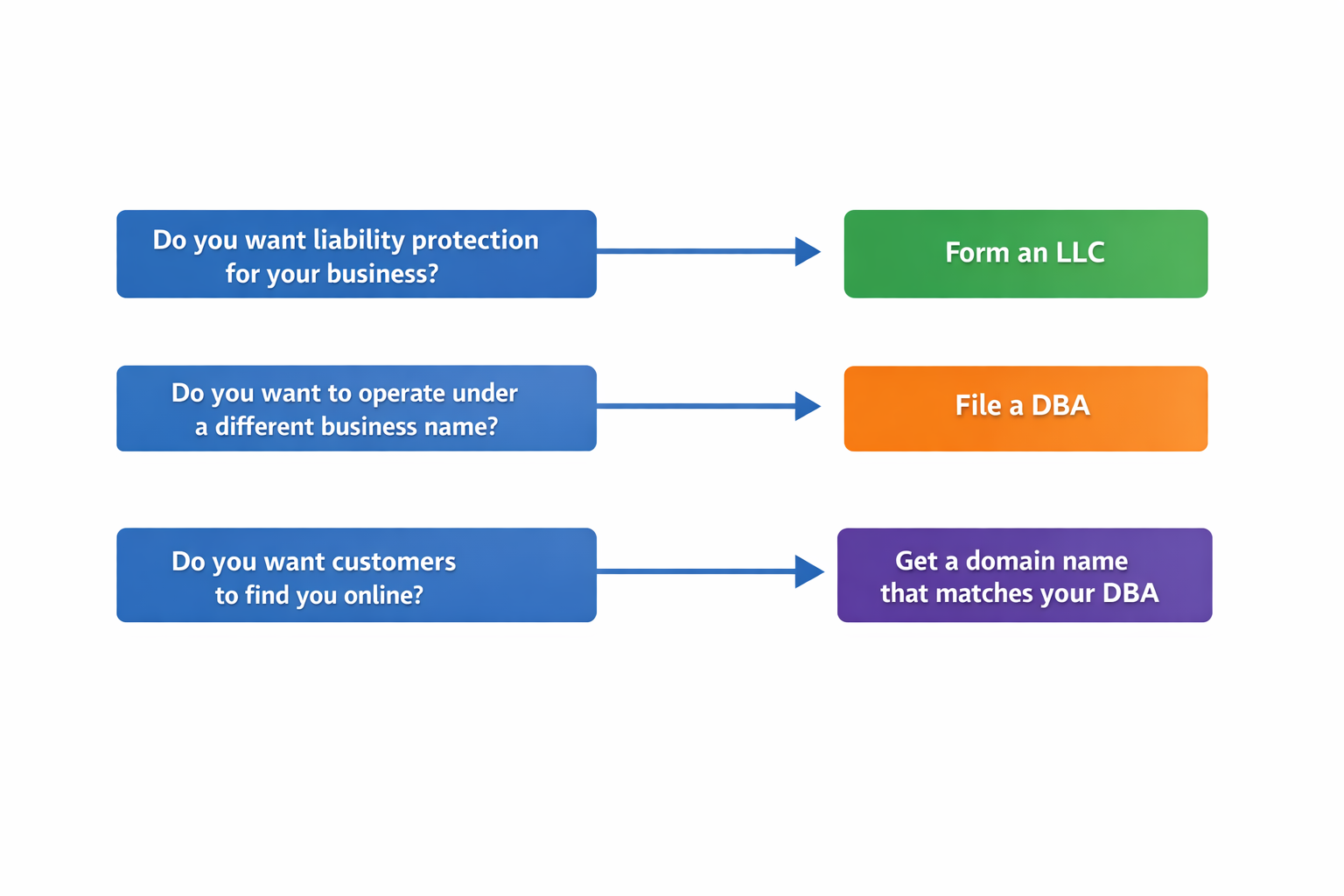
You can file a DBA whether you’re a sole proprietor, part of a partnership, or operating under an LLC, if you want to conduct business under a name different from your legal business name.
Forming an LLC, on the other hand, is about how you want to legally structure your business and helps protect your personal assets from business debts or liabilities.
A domain name is separate from both. It doesn’t affect your legal setup, but it determines how customers find you online. Matching your domain to your DBA creates a clear and consistent business presence.
How to register a DBA name
Registering a DBA is straightforward, but the exact steps and requirements can vary by state or county. In general, the process follows the same core sequence, regardless of where your business is located.
- Choose your DBA name
- Check state requirements
- Submit your DBA application
- Pay the filing fee
Step 1: Choose your DBA name
Start by deciding on the name you want to use publicly for your business. This name should be clear, easy to remember, and aligned with how you plan to market your business. Most states require that your DBA name be distinguishable from other registered business names, so it’s important to avoid names that are already in use.
At this stage, it’s also smart to think ahead about your online presence. Choosing a DBA name that matches an available domain name makes it easier to create a consistent brand once you launch your business online.
Step 2: Check state requirements
DBA rules are set at the state level, so requirements can vary depending on where your business operates. Some states handle DBA filings through the Secretary of State, while others require filing them at the county level.
Before submitting anything, check:
- Where DBAs are filed in your state
- Whether name availability searches are required
- If publication or renewal rules apply
Knowing these requirements ahead of time helps you avoid delays or rejected applications.
Step 3: Submit your DBA application
Submit your DBA application once you’ve confirmed the requirements. This usually involves providing basic information about your business, including your legal name, business address, and the DBA name you’re registering.
Many states allow business owners to file online, while others may require mail or in-person submissions. After filing, you’ll typically receive confirmation once your DBA has been approved. The approval can take from a few days to four weeks, depending on your state’s filing process and workload.
Step 4: Pay the filing fee
The final step is paying the required filing fee. DBA fees are generally lower than those for other business filings and typically range from $10 to $100, depending on the state or county.
After payment is processed and your DBA is approved, you’re officially allowed to operate under that name. From there, you can use your DBA on your website, business email, marketing materials, and other business platforms.
State-specific rules
DBA filing rules aren’t the same across the United States. While the general process is similar, each state sets its own requirements for where and how a DBA must be registered.
In some cases, filings are handled at the state level, while others require DBA registration at the county level. This is why it’s important to check the exact rules that apply to your business’s location before submitting your application.
Common differences between states include:
- Whether DBAs are filed with the Secretary of State or a county clerk
- If name availability checks are required before filing
- Whether the publication of the DBA in a local newspaper is mandatory
- How often must DBAs be renewed
Because these rules can change and vary widely, relying on official state resources is the safest way to ensure compliance. Below is a high-level overview of how DBA filing requirements can differ by state. You can find the DBA forms linked to each state.
State | Where to file | Typical filing fee | Renewal required | Notes |
|---|---|---|---|---|
County clerk | Varies by county | Yes | Publication in a local newspaper is required | |
County clerk | Varies by county | Yes | Filing location depends on where the business operates | |
County clerk | Varies by county | Yes | Publication requirement applies in most counties | |
State (Department of State) | Yes | Yes | Filing handled at the state level | |
County clerk | Varies by county | Yes | Name availability rules apply | |
State | Yes | No | DBA is referred to in this state as a “fictitious name” |
Cost breakdown
In most states, the initial DBA filing fee typically falls between $10 and $100, depending on whether you file at the state or at your local government office. However, that filing fee is often just one part of the total cost.
Some states or counties charge a name search fee, usually ranging from $5 to $40, to confirm that your DBA name isn’t already in use. Others include this step as part of the filing process at no additional cost.
You may also need to renew your DBA periodically. Renewal fees are generally similar to the original filing fee and often fall between $10 and $50, depending on how often the state requires renewal, which can range from once every one to five years.
Certain states also require you to publish your DBA in a local newspaper. Publication costs vary widely based on location and publication length, but they typically range from $40 to $200. This requirement is common in states like California and New York and can significantly increase the total costs.
Beyond these filing-related expenses, many businesses also set a budget for domain registration, professional email, and website setup to use their DBA online. While these aren’t required for a DBA application, they are often essential for building a professional business presence.
DBA vs trademark: What’s the difference?
A DBA is a trade name used for business purposes, but a trademark protects your brand name and logo from being used by others. In simple terms, a DBA lets you operate under a specific name, while a trademark gives you legal rights to stop others from using a similar name or brand in your market.
Because they serve different legal functions, registering a DBA by itself does not provide trademark protection. Even if you legally file a DBA, another business may still be able to use a similar name unless that name is protected by a trademark.
DBA vs trademark comparison
The table below highlights the key legal differences between a DBA and a trademark.
DBA | Trademark | |
|---|---|---|
Legal protection | Does not provide exclusive rights to the name | Provides legal protection against unauthorized use of your brand name or logo |
Registration process | Filed with a state or county clerk’s office, depending on location | Registered at the federal or state level, often through the USPTO |
Cost | Generally low, often between $10 and $100 | Higher upfront costs typically range from a few hundred dollars to several thousand dollars |
Scope | Limited to business operations within a specific location | Can offer broader protection across states or nationwide |
Benefits of a DBA name for your business
A DBA, when used thoughtfully, can enhance your business’s online visibility, your customers’ perception of your brand, and the effectiveness of your marketing efforts.
Below are the key ways a DBA can support your business as it grows:
- Boosts SEO and organic traffic: A clear, keyword-aligned DBA can improve how your business appears in search results.
- Builds trust and credibility: A consistent business name across your website, email, and listings makes your brand look more legitimate.
- Generates qualified leads: A DBA that clearly reflects what you offer helps attract customers who are already looking for your services.
- Supports long-term ROI: Using a DBA allows you to grow or pivot without constantly restructuring your business.
- Strengthens customer loyalty: A recognizable business name makes it easier for customers to remember and return to your brand.
- Enhances other marketing channels: A DBA creates consistency across email, social media, ads, and offline marketing.
Boosts SEO and organic traffic
A DBA can be optimized to reflect what your business actually offers, helping both search engines and potential customers better understand your services. When your DBA aligns with your domain name and website content, it sends stronger relevance signals and makes your business easier to discover online.
For instance, a company legally registered as Greenfield Holdings LLC will be far more visible in local search results when operating under a DBA like Greenfield Lawn Care, which directly reflects the service customers are searching for.
Builds trust and credibility
Consistency plays an important role in how trustworthy your business appears. When your DBA is used across your platforms and media, it creates a polished, reliable impression.
Customers are more likely to take a business seriously when they see emails coming from an address tied to a real business name rather than a personal inbox, especially during early interactions.
Continuing from the example above, an email from [email protected] feels far more credible than one from [email protected].
Generates qualified leads
A clear and descriptive DBA helps attract customers who already understand what you offer. When your business name reflects your service or specialization, it filters out unqualified inquiries and attracts leads more likely to convert.
A name like Northside Accounting Services, for example, immediately signals both expertise and focus, making it easier to attract the right audience.
Supports long-term ROI
Using a DBA gives your business room to grow without constant restructuring. You can launch new services, test new markets, or introduce product lines under different DBAs while keeping the same legal entity. This flexibility allows businesses to expand strategically without going through the trouble of forming a new company.
Strengthens customer loyalty
Customers develop brand recognition through repeated exposure. When your DBA is ubiquitous across your website, invoices, emails, and marketing materials, it creates this familiarity that gradually builds trust. This familiarity makes it easier for customers to remember your business, return for future services, and recommend you to others.
Enhances other marketing channels
A DBA acts as a unifying element across your marketing efforts. Whether someone encounters your business through a search ad, social media post, email campaign, or printed material, seeing the same business name creates a cohesive experience. This alignment helps reinforce your brand message and makes your marketing more effective across channels.
Check domain availability before filing your DBA
Before you file your DBA, it’s a good idea to check whether the matching domain name is available. Once a DBA is registered, there’s no guarantee the corresponding domain will still be open, and securing it later can be difficult or expensive.
You can run an availability check with a generic domain checker or use Network Solutions’ Domain Search tool to see which options are still available.
A domain name that aligns with your DBA makes it easier to succeed online. It also helps avoid conflicts with names that are already in use online.
By checking domain availability early, you gain more flexibility and avoid naming decisions that limit how your business appears online.
Find the perfect domain
Ready to register a domain name? Check domain availability and get started with Network Solutions today.
How to set up a professional email with your DBA
To set up a professional email with your DBA, you’ll need a domain name that matches your business name and an email service that supports custom domains. This allows you to create email addresses that reflect your business rather than relying on generic email services.
Using a professional email tied to your DBA helps your business appear more credible. Messages sent from a business-branded address look more trustworthy to customers and partners and reinforce a consistent business identity in everyday communication.
The process varies across different service providers, but setting up a professional email with your DBA usually involves the following steps:
- Choose an email provider
- Link your domain to the email provider
- Create your professional email address
Choose an email provider
Start by selecting an email provider that allows you to use your own domain name. Look for features like reliable delivery, spam protection, and easy setup, especially if you’re managing email alongside a website or other business tools.
Link your domain to the email provider
Once you’ve chosen a provider, you’ll need to connect your domain to their email service. This usually involves updating DNS records (particularly the MX records) to tell email servers where to route your messages. Most providers offer step-by-step instructions to guide you through this process.
Create your professional email address
After your domain is connected, you can create email addresses that match your DBA, such as [email protected] or [email protected]. These addresses can be used for sales, inquiries, and internal communication, helping your business maintain a professional appearance across every interaction.
Frequently asked questions
No, a DBA is not the same as an LLC. An LLC is a legal business structure, while a DBA is a fictitious business name used publicly.
If a business is legally registered as Bright Path Consulting LLC, it might use Bright Path Marketing as its DBA. The legal business entity stays the same, but the public-facing name is different.
To set up a DBA for your LLC, you file a DBA application with your state or county, depending on local requirements. Once approved, your LLC can legally operate under the DBA name.
A DBA is not always the same as a company’s legal name. It’s only used when a business operates under a name that differs from the one registered with the state.
If your business operates under the same name as its legal registration, a DBA may not be required. You may need it if you’re operating under a name that doesn’t match your legal business name. This is common for sole proprietorships, partnerships, and LLCs that want to use a more marketable or descriptive name.
Yes, an LLC can register a DBA. This is often done when an LLC wants to operate under a different brand name without forming a new legal entity.
No, a DBA does not provide exclusive rights to a name. It only allows you to use that name publicly in a specific location, which is why trademark protection is separate.
Some banks require a DBA if your business operates under a name different from its legal name. Requirements vary by bank, so it’s best to check before opening an account.
Make your DBA work online for you
Registering a DBA is a decisive step toward building a real business, not just a name on paper. The challenge is turning that name into something customers can actually find and trust online. That’s where the right setup matters. When your domain, email, and website are aligned from the start, you remove friction, avoid rework, and move faster with confidence.
We help businesses make that shift every day by providing the tools that turn intent into execution. Securing a matching domain gives your DBA a clear home online. A professional email reinforces credibility in every interaction. A website brings it all together, creating a place where customers can learn, connect, and take action.
If you’re ready to move forward, start by searching for a domain that matches your DBA, build your site with Website Builder, and set up a professional email that reflects your business name.
Find the perfect domain
Ready to register a domain name? Check domain availability and get started with Network Solutions today.