


More than 3 in 5 business website owners and managers watched their site crash or slow to a crawl during a sale or traffic surge in the past year, according to our survey of 507 people who run business websites. Black Friday and Cyber Monday are among the busiest shopping days of the year, sending a surge of shoppers to the pages a business most needs to stay up and running. For many, that rush is where things break.
We looked at how often sites fail during a surge and what pushes them over the edge. We also built a test store and ran a simulated rush of our own to see what helps. Here’s what we found, and how to get your site ready.
Key takeaways
- 61% of surveyed business website owners and managers experienced a website failure or serious slowdown during a sale or traffic surge in the past year.
- 33% of all surveyed owners and managers reported a payment or checkout failure that prevented orders during a sale or traffic surge.
- Among respondents whose sites failed, 72% blamed too much traffic or hosting limits.
- Among respondents whose sites failed, 36% took more than an hour to restore full functionality, while 9% were down for at least three hours or lost the rest of the sale.
- Among business website owners and managers whose business counts on Black Friday, 31% have not started getting their site ready for this year.
How often the rush takes a site down
Failures during a big sale are common, and they tend to hit right where it hurts, at checkout.
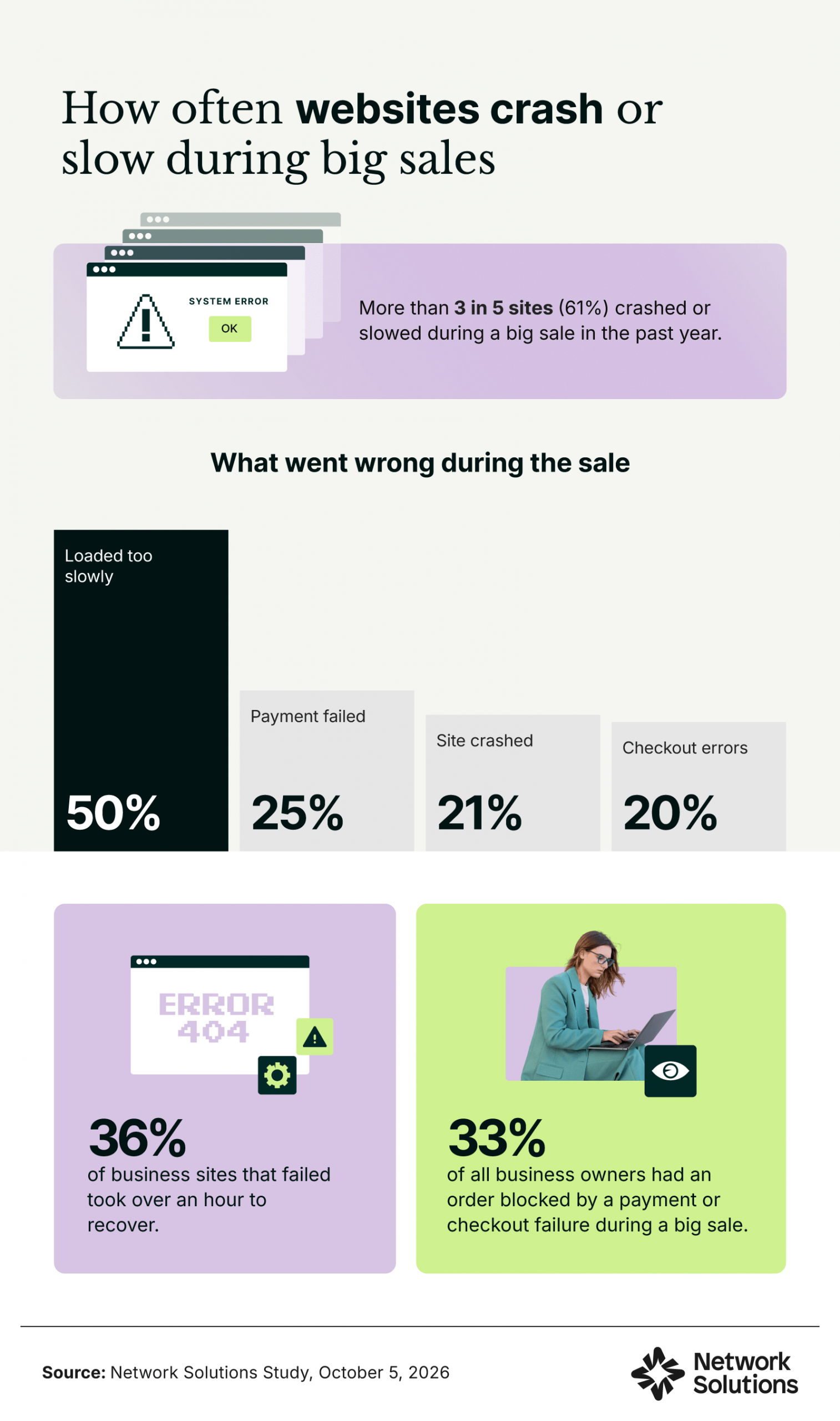
More than 3 in 5 business website owners and managers (61%) said their site failed or slowed badly during a sale or traffic surge in the past year. For an online store, that window is often one of the biggest sales periods of the year. One-third of all surveyed owners (33%) reported a payment or checkout failure that blocked orders outright, so the problem wasn’t just a slow page.
Getting a site back up was rarely quick. More than 1 in 3 owners and managers whose site failed (36%) needed over an hour to restore full functionality, and nearly 1 in 10 (9%) stayed down for three hours or longer or lost the rest of the sale.
Why sites buckle under the traffic
Most owners who looked back at what broke their site pointed to the surge in traffic.
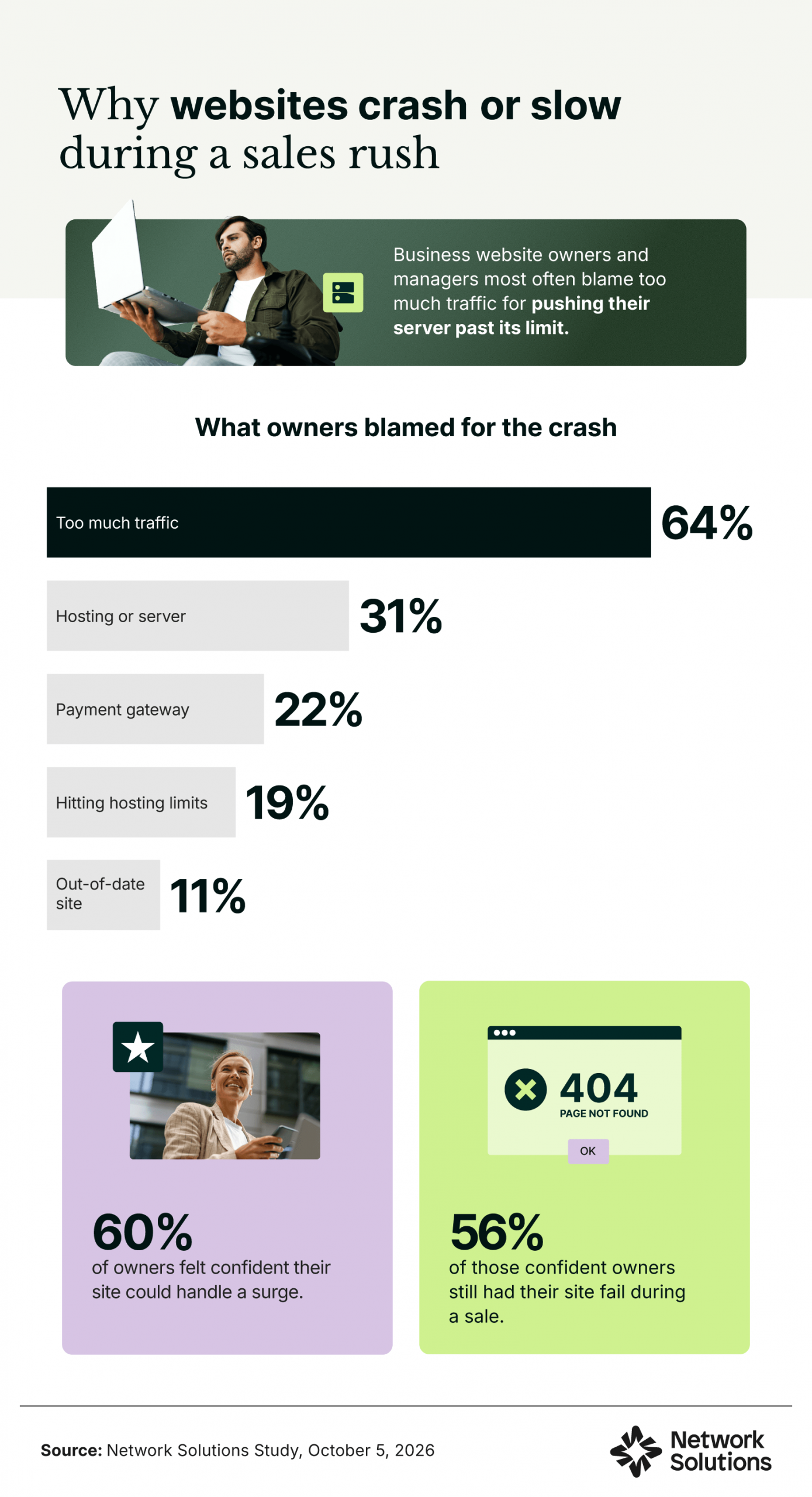
Among owners and managers whose site failed during a sales rush, nearly 2 in 3 (64%) believed too much traffic overwhelmed the site or server. Add in those who blamed their hosting plan’s limits, and that share rose to 72%.
About 3 in 10 (31%) cited a hosting or server issue, and nearly 1 in 5 (19%) said they hit their hosting plan’s limits. Many owners felt their setup couldn’t handle the extra demand. The good news is that capacity is something you can plan for before the sale.
Are online stores ready for Black Friday?
Black Friday matters to nearly everyone selling online, but readiness is another story.
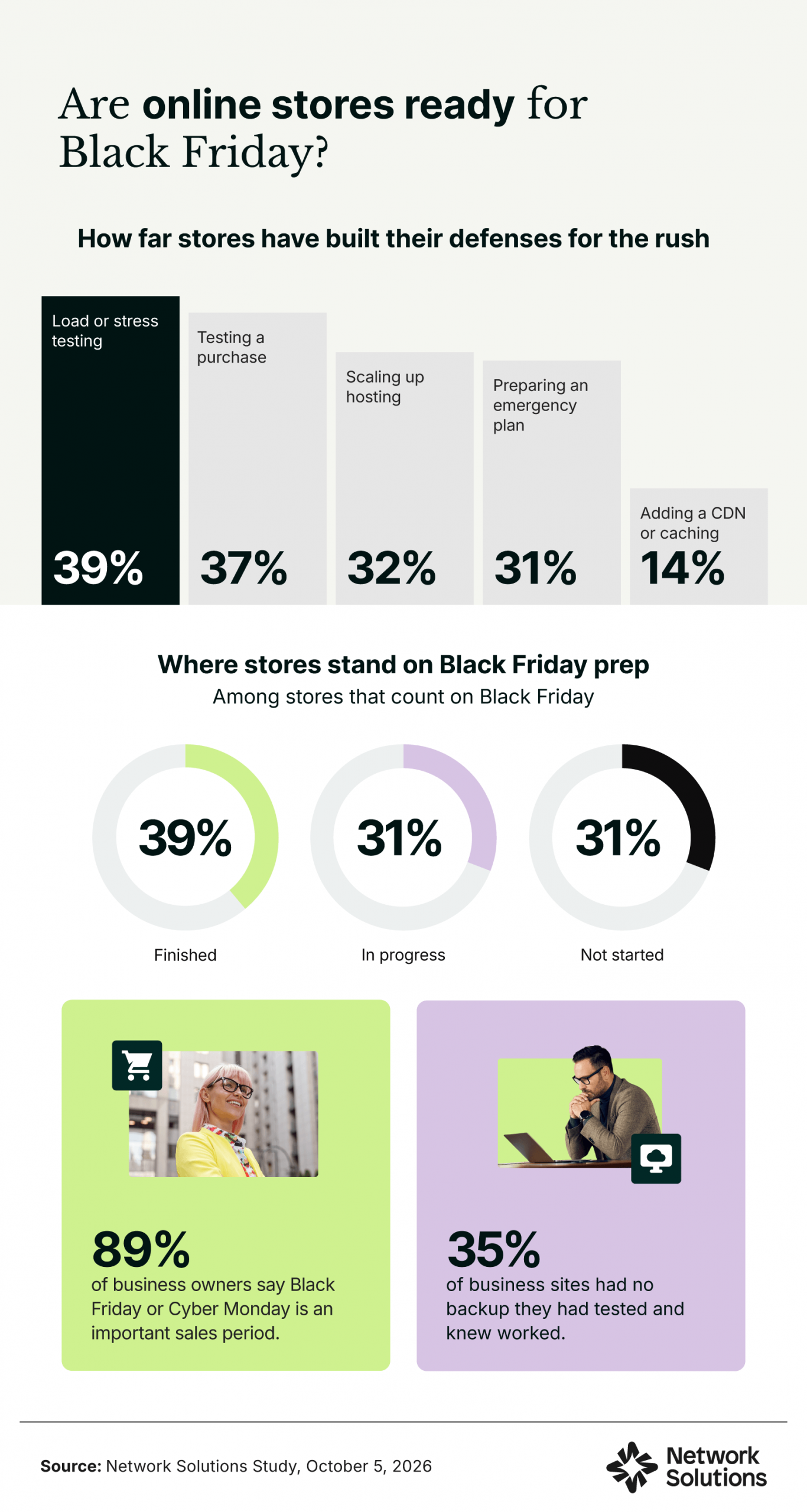
Black Friday and Cyber Monday matter to almost everyone in the survey, with 89% of business website owners and managers calling the weekend an important sales period. Readiness, though, is uneven. As of our October 5, 2026 survey, nearly 2 in 5 (39%) of business owners who count on the weekend and reported where their prep stood had finished, 31% were underway, and 31% had not started.
The gaps show up in the specific steps, too. 39% of business website owners and managers reported running load or stress testing before a big sale, and 14% reported adding a content delivery network (CDN) or extra caching to help absorb a surge of traffic. Scaling up hosting, which 32% reported, adds capacity too. More than 1 in 3 (35%) did not have a backup they had tested and knew would work.
What our simulated traffic test showed
To see the surge firsthand, we built a store of our own and sent simulated shoppers at it.
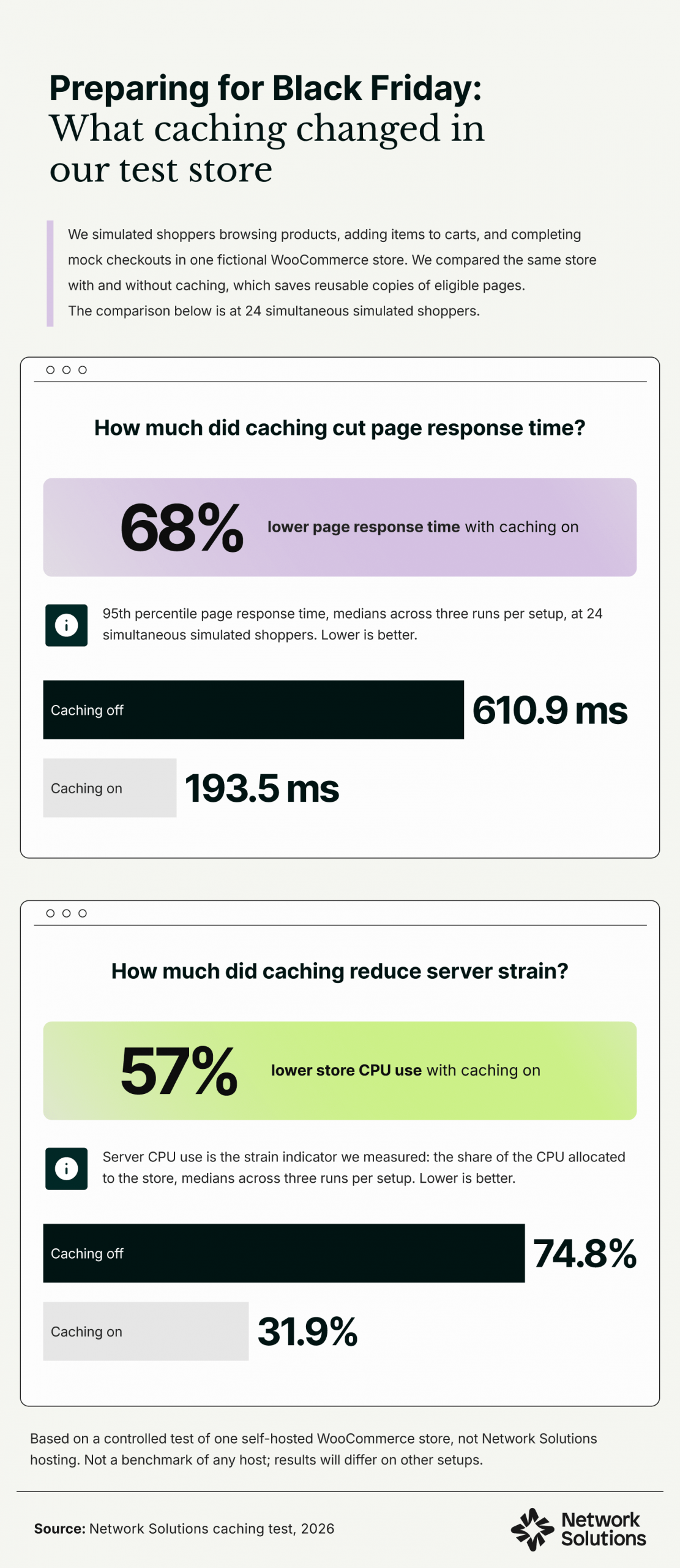
Testing a real business’s site requires permission, so we built our own eCommerce store on WooCommerce, complete with products, inventory, coupons, and a working checkout. We then simulated shoppers browsing, adding items to carts, and checking out. We ran each setup three times, with caching on and off (the figures quoted are the middle result across runs).
Test setup: we ran the store on a single self-hosted machine in our own test environment, not on a Network Solutions hosting plan. The store, its web server, PHP and database shared one CPU core and 2.4 GB of memory, while the simulated shoppers ran on a separate core. For the caching setup, the nginx web server saved copies of pages that anonymous visitors browse, such as the home, shop and product pages, for five minutes. Carts, checkout and logged-in sessions were never cached. We ran each setup three times at 6, 12 and 24 simultaneous shoppers.
Within the tested range, the store held up. All 355 attempted mock checkouts went through in both setups and at every traffic level. Prices, coupon math, order totals, and inventory updates behaved the same way whether caching was on or off (we intentionally left shopping carts and checkout pages out of caching).
Caching made a clear difference. It cut 95th-percentile page response time by 68%, from 610.9 ms to 193.5 ms, and store CPU usage by 57%, from 74.8% to 31.9%. That lines up with what owners told us about traffic and capacity being the pressure points.
One caveat: neither setup reached a breaking point at the test’s limit of 24 simultaneous simulated shoppers, and pushing toward 100 and 500 shoppers ran past the test rig’s own capacity. So the experiment shows how performance differed under those conditions, not the maximum a store can take.
This was a controlled test of one store on one small machine. It isn’t a benchmark of Network Solutions hosting or of any other host, and results will differ on other setups.
Staying online when it counts
Black Friday doesn’t have to be the weekend your site goes down. Most of the problems owners reported came back to capacity. Too much traffic, hosting limits, and server strain were what owners most often blamed, and owners can prepare for each of these before the rush.
In our test, turning on caching improved page speed and lowered server strain, and every mock checkout still went through. Among the owners whose sites failed, 36% needed more than an hour to recover. A few steps worth taking before the sale:
- Check your hosting plan: Make sure it has room for a traffic spike, not just an average day
- Turn on caching for high-traffic pages:it cuts server load when shoppers flood your most-visited pages. Leave carts and checkout out of caching, since caching those can break orders.
- Test your checkout: Run a mock purchase before the sale, not during it
- Have a backup plan: Know how you’ll restore your site fast if something breaks
We’ve spent more than 40 years helping people build and run their sites, and we keep adding tools to make this easier. If you’re not sure your setup can handle the rush, start with your hosting before the sale. These steps target the issues owners reported most: too much traffic, hosting limits, and server strain. They’re no guarantee, 56% of confident owners still had a failure, but they tackle those pressure points head-on.
Methodology
This survey was conducted online on October 5, 2026 by Fractl on behalf of Network Solutions. It surveyed 507 Americans who run or manage business websites to explore how often their websites fail during major sales events and traffic surges, and how they prepare for Black Friday. Respondents included eCommerce or online business owners and operators (56%), freelance web and tech professionals (37%), and agency professionals who manage client sites (7%).
The average age of respondents was 39, and the median annual revenue of the business behind their website was $50,000. Of those surveyed, 54% were men, 44% were women, 1% were non-binary or gender non-conforming, and 1% preferred not to say. By generation, 4% were baby boomers, 22% were Gen X, 52% were millennials, and 23% were Gen Z. Methodology percentages not totaling 100% are due to rounding. The margin of error for the full sample is approximately ±4.4 percentage points at a 95% confidence level.
Findings on website failures were based on a subgroup of 307 respondents who experienced a failure. Findings on Black Friday and Cyber Monday preparation were based on the 374 respondents who count on the weekend and reported where their preparation stood, while findings on website confidence were based on a subgroup of 305 respondents. Percentages reflect the respondents who answered each question or met the stated subgroup conditions. Agreement figures combine “agree” and “strongly agree.” Several questions let respondents choose more than one answer: the website problems experienced during a sale or surge, what owners believed caused a failure, what else resulted from a failure, the steps they take before a major sale, and what makes preparing difficult. Those percentages can add to more than 100% and should not be summed. Where the report gives a combined figure, such as the 33% who had a payment or checkout failure or the 72% who blamed too much traffic or hosting limits, each respondent is counted once, so it’s a deduplicated share, not a sum.
Separately from the survey, we ran a controlled experiment on one self-hosted WooCommerce store with a fictional 48-product catalog, comparing it with and without page caching. It was not run on Network Solutions infrastructure. The shopper behavior was an assumed mix chosen to exercise the store, not a measured shopper pattern.
All findings are self-reported and rely on respondents’ memories and best estimates. Reported causes of website failures reflect respondents’ beliefs rather than confirmed technical diagnoses. “Did not report” means a respondent did not select an action in the survey, not that they have never taken it. Backup findings apply to all respondents, not only those with automatic backups. Smaller subgroup findings should be read as directional.
About Network Solutions
For over 40 years, Network Solutions has helped people claim their space online, and we’re still evolving right alongside the internet we grew up with. From domain name registration and hosting to website building, security, and AI tools built to help you move from idea to action faster, we bring the tools you need to grow into one place. We believe you have what it takes to break through, and we’re here to help make it happen.
Fair use statement
Information in this article may be used for noncommercial purposes only. If you reference any findings, please provide a link back to this page and a mention of Network Solutions as the author.
Product names mentioned are trademarks of their respective owners. Their inclusion does not imply any affiliation, sponsorship, or endorsement.