
Buying domains is easy, but many struggle to activate, secure, and make the most of them. Here’s how you can immediately get value from your domains on Day 1.
Key takeaways:
- .com still dominates domain purchases, but alternative top-level domains (TLDs) are consistently gaining meaningful traction.
- Around one-third (roughly 35%) of domain buyers own multiple domains, signaling early adoption of multi‑domain strategies to address brand protection and security risks.
- Nearly 60% of domains return an error, leaving digital identities dormant and vulnerable.
Global domain name registrations reached 386.9 million in Q4 2025—the highest ever recorded—climbing by 22.7 million (6.2%) year‑over‑year as businesses and individuals intensified their investment in digital identity.
Your domain name is often the first major step in building your online presence. As digital expectations rise and customers make faster credibility judgments, simply registering a domain is no longer enough to establish a trustworthy online identity.
We analyzed Network Solutions’ first‑party domain data from 2025 to understand not just what people are registering, but what actually happens after purchase. The findings reveal a growing gap between domain ownership and digital identity—one that carries real implications for trust, security, and opportunity for building brand value.
About this report:
All data in this report is sourced from our customer base and domain inventory as of 2025. While typical industry reports focus on registration volume, this analysis uses our first-party data and internal subject-matter expertise to explore:
- Post-purchase behavior: What happens after a domain is bought
- Strategic insights: Trends in brand protection, risk management, and digital identity
Drawing on a portfolio of over 4 million domains as of 2025, we assessed a sample of domain activity to determine whether domains point to live sites, are parked, feature “coming soon” pages, or remain inactive. Where most industry reports cover registration trends, this one goes further into what happens after a domain is purchased, and why it matters.
We also covered comparative data to evaluate registration shifts between 2024 and 2025.
We will update this report regularly as new data becomes available.
State of domain registrations (2026)
Businesses are investing more in their online presence than ever, yet many are leaving domains—the foundational layer of that presence—unmanaged, un-activated and entirely exposed to risk.
What happens after the purchase matters because domains are no longer just web addresses. They are digital assets that can be claimed by competitors, targeted and squatted on by bad actors, or lost due to expiration and simple mistakes. And the cost of letting your domain lapse or sit unused has never been higher.
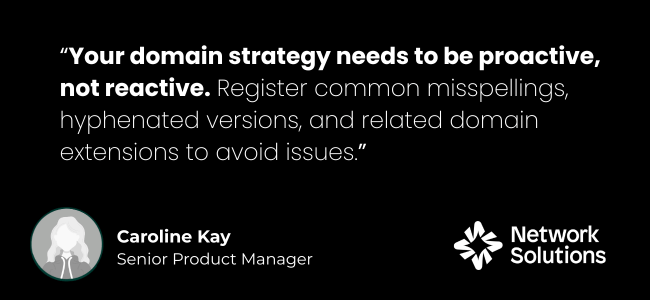
As our Senior Product Manager Caroline Kay puts it, “Your domain strategy needs to be proactive, not reactive. Register common misspellings, hyphenated versions, and related domain extensions to avoid issues.”
If you go the “reactive” route and leave important domain variations unregistered and unprotected, you may be dealing with very real threats that include:
- Typo-squatting and phishing: Attackers register misspellings of your domain to trick users into scam or phishing sites.
- Competitor hijacking: Rivals capture alternate extensions like .net or .org to siphon your traffic.
- Lookalike domains: Fake sites that mimic your brand are used to commit fraud and erode customer trust.
- Hyphen confusion: Missing hyphens can cause users to land on other sites if those versions aren’t secured.
A well-managed domain stays under your control and anchors your online identity. But still, a critical gap exists: Many take the first step (buying a domain) but not the next (using it to build trust, security, or visibility).
Let’s explore the hypothesis objectively using data.
Most common TLDs purchased in 2025 vs 2024
Our data shows that in 2025, .com continued to dominate, accounting for roughly 60% of all registrations, maintaining its dominant position as the default choice for credibility and recognition.
Top 10 TLDs registered in Network Solutions (2025 vs 2024) and % of registrations they account for
| 2024 | 2024 (% of orders) | 2025 | 2025 (% of orders) |
|---|---|---|---|
| .com | 59.98% | .com | 60.23% |
| .org | 8.24% | .online | 9.54% |
| .net | 8.15% | .org | 7.74% |
| .online | 7.55% | .net | 7.03% |
| .co | 2.36% | .co | 2.87% |
| .info | 2.14% | .info | 2.18% |
| .us | 1.69% | .us | 1.79% |
| .biz | 1.59% | .ai | 1.71% |
| .ai | 1.30% | .biz | 1.63% |
| .co.uk | 0.86% | .ca | 0.69% |
Here’s the same data comparing both years for each TLD, with .com dominance standing out.
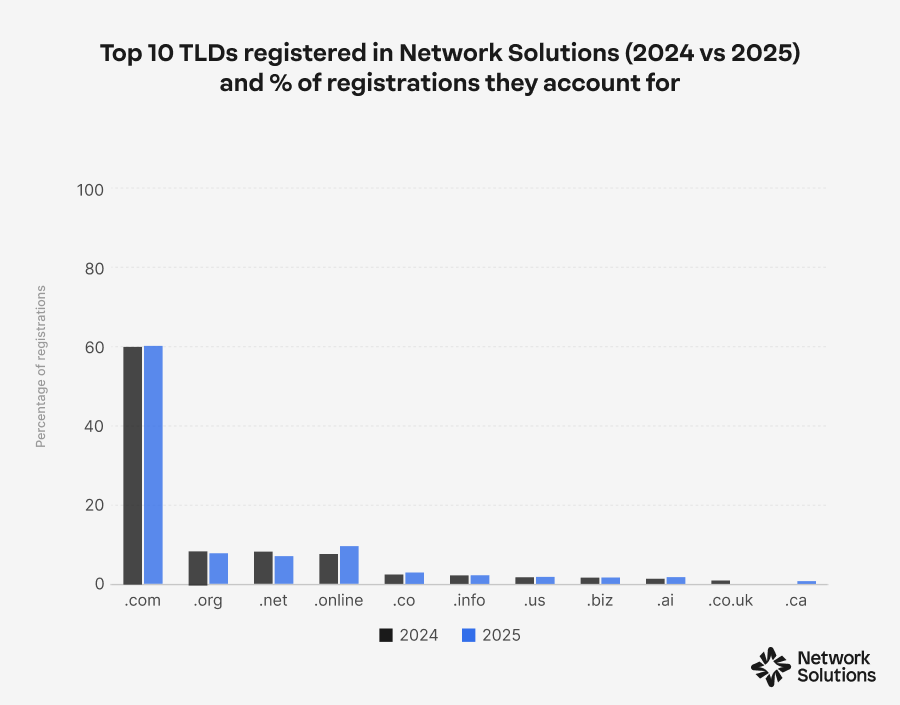
But while .com remains the foundation of digital identity, there is growing momentum in several alternative extensions that reflect how customers are adjusting their strategies, as seen here:
Top 10 TLDs registered in Network Solutions (2025 vs 2024) with position changes
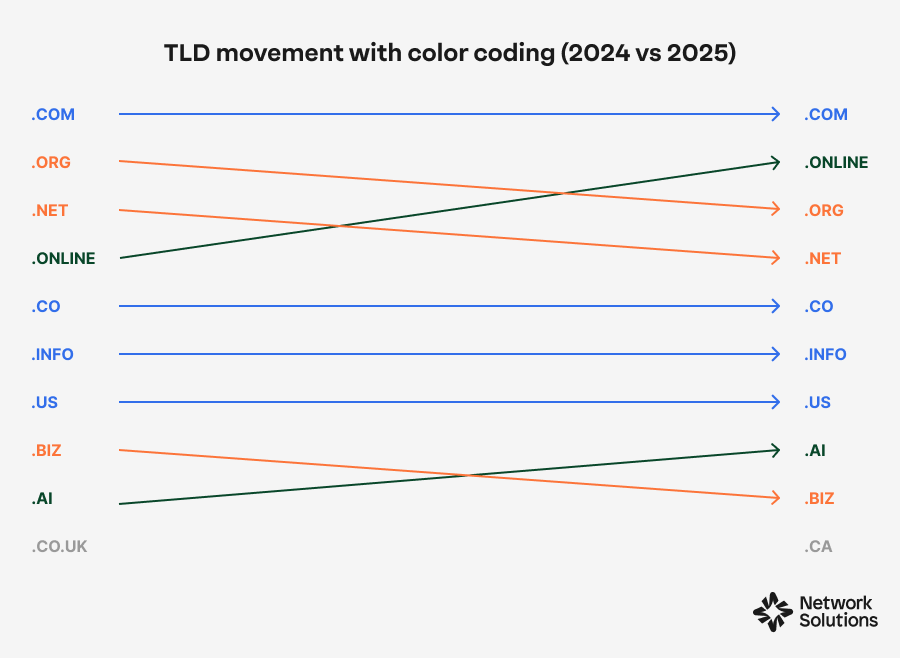
These shifts suggest that customers expand their domain identity beyond a single extension. They are increasingly weighing availability, branding, and naming strategy when choosing a TLD. Specifically:
- .online moved into the #2 position, rising from fourth place the year before. This growth was influenced by a 2025 promotion that included .online registrations with select .com purchases from Network Solutions.
- .org and .net remained firmly in the top 4, signaling continued trust in established, legacy extensions, particularly for nonprofits, communities, and technically oriented organizations.
- .ai registrations increased year over year, climbing from 9th place in 2024 to 8th in 2025. This reflects broader interest in AI‑aligned branding across more industries, not just among startups.
- .co consistently ranks among the top 5 extensions and continues to appeal to brands looking for short, flexible, and globally recognizable names when .com options are unavailable.
- .co.uk dropped out of the top 10, replaced by .ca, suggesting subtle geographic shifts in demand rather than a preference for extensions.
The data further shows that alternative domain extensions such as .store, .ai, .online, and .co are proving to be emerging alternatives:
- 🔼 45% = .store
- 🔼 41.7% = .ai
- 🔼36.5% = .online
- 🔼 31.3% = .co
Is .com “saturated”?
.com remains the anchor of digital identity, but intensifying competition means short, brandable names are harder to secure—many are already owned, parked, or used defensively. Saturation doesn’t eliminate the opportunity; it just raises the bar. The takeaway isn’t to replace .com. It’s to build around it with alternative domain variations and TLDs.
Why customers are exploring alternative TLDs
The move toward emerging TLDs is driven more by practical need than novelty. These factors make emerging TLDs a logical next step, especially when building or expanding a brand:
- Better availability: Less saturated than .com, making short, memorable, brand-relevant names easier and cheaper to secure.
- Branding flexibility: Extensions like .online, .ai, and .co enable cleaner naming that reflects identity rather than just what’s available.
- Built-in meaning: Many TLDs signal purpose instantly (e.g., .online for digital presence, .ai for tech-forward brands).
- Future-proofing: Early movers secure meaningful names before competition catches up.
- Business alignment: As AI and digital services become core offerings, extensions like .ai naturally fit modern models.
- Domain portfolio building: SMBs are increasingly managing their domain presence as a broader brand asset strategy.
Build your brand from every possible angle.
Secure multiple domains to protect against lookalikes, phishing risks, and competitors. Develop a domain portfolio that helps your brand break through the digital noise.

How many domains do customers own?
As naming competition grows and impersonation risks increase, portfolio ownership is shifting from optional to protective. Holding multiple domains helps businesses:
- Secure key variations and extensions
- Prevent brand misuse
- Preserve room for future growth
Total customers who own more than one domain
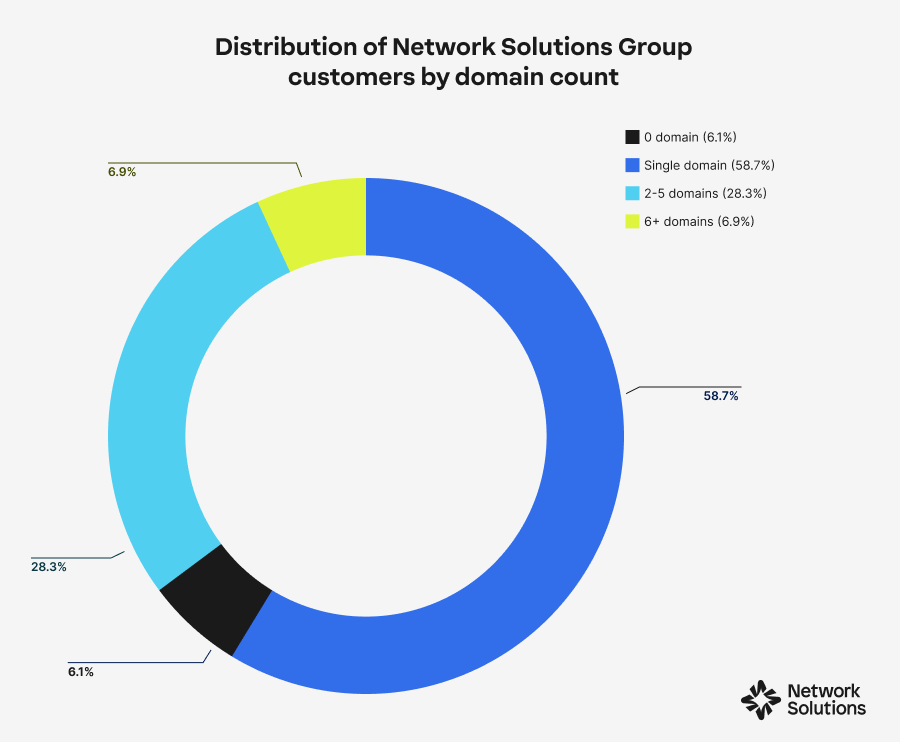
Most Network Solutions customers (58.8%) own a single domain—reflecting the traditional “one address” mindset. But nearly a third (28.3%) already own two to five domains, signaling a shift toward portfolio thinking: securing misspellings, alternate extensions, and defensive variations to guard brand identity.
A smaller segment (6.9%) holds six or more domains, split between established brands protecting their presence across markets and entrepreneurs treating domains as long-term assets. Just 6.1% have no domains at all.
While the single-domain default still dominates, multi-domain ownership is moving from niche to standard—driven by growing competition and rising awareness of digital identity protection.
Signs it’s time to expand your portfolio
You may benefit from more than one domain if certain conditions apply to your brand or business goals. Expanding isn’t just for large corporations, because a few strategic registrations can protect traffic, strengthen brand clarity, and deliver peace of mind.
If any of the following apply, it’s likely worth the modest annual cost:
- Your brand name is common or easily imitated.
- Your brand name is prone to misspelling (e.g, appl.com → apple.com).
- Competitors already own multiple extensions.
- You plan to expand into new markets or products.
- Your ideal .com is taken, but alternatives are available.
- You want to secure emerging identity spaces, such as .ai or .online.
- SEO, reputation, and digital branding are critical to your business.
- You want to invest in domains to “flip” them (we covered this in a later section).
Find the perfect domain
Ready to register a domain name? Check domain availability and get started with Network Solutions today.
What are people doing with their domains?
Buying a domain is the first step in establishing a digital identity—but what domain owners do after purchase is the real differentiator. This is where the most striking insight appears: Most domains never make it past the registration stage.
What happens to domains after purchase
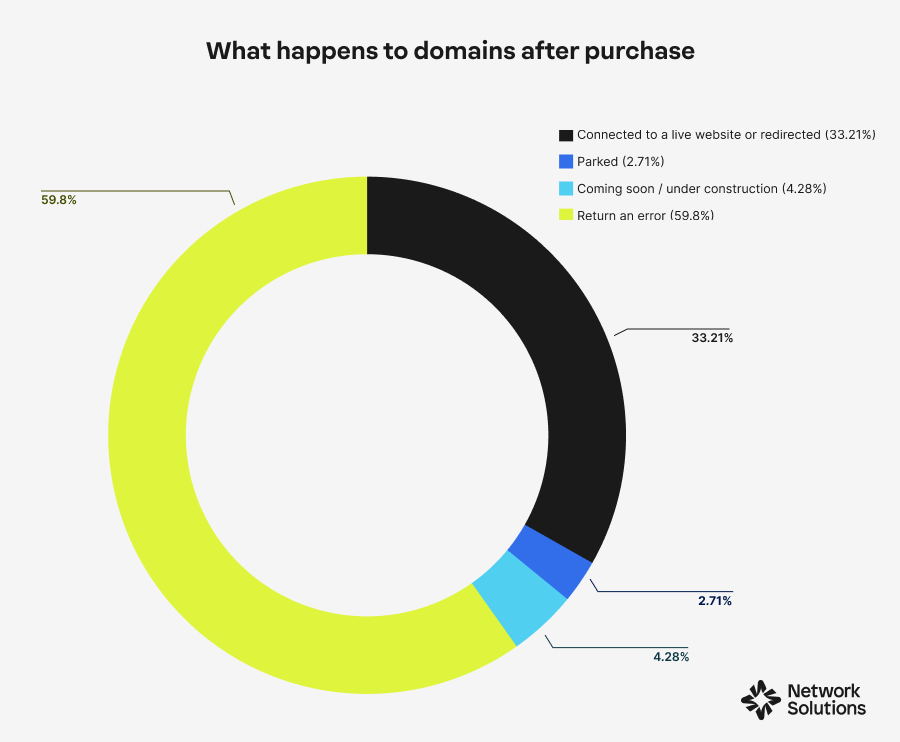
These behaviors reveal a widening gap between domain ownership and domain activation, signaling lost opportunity, and (in many cases) increased risk.
- 33.21% are connected (or at least redirected) to a live website, showing the clearest intent and high activation value.
- 4.28% point to a “coming soon / under construction” page, with value depending on how quickly the domain owner follows through.
- 2.71% are parked, but this works only when actively managed and not abandoned.
- 59.8% return an error (no DNS configuration, no website, no redirect, no placeholder), and the visitor essentially sees nothing.
Here’s a closer look at the numbers:
| Status | Description | Pros | Cons / Risks |
|---|---|---|---|
| Live website or redirect (33.21%) | Domain loads an active website or redirects to another URL; indicates full activation and intentional traffic routing | Signals legitimacy and trust Redirects consolidate identity and protect variations Generates brand value, traffic, credibility Ideal for multi‑domain owners or investors building authority | Requires correct DNS configuration Needs ongoing hosting/maintenance Redirect chains can break if not updated |
| Coming soon / Under Construction (4.28%) | Domain displays a placeholder page; indicates intent to develop but not yet launched | Signals progress and ownership Can build early interest Can collect leads Useful for phased brand rollout or pre‑launch identity building | If left up too long, signals stagnation or neglect Weak long‑term SEO value Confusing for customers if no launch timeline |
| Parked (2.71%) | Registered but not pointing to active content; often used for future launches, brand protection, or domain investing | Protects brand name or future product ideas Prevents misuse Valuable for domain investors building a portfolio | DNS misconfigurations create security openings No customer‑facing value High risk if renewal lapses |
| Returns an “error” (59.8%) | Domain loads nothing (no site, no redirect, no placeholder); Often caused by DNS errors, expired hosting, or incomplete/improper setup | — | Owners are often unaware that domain is “broken” Major trust loss if visitors see a dead end Security exposure (dangling DNS, hijacking, impersonation etc) Lost traffic and SEO value Can devalue the domain for investors or SMBs |
Taking those numbers together, the data suggests that roughly two-thirds of registered domains are not doing the job most owners registered for them to do.
The last and largest number (59.8%) stands out: About 6 out of 10 registered domains return an “error,” representing the most consequential category. No website, no redirect, no placeholder. Just a dead end. And there are no “pros” for it.
That’s a lot of paid, active registrations that do nothing at all. It matters because:
- Error-returning domains are not neutral: For businesses, a domain that returns an error signals inactivity or unprofessionalism to customers, and that lost trust rarely recovers.
- Error-returning domains are risky: Beyond reputation, misconfigured or abandoned DNS records create real security vulnerabilities for hijacking or impersonation (as discussed earlier).
Note: These are not lapsed domains. They are active registrations, maintained through renewal payments, that resolve to nothing.
Essential actions for maximizing your domains
Every domain in your portfolio—active or not—needs basic upkeep to stay secure and retain value. Unmanaged domains are vulnerable to a range of security risks, such as:
- Subdomain takeover, where attackers exploit dangling DNS records to serve content under a trusted brand name
- Re-registration by bad actors after accidental expiration
- Phishing attacks conducted through domains that closely resemble a legitimate company’s name
Even something as basic as keeping an SSL certificate active on a parked domain reduces its exposure to certain attacks.
Here’s how you can make your domain work for you immediately:
- Lock down the basics first, even if you’re not yet ready to build your website.
- Watch for early warning signs of misuse.
- Activate a placeholder page.
- Expand brand defense beyond the domain.
Lock down the basics first, even if you’re not yet ready to build your website
You don’t need a live website for a domain to be secure, but you need to manage it. Unattended domains are among the easiest targets for domain hijacking, impersonation, and phishing, simply because no one is watching.
These steps take minimal time but address the most common vulnerabilities:
- ✅ Enable auto-renew with a current payment method
- ✅ Keep WHOIS contact details up to date
- ✅ Clean up unused or outdated DNS records
- ✅ Point nameservers to a trusted provider
- ✅ Add SSL certificates, even on placeholder pages*
- ✅ Check in periodically to confirm everything is intact
Watch for early warning signs of misuse
Domain hijacking and misuse rarely announce themselves. They tend to surface quietly, often through small anomalies that are easy to dismiss. The sooner you catch these signals, the easier they are to address.
Investigate immediately if any of these anomalies surface:
- Unexpected DNS or nameserver changes
- Emails bouncing from domain-connected addresses
- Renewal notices you didn’t initiate
- Customers reporting strange behavior on your domain
An unmanaged domain isn’t a neutral asset. It’s a liability that risks turning into a security problem. Those few simple steps can protect your brand, your customers, and the value you’ve already paid for.
Activate a placeholder page
These few simple actions are enough to get you from “broken or dormant” to “credible and secure”. For instance, you can add a placeholder to mitigate doubt and trust issues.
Jennifer Weir, Senior Product Manager, adds that even the simplest action makes your domain useful: “If you’ve bought a domain but you aren’t ready to build a website yet, that’s OK. There are still ways you can make that domain work for you. Use our free Coming Soon Page* customized to suit your brand and with a contact form. This brings some personality to your domain while collecting valuable contact information from people interested in your business.”
Expand brand defense beyond the domain
Think of domain management beyond websites. Digital brand protection isn’t just about owning your domain; it’s about securing your entire online footprint. Because social media profiles often rank as high as websites in search results, they are prime targets for impersonators and squatters.
Nicole Cassis, SVP of Content and Communications, recommends: “The moment you buy a domain, go claim your matching handles on every social platform, even the ones you don’t plan to use right away.”
“That should protect the brand you’re building, keep your identity consistent, and help customers find you more easily, especially since social profiles often show up in search results alongside your website. If you are making a list of where to start, focus on Instagram, Facebook, LinkedIn, YouTube, X/Twitter, and TikTok.”
You can then redirect your domain to those social media channels.
Kate Furnifer, Director of Product Management, further advises: “Connect your Facebook, Instagram, X, and LinkedIn accounts to our free Social App* and use the centralized dashboard to create, publish, and respond to posts across all platforms. Our AI writer makes it even easier.”
Furnifer adds, “This keeps your visuals and messaging aligned without recreating content for each channel, saving you time and reducing errors. Stay on top of reviews and respond to feedback with a click of a button. Our easy-to-use app keeps your brand consistent, professional, and instantly recognizable everywhere you show up.”
*Note: If you bought your domain at Network Solutions, you get free marketing tools like a Coming Soon Page builder, Link in Bio, and Social Apps to help you get started with your domain, even if you’re not yet ready to build your website.
Predictions for 2026
Our 2025 data points to where digital identity is heading. These patterns make the same case for domains post-purchase in 2026:
- Inactive domains will become bigger liabilities.
- Domain activation will get easier.
- Portfolio thinking will become standard.
- Emerging TLDs will see higher adoption.
- Many will explore domain investing.
- Many will register domain variations to protect their brand.
Inactive domains will become bigger liabilities
As AI-driven tools make domain exploitation easier to automate, the cost of leaving domains unmanaged is rising. The 59.8% of domains currently returning errors represent a large inventory of latent risk, and that risk won’t resolve itself.
In 2026, expect inactive domains to be treated not as “unused,” but as exposed:
- Your IT/web security teams will probably expect basic hygiene even for parked domains.
- Customers will interpret dead links as signs of abandonment.
- Attackers will continue targeting unmanaged DNS records.
Even inactive domains deserve active management.
When asked what common domain security mistakes new domain owners make, our Senior Product Director, Anthony Matera, warns against complacency: “Don’t believe you won’t get targeted/hacked. Weak, default, or reused passwords can be cracked in seconds.”
Domain activation will get easier
One reason so many domains remain inactive today is friction. Traditionally, launching even a basic website used to require time, technical confidence, and multiple tools. But that barrier is falling quickly.
AI‑powered website builders, integrated hosting, and one‑click setup tools are shortening the path from registration to activation. For many owners, the gap between “I bought a domain” and “something is live” is shrinking from weeks or months to hours.
Malania Arezzi, VP of Customer Experience, expands on this trend: “It is so easy to get your business online, and there are multiple ways to accomplish it. Website builders are so easy to use that anyone can build a website. With options such as drag-and-drop editors and even AI, you can get a website up and running the same day you bought your domain. If you want a more custom website or plan to have an extensive store online, there are more customizable tools such as WordPress that will give that custom feeling but it may not be as quick as a website builder tool.”
Chris Day, VP of Customer Fulfillment, adds, “Your website is the digital expression of your brand—an extension of your domain and often your first impression. For most small businesses, website builders offer the fastest path to launch, combining beautiful design, guided content creation, and increasingly AI-powered setup with little to no technical effort.”
As tools like website builders mature:
- Fewer domains will sit indefinitely in “coming soon” or error states.
- Redirects and simple landing pages will become the norm.
- The expectation that every domain does something will rise.
In other words, inactivity is less warranted when activation requires minimal effort.
Alicia Pringle, Senior Director of Online Marketing, emphasizes the importance of early activation even if you start small: “The sooner you get your website up with at least a little bit of helpful content on it, the sooner search engines like Google will find and crawl your website. Think of it as progress, not perfection. Start small and grow with intention.”
Portfolio thinking will become standard
The single-domain business is fading. As naming competition intensifies and brand impersonation grows more common, multi-domain ownership is shifting from a premium strategy to a defensive baseline.
Businesses are increasingly:
- Securing multiple extensions and geographic variants
- Segmenting domains by product line or campaign
- Holding future-focused names tied to emerging technologies
More than one-third of customers already own multiple domains. This trend is expected to accelerate as businesses expand globally and take identity protection more seriously.
Emerging TLDs will see higher adoption
As desirable .com names become harder to secure, extensions like .online, .ai, and .co, and other new TLDs continue to move from niche to mainstream and now signal industry positioning.
For most brands, these aren’t replacements for .com. Instead, they are additions that expand their digital identity.
Many will explore domain investing
Like real estate, domains can appreciate and sell at a premium—but consistent returns separate the casual investor from the savvy one.
Michael White, Vice President for Product Management (Domain Aftermarket), advises, “Domains can serve as valuable digital assets, but sales often require time and patience. In practice, a small percentage of domains generate the majority of profits. Success typically comes from owning a smaller portfolio of high‑quality, commercially relevant names, carefully managing renewal costs, and patiently waiting for the right buyer.”
On acquiring domains, White uses a real estate analogy:
- Listing a domain for sale is like selling property at market value—you get close to what it’s worth
- Bidding on aftermarket domains is like a real estate auction—competitive, but often more cost-effective for savvy buyers
Beyond investing and flipping, the more pressing reason businesses will need multiple domains is protection.
Many will register domain variations to protect their brand
Kay reminds that unprotected domain variations invite scammers, competitors, and typo-squatters to steal your traffic, harvest customer data, and damage your reputation through phishing or lookalike sites.
Major brands have learned this the hard way. Tesla lost tesla.org to unrelated content, Nissan was forced onto nissanusa.com, and Facebook paid $8.5M for fb.com. Early registration is far cheaper than a buyback.
Beyond defensive registration, Kay recommends:
- Account security: Enable 2FA, lock domains against unauthorized transfers, and add contact privacy
- Regular audits: Expand your portfolio as your brand and product lines grow
- GlobalBlock: Preemptively blocks your brand across hundreds of TLDs
- AdultBlock: Keeps your brand off adult-themed domains
Getting a .com alone is still essential, but no longer sufficient.
While .com remains the foundation of online credibility, it can no longer carry the full weight of digital identity alone. The strongest strategies today get a trusted .com with emerging TLDs for flexibility and differentiation, actively managed to reinforce—not dilute—brand trust.
Far from fringe choices, emerging TLDs will become practical tools for standing out, securing meaningful names, and protecting your online presence in an increasingly competitive landscape.
Kay recommends, “Typically, 5 to 10 well-chosen domain variations—including common misspellings and hyphenated versions—are enough to provide broad brand protection without unnecessary costs. This balance safeguards your brand effectively while managing expense.”
Treat your domains as assets
Domains remain one of your most stable long-term digital assets—unlike social platforms, algorithms, and marketplaces, which all come and go.
Registering a domain takes minutes, but building and protecting your digital identity takes deliberate, ongoing effort. The data in this report showed that most domain owners are still stuck between buying and acting, mostly because they either (1) simply don’t know what to do next, or (2) don’t realize there’s a problem at all.
Start with the essentials
These high-impact moves turn domains from liabilities into assets:
- Secure the right variations: Cover .com and the extensions most relevant to your brand (.ai, .co, .org, .online). One domain can’t carry your full identity anymore.
- Configure DNS immediately: Even a placeholder or redirect prevents error states, which are among the fastest ways to lose customer trust.
- Use redirects intentionally: Point secondary domains to your primary site. Unused domains become brand signals instead of dead ends.
- Monitor regularly: Check that domains are resolving, DNS records are accurate, SSL is active, and auto-renew is on. A quick monthly scan is enough.
- Protect ownership details: Keep WHOIS info, billing methods, and contacts current. Accidental expiry is still one of the most common causes of identity loss.
Why move now?
More than just addresses, domains are assets that carry business value and protect your reputation.
The signals across this report are consistent:
- Inactive domains will carry more risk.
- Activation will get easier, raising expectations for inactivity.
- Domain portfolios will continue to grow.
- Brand protection will increasingly drive purchasing decisions.
- Digital identity will be spread across multiple names—not just one.
A portfolio mindset is quickly becoming the norm because desirable .com names are scarce, most owned domains go unused, and newer extensions like .ai and .co offer flexible ways to protect and grow a brand.
For most businesses, this simply means a core domain plus a few strategic variations, rather than a large collection.
Put your domains into action now
Buying a domain is no longer the finish line. In 2026, it’s the starting point. Those who act now—activating, securing, and strategically expanding their portfolios—will be better positioned to protect their identity, capture opportunity, and stay ahead of risks that are becoming harder to ignore.
Publishing a simple page, connecting a redirect, or securing multiple variations of your brand takes minutes instead of weeks.
The goal isn’t to execute a perfect strategy. It’s simply to take action. Even a redirect or “coming soon” page sends a message that your business is active, legitimate, and paying attention.
In 2026, successful digital identities don’t just happen by accident. They happen because you intentionally take control, and that all starts with your domain.
Making the best use of your domains is now easier than ever
- Have a domain but not yet ready to commit to a proper website? Use our free marketing apps to build your ‘coming soon’ page, set up your social links, start capturing/nurturing leads, and plan your marketing.
- Ready to move past your ‘coming soon’ page and launch your website? Read our simplified guide on I Bought a Domain Name, Now What? 8 Steps To Maximize Your Domain to guide you on the next step of your digital identity journey.
- Ready to build your website? You can either use a website builder or do a custom build, just make sure to get reliable hosting.
- Need help? Our online presence experts are ready to work with you.
Your next breakthrough could be waiting to begin with the domains you activate today.