



Key takeaways:
- AI search optimization builds on traditional SEO, so you don’t need to start from scratch.
- Clear structure, high-quality content, internal links, structured data, and technical SEO help AI search engines understand your web pages.
- To optimize a website for AI search, focus on direct answers, trustworthy information, strong E-E-A-T signals, and content that matches user intent.
AI search is changing how people find information online. Instead of scanning only traditional search engines and blue-link search results, users may now see AI Overviews, AI-generated answers, and summaries from AI-powered search engines before they click a website.
That shift can affect traffic. Pew Research Center found that Google users only clicked a traditional search result in 8% of visits when an AI summary appeared, compared with 15% when no AI summary appeared.
But at the same time, AI search can also create new visibility opportunities. Adobe research cited by The Verge found that AI search referrals to U.S. retail sites increased 1,300% during the 2024 holiday season compared with the previous year. Visitors from AI search also spent 8% more time on site, viewed 12% more pages, and were 23% less likely to bounce than visitors from traditional search referrals.
The good news: Search engine optimization isn’t really starting over. If your website already follows traditional SEO basics—crawlable pages, useful content, clear structure, relevant internal links, and a secure, fast experience—you’re already building the foundation AI systems need to understand your business.
This guide explains how to optimize your website for AI search while still improving your visibility in Google search results, traditional search results, and other AI platforms.
Find the perfect domain
Ready to register a domain name? Check domain availability and get started with Network Solutions today.
What AI search is, and why it matters
AI search is the use of generative AI to answer user queries directly. Instead of showing only a list of links, AI search engines and AI engines may summarize information, compare options, recommend next steps, and answer follow-up questions in a conversational way.
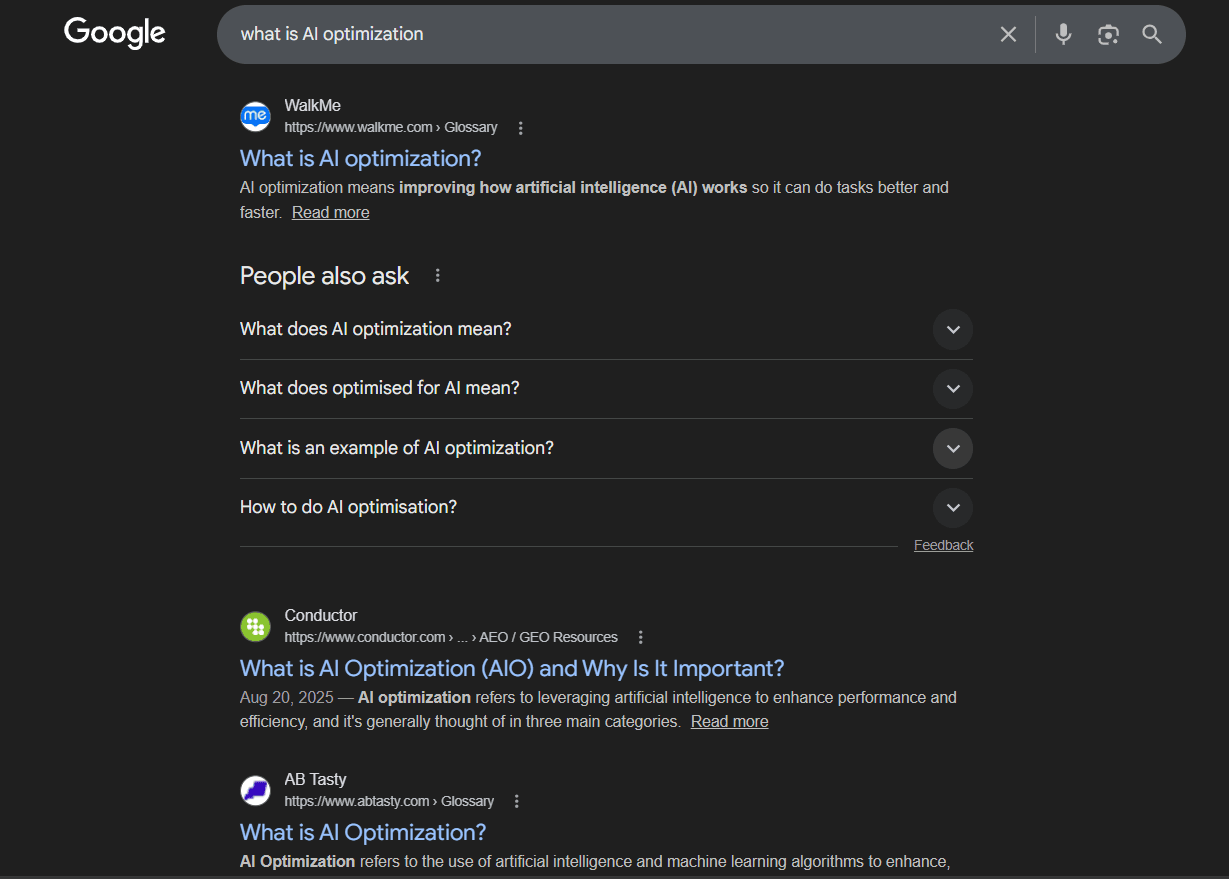
In traditional search engines, users see a list of blue links and choose which page to visit. Just like the image below, you can see the links that take you to a website with the most relevant keywords related to the query.
In AI-powered search engines, the experience is different: answers appear first, links second. AI-generated responses summarize information directly on the results page, often citing only a handful of sources.
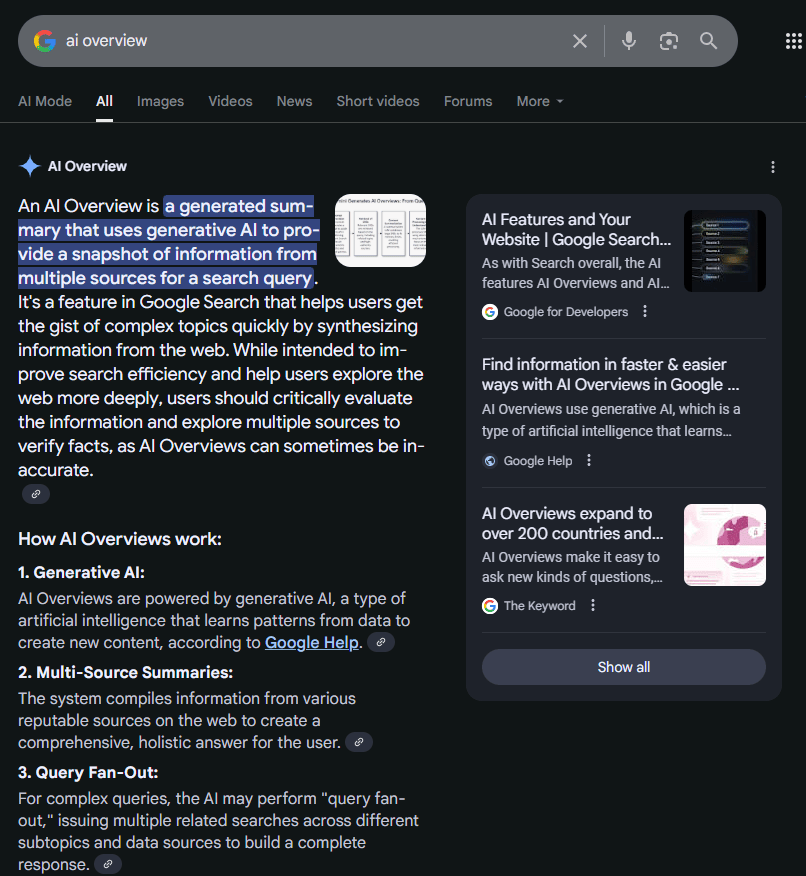
This changes the visibility equation. AI-driven search systems decide:
- Which content is eligible for retrieval
- Which sources are credible enough to reference
- How information is summarized
- Whether your brand appears as a citation
Sometimes, AI platforms may reference your content without sending much traffic back to your site. But your page can still shape the answer someone sees, even if they never click through like they would in traditional search results.
That’s why optimizing for AI search isn’t just about rankings anymore. It’s mainly about being selected and cited.
But while you can’t control exactly how AI generates answers, you can control how clear, accessible, and trustworthy your site appears. When your pages are easy to crawl, structured clearly, and backed by credible signals, they’re more likely to be included.
Next, let’s look at how generative engine optimization builds on traditional SEO, and what that means for your strategy moving forward.
GEO vs SEO: What stays the same, what changes?
Generative engine optimization (GEO) focuses on helping your content appear in AI-generated answers from generative AI tools. Answer engine optimization, or AEO, is a related term that focuses on making your content easy for AI systems to use when creating a direct answer.
Search engine optimization (SEO) focuses on improving visibility in traditional search engines, search engine results pages, and traditional search results.
Basically:
- SEO helps you rank.
- GEO helps you get referenced.
These terms sound different, but they overlap. Google says its generative AI features are rooted in its core search ranking and quality systems. Google also says AEO and GEO are terms used to describe visibility work for AI search experiences, but from Google Search’s perspective, optimizing for generative AI search is still part of SEO.
That means traditional SEO still matters. Crawlability, indexability, useful content, keyword research, technical SEO, internal links, site speed, structured data, and good page experience all still support visibility.
What changes is how the answer appears. Traditional search may show your page as a blue link on a results page. AI search may use your content inside a direct answer, cite your page as a source, or mention your brand without sending an immediate click. That’s why AI search optimization should build on your existing SEO strategies, not replace them.
Here’s a simple comparison:
Area | SEO | GEO |
|---|---|---|
Focus | Ranking in search engines | Inclusion in AI answers |
Goal | Earn clicks | Be selected and cited |
Metrics | Rankings, CTR, traffic | Citations, share of voice, brand mentions |
Optimization | Keywords, links, technical SEO | Structure, clarity, authority signals |
You can think of GEO as the next layer of search optimization, one that focuses on answer engines, not just search engines.
How AI decides what to use and who to credit
Before AI search engines can summarize or cite your website, your content needs to be eligible. That means your pages should be crawlable, indexable, clearly structured, easily accessible to web crawlers, and up-to-date enough to be useful. If important pages are blocked by robots.txt, hidden behind restrictions, missing from internal links, or filled with outdated information, they may not appear in AI search results, even if they are helpful.
Once that foundation is in place, AI systems look for content they can process quickly and that they can trust. A strong page gives a direct answer near the very beginning, ideally within the first 40–60 words of a section, then supports that answer with examples, context, citations, or original insight. Treat this as a practical writing rule, not a fixed ranking formula.
AI search also prioritizes intent over keyword density. In other words, the page should answer what the user really means, not just repeat matching keywords. If two people ask the same query in different ways, the best content should still satisfy the same search intent.
This is where answer optimization and citation optimization work together. Answer optimization helps AI tools understand and extract your content. Citation optimization helps them decide whether your website is credible enough to be mentioned as a source.
AI tools tend to favor pages that:
- Clearly answer a specific question
- Use simple, descriptive headings
- Break information into short, focused sections
- Use bullet points, tables, or steps where helpful
- Avoid long introductions that delay the answer
- Provide high quality content with practical details, examples, or original data
- Use concise language that is easy to process and understand
But clear answers are only part of the equation.
AI search engines are more likely to credit content when the source also looks trustworthy. That means the page shows clear E-E-A-T, includes up-to-date information, cites trusted sources, avoids exaggerated claims, and makes it easy to see who wrote or reviewed the content. Brand mentions across authoritative sites, customer reviews, and consistent business details can also help AI platforms understand what your company is known for.
The AI search optimization playbook
AI search can feel overwhelming, but the work becomes easier when you focus on the highest-impact improvements first. Start with access, then structure, then trust, then measurement.
Here’s how to approach it.
- Make sure AI bots can access your content
- Structure content so it can be lifted into AI answers
- Use schema markup and structured data to clarify meaning
- Write for topical completeness, not keyword stuffing
- Strengthen trust signals and E-E-A-T cues
- Optimize beyond Google: Multi-surface visibility (including video)
Make sure AI bots can access your content
AI search engines can’t use content they can’t access, so start with technical SEO basics:
- Check your robots.txt file.
- Remove accidental noindex tags.
- Keep your sitemap updated.
- Make sure important web pages are connected through internal links.
Your crawl settings should allow search engines, web crawlers, and relevant AI bots to reach your most important content.
But access is only the first step. Technical clarity also helps AI models parse your pages correctly. Use:
- Semantic HTML
- Descriptive headings
- Visible text
- Logical page hierarchy
- Strong site speed
- Mobile-friendly design
- Secure browsing
These basics help search engines understand your content and make your site easier for visitors to use.
You may also hear about llms.txt, a proposed file similar in concept to robots.txt but designed to guide AI tools to important site content. You can create one if it fits your workflow, but treat it as optional. Google says pages must be indexed and eligible to appear in Google Search with a snippet to be shown as supporting links in AI Overviews or AI Mode, but llms.txt and other special AI text files don’t affect visibility in Google Search because Google Search ignores them.
Structure content so it can be lifted into AI answers
Once your pages are accessible, the next step is making them easy to extract from.
AI systems don’t “understand” content the way humans do. They scan for clear signals—headings, short answer blocks, lists, and structured sections that map cleanly to search queries.
If your page is one long wall of text, it’s harder to use. Here’s what helps:
- Use clear H2 and H3 headings that match natural language queries.
- Start sections with a direct answer before expanding.
- Keep paragraphs short (2–4 sentences).
- Use bullet points for steps or lists.
- Use simple tables for comparisons.
Instead of long, flowing paragraphs, structure your content in sections that can stand on their own. Here’s what that looks like in practice:
Micro-template: 30–80 word answer block
For example:
What is AI search optimization?
AI search optimization is the process of structuring and clarifying your website content so AI systems can easily access, understand, summarize, and cite it in AI-driven search results. It focuses on crawlability, clear formatting, authority signals, and direct answers.
After this short definition, you can expand with examples, deeper explanation, or implementation details.
Micro-template: Steps in bullets
If you’re explaining a process, don’t bury the steps in a paragraph.
Instead of this:
To optimize your site, you should review your technical setup, improve structure, add schema, and strengthen authority signals across your pages.
Do this:
To optimize your site:
- Review your technical setup
- Improve content structure
- Add schema markup
- Strengthen authority signals
Short bullet points are easier for both readers and AI systems to interpret.
Micro-template: Simple comparison table
When comparing strategies or definitions, a small table makes the difference clearer.
Traditional SEO | AI search optimization |
|---|---|
Focus on rankings | Focus on being cited |
Optimize for keywords | Optimize for clarity and structure |
Measure traffic | Measure citations and visibility |
A clean table gives AI clear relational signals and helps readers scan quickly.
Natural language optimization matters here, too. Write the way customers ask questions. If a customer might ask, “Can AI tools find my website?” use that conversational phrasing in your headings, FAQs, or body copy when it fits naturally.
The goal isn’t to oversimplify your content. It’s to format it so the answer is obvious. When AI systems can clearly see where an answer begins and ends, they’re more likely to use it.
Use schema markup and structured data to clarify meaning
Schema markup is a type of code added to your website that helps search engines understand what your content represents. It doesn’t change how the page looks to visitors. It works behind the scenes, labeling information so machines can interpret it more accurately.
Structured data is the format that organizes those labels.
For example, instead of AI simply seeing text on a page, schema markup can signal:
- “This is an article.”
- “This section is a frequently asked question.”
- “This is a step-by-step process.”
That added clarity helps search engines and AI systems understand your content faster and with less guesswork.
For AI search optimization, structured data can make your content easier to interpret. It gives AI systems and search engines machine-readable context about your page, such as whether it is a blog post, FAQ, product page, local business page, article, event, or how-to guide.
Here are a few schema types worth prioritizing:
- Article schema for blog posts and educational resources
- FAQ schema for question-and-answer sections
- How-To schema for step-based guides
- Organization schema to reinforce brand identity and authority
- Product schema for product pages
- Local Business schema for local service businesses
- Video schema for relevant YouTube videos or embedded videos
You don’t need to implement everything at once. Start with the schema that matches the page’s purpose.
A simple workflow:
- Add the relevant structured data.
- Validate it using a testing tool.
- Monitor and update as your content evolves.
Note: Schema markup does not guarantee visibility in Google AI Overview, AI Overviews, or other AI search results. Google also says no special schema is required for AI features. Still, structured data remains useful because it supports your overall SEO strategy and helps clarify what your content means.
Use structured data only when it matches visible page content. Don’t add schema for information users can’t see on the page.
Write for topical completeness, not keyword stuffing
AI systems rely heavily on natural language processing (NLP). They don’t just scan for repeated keywords, but they also look for context, relationships between ideas, and overall topic coverage.
That means repeating the same phrase over and over won’t help. In fact, keyword stuffing can make your content feel thin or unnatural. Instead, focus on topical completeness.
Topical completeness means covering a subject clearly and fully. If you’re writing about AI search optimization, that might include:
- What AI search is
- How it differs from traditional search engines
- Technical optimization basics
- Content structure best practices
- Measurement and performance tracking
When related subtopics are naturally connected, AI systems receive stronger contextual signals about what your page is truly about. Here’s a simple workflow for guidance:
- Identify the main topic you want to rank or be cited for.
- Outline the core questions someone would logically ask next.
- Create supporting sections or linked articles that address those questions.
- Use internal linking to connect related pages clearly.
Internal linking reinforces topical relevance. It helps search engines understand how your content fits together—and strengthens your overall content strategy.
Strengthen trust signals and EEAT cues
E-E-A-T stands for Experience, Expertise, Authoritativeness, and Trustworthiness. You may also see it searched as E E A T. For small business websites, it means your content should make it clear who is behind the page, why they’re credible, and why the information can be trusted.
AI search engines are more likely to use and cite content that feels clear, current, and credible. The answer should be easy to extract. The information should be specific and up to date, with publish dates and regular updates where needed. The page should show who wrote it and why they’re qualified, such as an author bio, reviewer note, professional background, or relevant business experience.
Reviews can also strengthen brand authority. Actively manage and build customer reviews, respond professionally, and keep your business profiles accurate. For local businesses, ecommerce websites, and service providers, reviews help show that real people have interacted with your brand.
Citations from trusted sources can also enhance brand authority in AI search. When referencing data, link to reputable sources instead of making vague claims. The original generative engine optimization study found that optimization methods such as adding citations, statistics, and authoritative language could boost visibility by up to 40% in generative engine responses, though results vary by topic and platform.
The content should also make it obvious who it’s for. A guide for small business owners should sound different from a technical guide for developers. That audience focus helps AI search engines determine when your page is the right fit for their results.
Optimize across AI platforms, not just Google
Google’s AI features matter, but Google isn’t the only place customers may discover your business. Different AI platforms may pull from different sources, including websites, documentation, review platforms, Reddit threads, YouTube videos, product pages, local listings, and other user-generated content.
That means your strategy should go beyond one search results page. AI-powered tools may use your website, third-party brand mentions, video content, or trusted community discussions to shape an answer. The more clearly your expertise appears across credible surfaces, the stronger your chances of appearing in AI search results.
Here’s a simple way to think about different AI platforms:
AI platform | How it tends to work |
|---|---|
ChatGPT | Often leans on consensus sources, such as encyclopedic-style pages, comparison sites, review sites, and community discussions. For “best of” or B2B product questions, clear roundups and fast-loading pages can be helpful. |
Claude | Often favors deeply structured, explanation-rich content. Clear definitions, frameworks, bullet points, and concept-by-concept breakdowns can make content easier to surface. |
Perplexity | Relies heavily on live web retrieval and citations. It often surfaces sources with direct answers, product documentation, metrics, practical details, and authentic community discussion. |
Google AI Overviews | Still relies heavily on Google Search and Google’s AI systems. Pages that are crawlable, relevant, complete, and competitive in search results may have a stronger chance of being cited, but rankings alone do not guarantee inclusion. |
That’s where multi-surface optimization comes in. Instead of thinking only about traditional search, think about where AI discovery might happen:
- Your website blog or resource hub
- Product or service pages
- Google Business Profile
- Customer review platforms
- YouTube videos
- Help centers or documentation pages
- Structured FAQs
- Expert quotes or third-party mentions
- Relevant community discussions
Video SEO can also support AI visibility. If you publish YouTube videos, use clear titles, helpful descriptions, accurate transcripts, and links back to related website pages. Google notes that its generative AI search features can bring in relevant images and video, which creates more opportunities beyond standard web page links.
For small business owners, this doesn’t mean chasing every platform. Focus on the places your customers already use. Keep your website current, build reviews, publish helpful content, and make your business information consistent across major profiles and directories.
But if you personally want to explore other AI platforms and see how they’re generating their sources, you can check out Network Solutions’ AI All-Access Pack.
Common mistakes that hurt AI search visibility
Even strong websites can struggle with AI visibility if small issues go unnoticed. Here are common mistakes that reduce your chances of being selected or cited — and how to fix them:
- Blocking crawlers unintentionally: If AI systems can’t access your content, they can’t use it. Review robots.txt, noindex tags, and restricted resources regularly.
- Burying answers in poorly structured content: AI search engines need clear answers they can identify quickly. If the answer is buried several paragraphs down or surrounded by messy formatting, it becomes harder to extract and cite in AI search results. Start each major section with a direct answer, use logical H2 and H3 headings, keep paragraphs short, and make sure your title tag and meta description match the page’s main purpose.
- Publishing thin or generic content: Thin, generic copy, keyword stuffing, and vague metadata make it harder for users and AI systems to understand what your page offers. High quality content should answer the query clearly, add useful detail, and support the page’s purpose. Instead of chasing shortcuts, use traditional SEO and practical SEO strategies to optimize the website for AI search.
- Ignoring schema markup: Without structured data, AI must guess what your content represents. Add and validate relevant schema types, such as Article or FAQ.
- Outdated information: AI systems may prioritize fresher sources for certain search queries. Update publish dates and refresh statistics when needed.
- Weak authority signals: If it’s unclear who wrote the content or why they’re credible, citation likelihood drops. Add author bios, credentials, and clear expertise cues.
- Measuring rankings only: AI visibility doesn’t always show up in traditional search rankings. Track citations, AI Overviews, and referral traffic patterns alongside rankings.
How to measure AI search performance (beyond rankings)
AI visibility doesn’t always show up in your rank tracker.
You might still hold a strong position for a keyword — but if an AI Overview appears above the blue links, user behavior can change. That means you need to measure not just where you rank, but how your brand appears within AI-driven search results.
Here’s how to approach it:
- Monitor search results that trigger AI Overviews
- Track referral traffic trends
- Measure share of voice and citations
- Connect visibility to business impact
Step 1: Monitor search results that trigger AI Overviews
Start by identifying which search queries in your space trigger AI Overviews or other AI-generated summaries.
Search your priority keywords manually and note:
- Does an AI Overview appear?
- Is your brand cited?
- Which competitors are mentioned?
Tracking this over time helps you see patterns in AI visibility, not just search rankings.
Step 2: Track referral traffic trends
In Google Analytics, look for:
- Changes in referral traffic from search engines
- Shifts in organic traffic on informational pages
- Pages that see impressions but fewer clicks
AI referrals may not always appear clearly labeled, but changes in traffic patterns — especially declines paired with strong rankings — can signal increased AI summarization activity.
Joe Muller, Search Engine and AI Optimization Manager at Network Solutions, says, “I always recommend setting up Google Analytics and claiming your domain in Google Search Console. Both tools are free, relatively easy to set up for most folks, and give users intel on how people are getting to their site. Google Analytics is great for visit and pageview information, and Google Search Console helps you understand how a user gets to your site from Search.”
Step 3: Measure share of voice and citations
Traditional keyword tracking focuses on rank position. AI-driven search requires looking at how often your brand appears in AI answers compared to competitors.
You can track this by:
- Manually sampling priority search results weekly or monthly
- Recording citation frequency across AI platforms
- Benchmarking which brands are consistently referenced
The goal isn’t perfection. It’s trend awareness.
Step 4: Connect visibility to business impact
AI visibility doesn’t always equal immediate referral traffic. But it can influence:
- Brand recognition
- Assisted conversions
- Branded search growth
Watch for increases in branded search queries or direct traffic over time. Those can signal stronger brand visibility even if click-through behavior shifts.
The key takeaway: Measuring AI search performance means looking at a broader set of signals. Rankings still matter. Referral traffic still matters. But citations, share of voice, and visibility inside AI search results now matter too.
Next, we’ll wrap this up with a quick checklist you can use to optimize your site for AI search this week.
Quick checklist: Optimize your site for AI search this week
If you want to improve AI visibility without overhauling your entire strategy, start with these fundamentals.
Technical
Make sure AI systems can access and interpret your content correctly.
- Confirm important pages aren’t blocked by robots.txt or noindex.
- Fix broken internal links and improve crawl paths.
- Add relevant schema markup (Article, FAQ, HowTo).
- Ensure pages load quickly and work on mobile.
Content structure
Format your content so answers are easy to extract and summarize.
- Add clear H2 and H3 headings.
- Start sections with direct answers.
- Break long paragraphs into shorter blocks.
- Use bullet points for steps and tables for comparisons.
- Align headings with natural language queries.
Authority
Show that real expertise stands behind your content.
- Add or update author bios.
- Show publish and refresh dates.
- Cite reputable sources where relevant.
- Stay consistent in your core topics.
Measurement
Track visibility beyond rankings to understand your AI presence.
- Identify search queries that trigger AI Overviews.
- Track whether your brand appears in AI-driven answers.
- Monitor changes in referral traffic.
- Watch trends in branded search volume.
AI-driven search isn’t about shortcuts. It’s about clarity, structure, and credibility—applied consistently.
Frequently asked questions
Yes. SEO still matters because AI-driven search builds on traditional search signals like crawlability, relevance, and authority. The difference is that visibility now also includes being selected in AI-generated answers — not just ranking in blue links.
SEO focuses on improving search rankings. Generative engine optimization (GEO) and answer engine optimization focus on increasing your chances of being included or cited in AI answers. In short, SEO helps you rank, while GEO and answer engine optimization help you get referenced.
Start with a clear structure. Use descriptive headings, provide direct answers near the top, and make sure your pages are crawlable. Strong authority signals and updated content also improve your chances of being cited.
It’s not required, but it helps. Schema markup adds structured data that clarifies what your content represents, making it easier for AI systems to interpret and retrieve accurately.
Manually review search results that trigger AI Overviews and note whether your brand appears. Over time, track trends in citations, branded search queries, and referral traffic.
Make your website easier for AI search to understand
AI search may be changing how people find answers, but the foundation remains familiar to website owners: helpful content, clear structure, technical SEO, and trust. You don’t need to chase every new AI tool to make progress.
Start with one important page. Add a direct answer near the top, organize the content clearly, refresh outdated information, and use structured data where it fits. Then repeat the process across your highest-value pages.
As AI platforms shape more online discovery, website owners need a clear and credible site that both people and search engines can understand. We can help you build and update that foundation with our DIY Website Builder and free marketing tools with every domain purchase.
AI search rewards clarity, credibility, and usefulness. If you create content that answers real customer questions and makes your expertise easy to understand, you’re already moving in the right direction.
Build a site AI search can understand
Create clear, structured pages with Network Solutions’ DIY Website Builder.