


Key takeaways:
- Complete product data helps AI agents understand what you sell, compare options, and match your products or services to customer needs.
- A clear checkout gives shoppers and AI agents the details they need to evaluate payment, shipping, taxes, delivery timelines, and returns before purchase.
- Strong infrastructure and trust signals, such as structured data and easy-to-find policies, make your website easier to read, use, and trust.
Now that you already understand the basics of agentic commerce, the next step is preparation: making sure your website can be found, interpreted, and used by AI agents. These systems are beginning to influence product discovery and purchase interactions, so your site should be readily accessible to both people and automated shopping experiences.
As AI-driven commerce becomes more common, businesses need to evaluate whether their websites can support AI shopping agents without creating new friction. Readiness begins with clear product data, accurate availability details, an easy-to-complete checkout process, and trust signals that help customers and AI agents evaluate your business.
For instance, Google Universal Commerce Protocol shows that agent-assisted shopping is moving into real search and checkout experiences. In this guide, we’ll cover why readiness matters, what an agent-ready website includes, how to check your site, and which improvements to handle first.
For foundational context, read the first part of the series on what agentic commerce is about. This guide focuses on agentic commerce readiness and the practical steps to help make your website agent-ready.
Why agentic commerce readiness matters
Agentic commerce readiness matters because it strengthens the same foundations that already support online sales: accurate information, easy navigation, reliable checkout, and clear reasons to trust your business.
- AI agents are a new path to purchase: For small business owners and e-commerce managers, AI agents may become another path between a customer’s intent and your website. Instead of relying only on a shopper to search, compare, and decide, your product data and checkout experience may also need to be clear enough for AI agents to review.
- Complete, consistent product details help everyone: When product details are complete, consistent, and easy to understand, your catalog is easier to compare against customer needs. This helps human shoppers make decisions faster and gives agent-assisted experiences better information to work with when comparing prices, checking availability, or narrowing down options.
- Clear checkout details reduce friction: Readiness also reduces transaction barriers. A checkout process that clearly shows payment options, shipping costs, taxes, delivery timelines, and return policies gives shoppers fewer reasons to abandon the purchase. It also gives AI agents clearer information for evaluating whether transactions can be completed with fewer gaps or manual steps.
- Agent-initiated transactions require the same clarity: AI agents add another layer to that experience. If an approved agent is helping a shopper compare products, build a cart, or move toward checkout, it needs the same clear payment, shipping, tax, and return details a person would expect.
- Trust signals still matter: Security cues, current inventory details, clear customer support options, and reliable delivery information can lower the risk of missed expectations. These same details improve customer satisfaction for human shoppers who want confidence before they buy.
As AI agents become a more common interface for search and purchase decisions, those details can help your business be easier to evaluate.
What makes a website agent-ready?
An agent-ready website is one that AI agents can find, understand, compare, trust, and use. For an e-commerce business, that means your website presents the right information in the right places, so automated shopping experiences can evaluate your products or services with fewer gaps.
This does not mean you need to rebuild your site before adopting agentic commerce readiness practices. Many readiness improvements start with the data and structure you probably already have.
Satyam Mishra, Network Solutions’ Software Engineering Manager, clarifies by saying that “An easy site has semantic HTML, JSON-LD schema, machine-readable pricing and availability, accessible form labels, and a robots.txt that tells agents what they’re allowed to do. A hard site relies on visual design to communicate meaning, renders content through JavaScript, and has no structured data for agents to parse. If your site was only built for human eyes, agents will struggle with it.”
Use these five areas to review how well your site supports those signals:
- Structured product information: Complete, organized product data helps AI agents understand what you sell, who it is for, how it compares, and whether it matches a shopper’s needs. This includes names, descriptions, categories, images, specifications, pricing, inventory, and availability details.
- Clear site navigation: Easy-to-find pages, clear menus, working links, and a logical site structure help AI agents and human shoppers move through your website. Product pages, checkout pages, contact information, shipping details, and return policies should be easy to locate.
- Fast-loading, easy-to-read pages: Content that depends heavily on JavaScript can be hard for automated systems to read, so important information should also exist in the page’s HTML or via server-side rendering. Slow, unreliable pages create friction for visitors and agents alike, while simpler, faster-loading HTML is generally more accessible to both.
- Optimized for mobile: Fast, responsive pages help visitors browse and buy across devices. Mobile performance also supports agentic commerce readiness, as agents may rely on the same page structure, speed, and usability signals that shape the customer experience.
- Accessible pricing and availability: Clear prices, stock status, booking options, delivery timelines, or quote guidance help reduce uncertainty. When pricing or inventory information is missing or outdated, AI agents have less context to compare products or support transactions.
You should also check how your website connects to existing systems, including loyalty programs, fulfillment systems, and any legacy systems that still support orders, inventory, or customer accounts.
When your site is clear, up to date, secure, and easy to use, it is better prepared for AI-assisted product discovery and transactions.
How can I check if my site is ready?
The best place to start is with a readiness check. Network Solutions’ new AI agent-readiness checker tool, its Site Health Advisor, is designed to help business owners understand how prepared their website is for agentic commerce experiences.
Mishra explains that “The Network Solutions Site Health Advisor at networksolutions.com/site-health-advisor runs 14 checks across the key signals AI agents rely on—things like robots.txt, sitemap, link headers, markdown negotiation, AI bot rules, MCP Server Card, Agent Skills, OAuth discovery, and API catalog availability. You simply enter your domain, the tool scans it instantly, and returns a score out of 14 with a clear pass, fail, or warning for each check.”
To check your site, follow these steps:
- Open Network Solutions’ Site Health Advisor
- Enter your website URL.
- Run the scan.
- Review the Agent Readiness score.
- Check each PASS, WARNING, or FAIL rating.
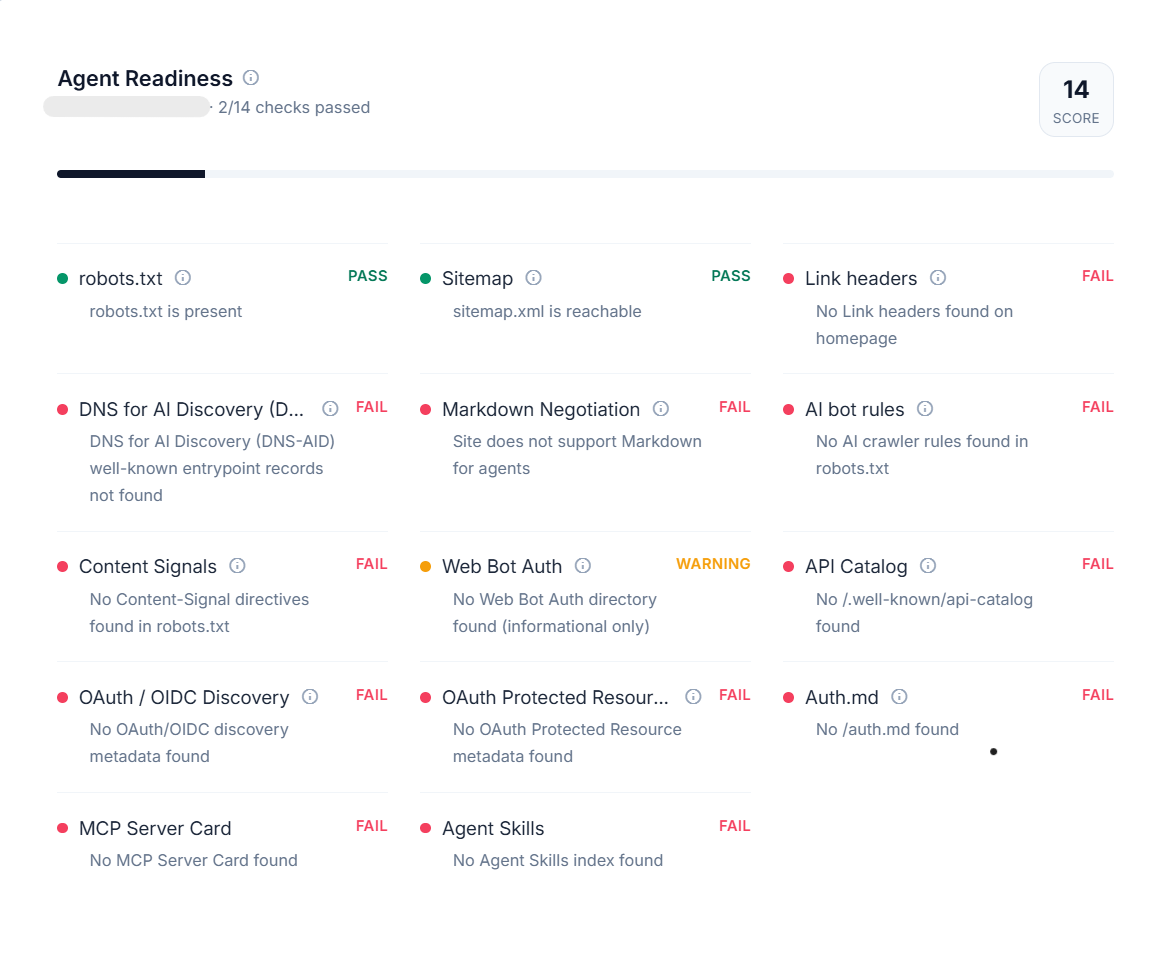
The report reviews 14 technical checks across four main areas:
- Site discovery: robots.txt, sitemap, link headers, and DNS for AI Discovery (DNS-AID)
- AI access and content use: Markdown Negotiation, AI bot rules, and Content Signals
- APIs and secure access: Web Bot Auth, API Catalog, OAuth or OpenID Connect discovery, OAuth Protected Resource metadata, and auth.md
- Agent connections and capabilities: MCP Server Card and Agent Skills
A PASS means the tool found the expected file, record, header, or endpoint. A FAIL means it could not find that signal. A WARNING identifies an informational check rather than a required change.
Your readiness score highlights areas where your website may need improvement. Some recommendations are simple content or technical updates, while others may require support from a developer or platform provider.
- Fix basic website signals: Update or add items such as your robots.txt file or sitemap if they are missing or configured incorrectly.
- Review technical recommendations carefully: Some checks, such as DNS-AID, are experimental, while others, like Web Bot Auth, are informational. Consult a developer before making changes to headers, APIs, authentication settings, or agent connection files.
- Improve customer and agent experiences: The report may identify opportunities to make product information, pricing, availability, return policies, and important pages clearer and easier to find.
- Address advanced setup issues: Recommendations involving structured data, product feeds, APIs, or platform settings may require technical assistance.
Important: A readiness score does not guarantee AI visibility, product recommendations, checkout eligibility, or completed transactions. It helps you identify where to focus first, so you can improve agentic commerce readiness in a practical, measured way.
Chris Day, Network Solutions VP of Customer Fulfillment, explains why this kind of readiness check matters, saying, “Most small businesses don’t have an AI problem—they have a data quality problem. Incomplete product information. Inconsistent pricing. Outdated inventory. Checkout friction. Those issues have always impacted customer experience and search visibility. AI simply makes them more visible.”
How should SMBs prioritize fixing these issues across the customer journey?
Day encourages businesses to think about the journey in three stages:
- Discovery: Can customers—and AI—understand who you are and what you offer?
- Evaluation: Can they easily compare pricing, availability, shipping, reviews, and policies
- Transaction: Can they complete a purchase without unnecessary friction?
“Notice that none of those priorities are unique to AI. They’re the same fundamentals that have always created better customer experiences. Agent readiness simply gives businesses another reason to get them right,” Day explains.
Review your Agent Readiness results
Treat your readiness score as a starting point, not a final judgment on your website. The recommendations should show which areas support agentic commerce readiness and which need more work.
Common gaps include unclear product data, missing availability details, hard-to-find policies, checkout friction, weak security cues, or risk signals that make it harder to complete transactions. Some fixes are content updates. Others require your developer, e-commerce platform, or technical partner to help make your site agent-ready.
What are the highest-impact changes a small business owner can make themselves (no developer needed)?
Day emphasizes that if he could only fix three, they’d be the following:
- Complete every product listing: Include detailed descriptions, specifications, pricing, availability, and high-quality images.
- Keep information current: Accurate inventory and pricing build confidence for both customers and AI systems.
- Encourage authentic customer reviews: Research consistently shows that roughly nine out of ten consumers read online reviews before making a purchase, and those same trust signals help both customers and AI assess which businesses are credible enough to recommend.
Day adds, “The encouraging part is that none of these require cutting-edge technology. They’re the same fundamentals that have always built trust, improved search visibility, and increased conversions. Agentic commerce doesn’t change those fundamentals—it simply raises the importance of getting them right.”
How to prepare your site for AI agents
After you review your readiness score, the next step is to turn those findings into a practical action plan. Agentic commerce readiness does not have to happen all at once. Start with the updates that make your website easier to understand, use, and trust.
- Improve your product data.
- Check your structured data and product feeds.
- Make checkout easier to complete.
- Make policies clear and easy to find.
- Ask your platform or developer about agent access.
- Set a practical priority timeline.
Some improvements can be handled directly in your website or e-commerce dashboard, such as updating product details, clarifying policies, and reducing checkout friction. Others may require help from a developer, platform provider, payment processor, or e-commerce partner, especially when they involve structured data, product feeds, API access, or agentic commerce protocol support.
Step 1: Improve your product data
Start with the product pages that drive the most sales, traffic, or inquiries. These pages should have clear, complete product data that helps AI agents compare your products with a shopper’s needs.
Review your product pages for details that help shoppers and AI agents understand exactly what you sell, when it is available, and whether it fits the buyer’s needs. Start with these updates:
- Review each page for accurate names, descriptions, categories, specifications, images, pricing, inventory, and availability.
- Remove vague wording that does not clearly explain the product, service, or buying requirements.
- Add missing details for product size, material, compatibility, service area, delivery timeline, or booking requirements.
- Keep product identifiers consistent across your website, product feeds, and e-commerce platform, including stock keeping units (SKUs), Global Trade Item Numbers (GTINs), and manufacturer part numbers (MPNs).
This makes your catalog more machine-readable and supports product discovery. Structured data, such as product schema, can also help search systems and AI agents understand your product pages, but setup may require a developer or platform provider.
Step 2: Check structured data and product feeds
Structured data and product feeds help AI agents and search systems understand product details without relying only on page copy. Schema.org is the common vocabulary that businesses and developers use to label information such as product names, prices, availability, and reviews.
A developer or platform provider can confirm whether your product pages use it, often through JSON-LD. Developers can also use Schema.org documentation to verify which product properties are recommended and check whether pricing, availability, review, and product information are marked up correctly.
Clear, current product feeds also support emerging commerce frameworks such as OpenAI’s Agentic Commerce Protocol (ACP) and Google’s Universal Commerce Protocol (UCP), which use structured product information to help AI systems compare items and support shopping tasks. Emerging payment protocols such as x402 are extending this shift into how agent-initiated transactions are authorized and paid for.
Google has also begun showing ‘Buy’ buttons and checkout options in search results, allowing some shoppers to complete purchases from the search page. Ask your developer, e-commerce platform, or feed provider to confirm that your catalog is accurate, current, and easy for approved systems to read.
Step 3: Make checkout easier to complete
Review your checkout for friction that can slow down both human shoppers and AI-assisted transactions. A clear checkout helps customers understand what they are paying for, what happens next, and whether the order can be completed without extra steps.
A repeat purchase shows how many systems may need to work together during a single agent-assisted transaction. Mishra gives this example, saying, “A customer asks their AI assistant to ‘reorder my usual coffee beans.’ The agent visits the store, finds the product, checks availability, applies a saved discount, and completes checkout—without the customer opening a browser. For that to work, the website needs to be structured in a way an agent can read and act on.”
Start by checking that payment options, shipping costs, taxes, delivery timelines, and return policies are visible before the final purchase step. If shoppers need to create an account, choose a delivery option, apply a discount, or confirm order details, make those steps clear. This information can also help AI agents evaluate whether transactions can move from cart creation to completion.
Smoother checkout also supports emerging shopping experiences like Google’s UCP, in which product, shipping, return, and payment details may help determine whether a purchase can be completed via connected search and checkout flows.
Keep security visible as well, especially around payment pages and customer data.
Step 4: Make policies clear and easy to find
Clear policies help human shoppers and AI agents evaluate whether your business is trustworthy before a purchase. They also reduce risk by setting expectations for transactions, delivery, and post-purchase support.
Make sure the following are in order:
- Review your shipping page, return policies, customer support details, privacy information, and security signals.
- Make delivery timelines, shipping costs, tracking details, return windows, refund terms, and contact options easy to find.
- Update thin or missing policy details so shoppers can make decisions with fewer unanswered questions.
- Keep related details in clear, logical places instead of scattering them across several pages.
- Give AI agents enough context to compare your business with other options and evaluate whether a purchase is likely to meet the shopper’s expectations.
Businesses can also signal how AI systems may use their content. For example, a site may allow AI shopping agents to read product information and support transactions while opting out of using that content for AI model training.
This is a trust and control feature, not a requirement; a developer can help review the available settings and confirm that they match your preferences.
Step 5: Ask your platform or developer about agent access
Some agentic commerce readiness work depends on how your e-commerce platform, payment provider, or developer handles system access. Ask what your current setup can share with approved tools and where technical updates may be needed:
- Site speed and page structure: Fast-loading pages help both visitors and AI agents. If your site relies heavily on JavaScript to display content, make sure that content also shows up in the page’s basic code (this is often called “server-side rendering”) so it’s easier for automated systems to read. Using servers closer to your visitors (“edge computing”) can also help pages load faster.
- Files that guide automated visitors: Your site should have a sitemap (a list of your important pages) and a robots.txt file (which tells automated systems what they can and can’t access). Check that robots.txt isn’t accidentally blocking AI agents from reaching your product or policy pages. You can also set up Content Signals, a newer addition to robots.txt that lets you specify how your content can be used, such as allowing AI agents to read it for shopping while opting out of AI training. Some businesses are also adding a file called llms.txt, a simplified, text-based summary of the site written specifically for AI systems to read.
- Login and account security: If customers have accounts, ask whether your platform supports secure sign-in methods (like OAuth) that let approved apps or AI tools access an account without needing the customer’s password.
- Traffic and security controls: Rate limits control how many requests your site accepts at once, preventing automated systems from overwhelming it. Along with security tools like web application firewalls, these should be set up to let legitimate AI agents through while still blocking bad traffic.
Why it matters: These settings work behind the scenes, but they determine whether legitimate AI agents can actually reach and read your site. A developer or platform provider can review and adjust them without much extra time or cost.
Step 6: Set a practical priority timeline
Treat agentic commerce readiness as a staged process rather than a one-time website project. Start with quick fixes that improve clarity for shoppers and AI agents, such as better product descriptions, current inventory, clear availability, visible policies, and fewer checkout steps.
Next, review the systems that support those experiences. This may include product feeds, structured data, checkout settings, security tools, and platform capabilities. Some of this work can be handled in your dashboard, while technical items may need a developer, platform provider, or e-commerce partner.
Use your readiness score to shape a simple technical roadmap. For many businesses, adopting agentic commerce starts with clearer information, then stronger checkout and trust signals, then deeper platform support.
How Network Solutions can help
Agentic commerce readiness starts with a strong website foundation. We help small businesses build and maintain the pieces that support clearer product discovery, stronger trust signals, and a better customer experience.
For starters, your website should be easy to update, easy to navigate, and clear enough for shoppers to understand quickly. Our Website Builder can help you create and manage pages that present your products, services, policies, and contact details in a more organized way. Our reliable web hosting supports site performance and reliability, which matter when visitors and AI agents need to access information without delays.
Security is another important part of readiness. SSL certificates and cWatch can help protect your online presence and give customers more confidence when they visit your site. For search visibility, our SEO Tool can help you review pages and improve your business’s visibility in search results.
Frequently asked questions
Start with an agentic commerce readiness check. Then review your product data, structured data, checkout, policies, security, and site navigation. Your website should be able to provide AI agents and shoppers clear information to evaluate your business and the products you sell.
Start with your top product or service pages. Check names, descriptions, prices, images, inventory, availability, delivery details, and return policies. Clear product data helps support product discovery and comparison.
Structured data helps search systems and AI agents understand your website. Product schema, often added through JSON-LD, can make product details more machine-readable. Ask your developer or platform provider if your site supports it.
That depends on your platform, payment setup, and support for agentic commerce protocols. You can prepare by making checkout clear, showing payment and shipping details early, and reducing steps that may block transactions.
An agentic commerce protocol is a set of technical rules that helps AI agents, merchants, platforms, and payment systems exchange shopping information. For a deeper overview, read our guide on what agentic commerce is.
Start preparing for agentic commerce today
Agentic commerce readiness is a process you can improve in stages. Start with updates that make your website easier for AI agents and human shoppers to understand: clearer product data, accurate availability information, visible policies, a smoother checkout process, and stronger security.
Use our Site Health Advisor to point you in the right direction to making your website agent-ready. Your website improvements lead to better product discovery, stronger trust signals, and a more reliable customer experience. As your needs grow, you can work with your platform, developer, or payment provider to address additional technical readiness items.
But you don’t have to prepare for agentic commerce alone. We can help you improve the website basics that matter most for both AI agents and human shoppers: clear pages, stronger security, better search visibility, and a more trusted online presence.