

Key takeaways:
- Use October to build visibility before peak holiday weeks.
- Test content, emails, and ads while you still have time to improve them.
- Let AI speed up research and drafting, then verify every fact and make the final decisions yourself.
In October, we’re roughly 60 days out from the peak holiday rush.
Shoppers are already looking for ideas, comparing options, and deciding which businesses deserve a place on their lists. In Bankrate’s 2025 Early Holiday Shopping Survey, 49% of holiday shoppers said they planned to begin before the end of October.
Waiting for November means arriving after many customers have already started.
With your digital foundation securely locked down in September, the energy of your holiday prep shifts toward getting seen. It’s the perfect window to turn up your visibility and build a list of warm leads before the Thanksgiving rush.
If you’re following our four-part holiday series, you’ve already seen the picture in our 2026 Holiday Marketing Guide and focused on your website updates in our September holiday marketing checklist.
Now, we’ll cover how to build momentum this month.
For the complete September-to-November plan in one place, be sure to download the free playbook.
Get the complete holiday roadmap
Use the 2026 Holiday Readiness Playbook for SMBs to follow the full September-to-November plan, prepare for key deadlines, and use AI without losing the judgment and personality that make your business recognizable.
Why launch holiday campaigns 60 days out?
Launching holiday campaigns about 60 days out gives your business enough time to reach shoppers before competition and ad costs intensify.
By this point, many customers are already researching gifts, comparing prices, saving products, and planning purchases. Starting early lets you:
- Build awareness before peak shopping weeks, so customers already know your brand when they’re ready to buy.
- Test your campaigns early, including ads, emails, offers, landing pages, and messaging.
- Use early performance data to improve results before Black Friday, Cyber Monday, and December shopping peaks.
- Grow remarketing audiences from people who visit your site or engage with your content but do not purchase immediately.
- Promote shipping deadlines and inventory sooner, especially for products that may sell out or require extra delivery time.
By the end of October, your core campaign should be live, your message should be consistent, and your first results should be guiding the next round of decisions.
Your October holiday marketing checklist
September was about getting your business ready for holiday shoppers. Let’s put those preparations into practice this October.
Each section below includes actions you can check off. You’ll also find AI tips throughout; use them as an assistant. Give it approved information, protect sensitive data, verify its work, and keep the final decision yours.
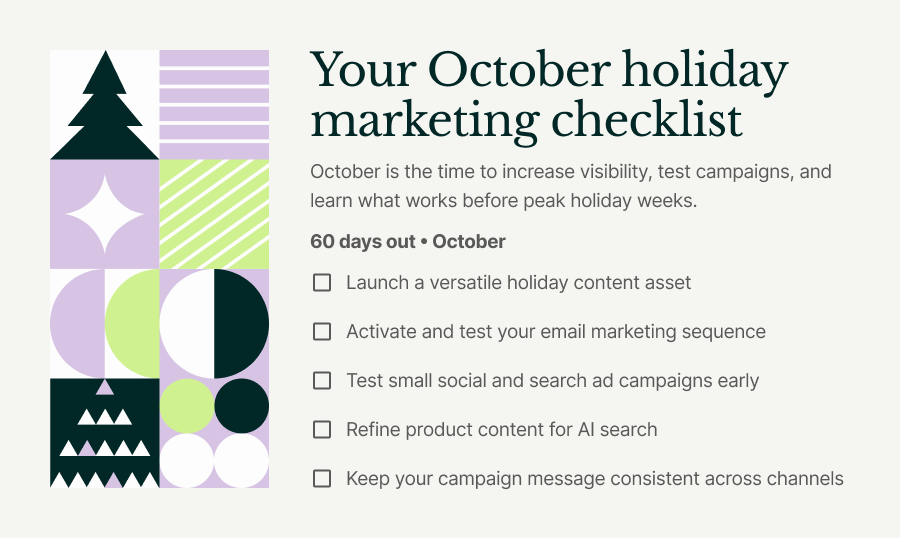
These are the five priorities this month:
- Launch a versatile holiday content asset
- Activate and test your email marketing sequence
- Test small social and search ad campaigns early
- Refine product content for AI search
- Keep your campaign message consistent across channels
1. Launch a versatile holiday content asset
Creating content for every channel can quickly become a full-time job. Instead of starting from scratch each time, build one core asset and use it across your marketing.
A holiday gift guide is a great place to start. It gives shoppers inspiration and makes decision-making easier. It also gives you content you can repurpose for weeks.
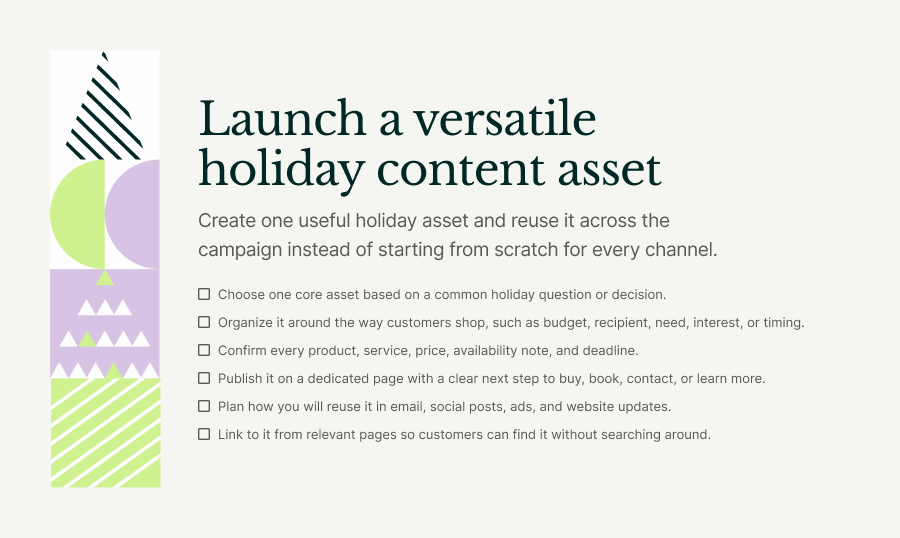
Here’s how you can create a holiday content asset:
- Choose one holiday question, problem, or decision your customers need help with.
- Organize it around the way customers shop, such as budget, recipient, need, interest, or timing.
- Confirm every product, service, price, availability note, and deadline.
- Pick a format that makes the information easy to understand.
- Publish it on a dedicated page with a clear next step to buy, book, contact, or learn more.
- Plan how you will reuse it in email, social posts, ads, and website updates.
- Link to it from relevant pages so customers can find it without searching around.
Once the outline and source information are approved, AI can help turn the core asset into more formats without forcing you to start over.
Use AI to:
- Suggest clear categories based on your approved products, services, and audience.
- Draft short descriptions using the facts you provide.
- Adapt the asset into email copy, social posts, and ad variations.
- Generate subject line and caption ideas for you to refine.
Turn one holiday idea into weeks of content
Draft your gift guide copy, email sequences, and ad variations, then compare answers from ChatGPT, Claude, Gemini, and Grok. Get four AI tools in one place.

2. Activate and test your email marketing sequence
October provides a quiet window to warm up your subscriber list before consumer inboxes become completely overwhelmed in November. A short sequence can introduce your holiday content, explain your offer, and remind customers about important dates.
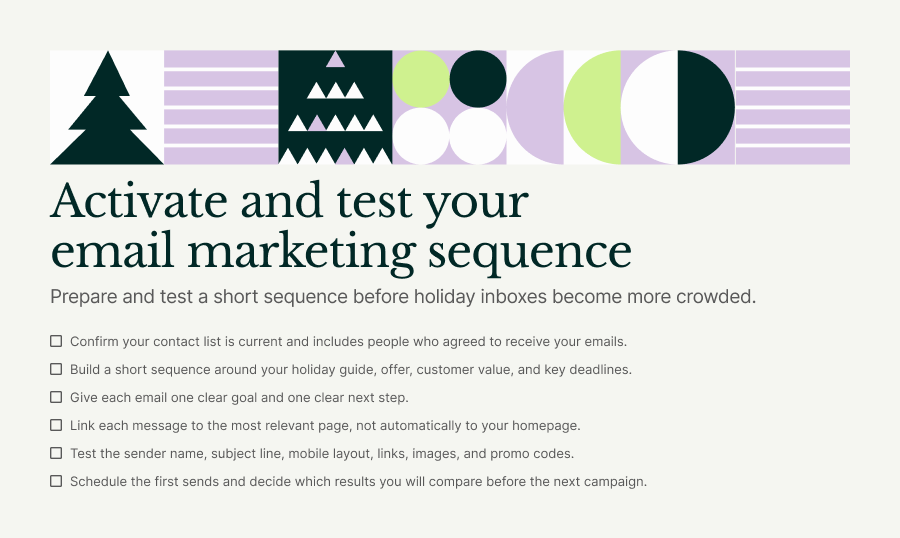
Here’s a list you can check off:
☐ Confirm your contact list is current and includes people who agreed to receive your emails.
☐ Build a short sequence around your holiday guide, offer, customer value, and key deadlines.
☐ Give each email one clear goal and one clear next step.
☐ Link each message to the most relevant page, not automatically to your homepage.
☐ Test the sender name, subject line, mobile layout, links, images, and promo codes.
☐ Schedule the first sends and decide which results you will compare before the next campaign.
After you set the audience, offer details, and goal for each email, use AI to speed up drafting and testing. Review every message for accuracy, tone, and a natural reason to click before sending it.
Use AI to:
- Brainstorm subject line and preview text variations.
- Shorten long paragraphs for easier mobile reading.
- Suggest alternative calls to action for testing.
- Create versions for approved customer segments using the information you provide.
Important: Never upload customer personal information to an unapproved AI service.
3. Test small social and search ad campaigns early
Running small ad tests now reveals which words and images attract your customers. If you figure this out early, you can avoid wasting money when peak competition drives advertising costs up next month.
If you want expert support with keyword research, campaign setup, and ongoing adjustments, explore our pay-per-click advertising services.
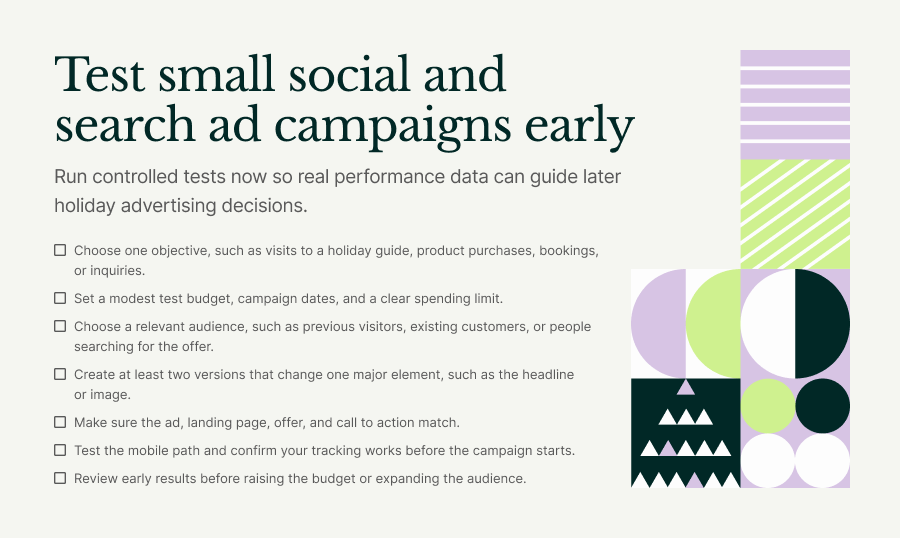
Follow this checklist:
☐ Choose one objective, such as visits to a holiday guide, product purchases, bookings, or inquiries.
☐ Set a modest test budget, campaign dates, and a clear spending limit.
☐ Choose a relevant audience, such as previous visitors, existing customers, or people searching for the offer.
☐ Create at least two versions that change one major element, such as the headline or image.
☐ Make sure the ad, landing page, offer, and call to action match.
☐ Test the mobile path and confirm your tracking works before the campaign starts.
☐ Review early results before raising the budget or expanding the audience.
Once the campaigns have enough real activity to review, AI can help you organize the results and prepare the next test.
Use AI to:
- Draft headline and ad copy variations from your approved offer.
- Summarize click and engagement data you have removed personal information from.
- Identify patterns across your stronger and weaker ads.
- Suggest one variable to test next.
Again, remember to check every suggestion against your actual budget, audience, offer, and capacity. Keep spending decisions and campaign changes under human control.
Learn more through our guide on how to advertise with Google.
4. Refine product content for AI search
Search, social media, reviews, and business websites still shape holiday discovery. AI is becoming another path. Basis found that 17% of consumers planned to use AI for 2026 holiday shopping or planning, while another 23% were unsure. Adoption is still developing, which makes clear information useful across both traditional and AI-assisted discovery.
Generic descriptions give shoppers little reason to choose you and give AI systems little specific information to use. Update your most important pages with the details people need to compare options confidently.
Here’s what else you need to do:
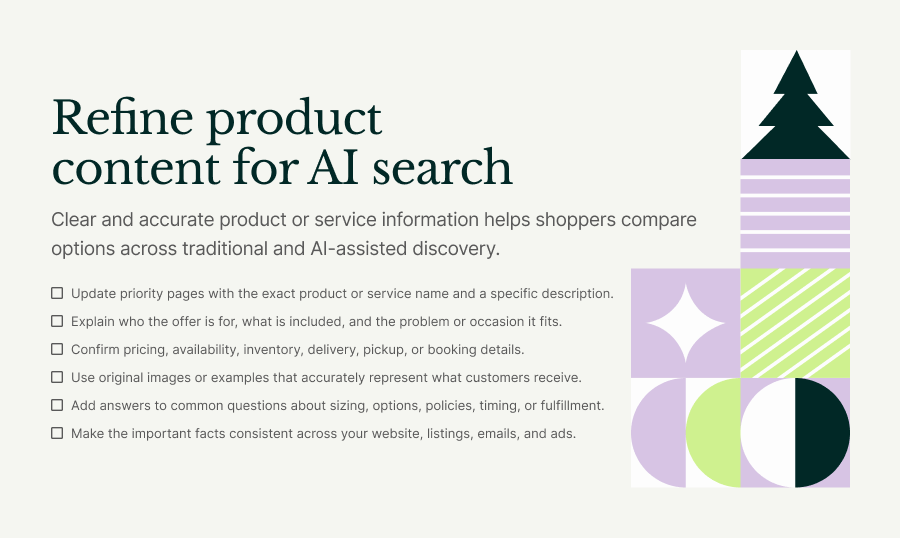
☐ Update priority pages with the exact product or service name and a specific description.
☐ Explain who the offer is for, what is included, and the problem or occasion it fits.
☐ Confirm pricing, availability, inventory, delivery, pickup, or booking details.
☐ Use original images or examples that accurately represent what customers receive.
☐ Add answers to common questions about sizing, options, policies, timing, or fulfillment.
☐ Make the important facts consistent across your website, listings, emails, and ads.
After you gather the approved facts and real customer questions, use AI to review the page for gaps and unclear language. Before publishing, verify every specification, claim, price, policy, and fulfillment detail. Delete any AI suggestion that assumes a fact your business has not confirmed.
Use AI to:
- Flag vague descriptions and missing decision-making details.
- Suggest questions a holiday shopper may ask.
- Draft FAQ ideas using only the information you provide.
- Suggest valid use cases or audience needs for you to confirm.
5. Keep your campaign message consistent across channels
Most holiday purchases don’t happen after a single interaction. Shoppers rarely buy the very first time they see a product online.
But seeing consistent brand messaging across your website, emails, and social media platforms builds the familiarity required to earn their trust. They might discover your business on social media, revisit it through email, and return later through search. Consistent messaging helps connect those touchpoints.
Choose one core October message, then adjust its length and format for each channel without changing the offer. Our Social App can help you schedule and monitor posts across major social platforms, while the Marketing Calendar helps keep the campaign plan in view.
Follow and check these off:
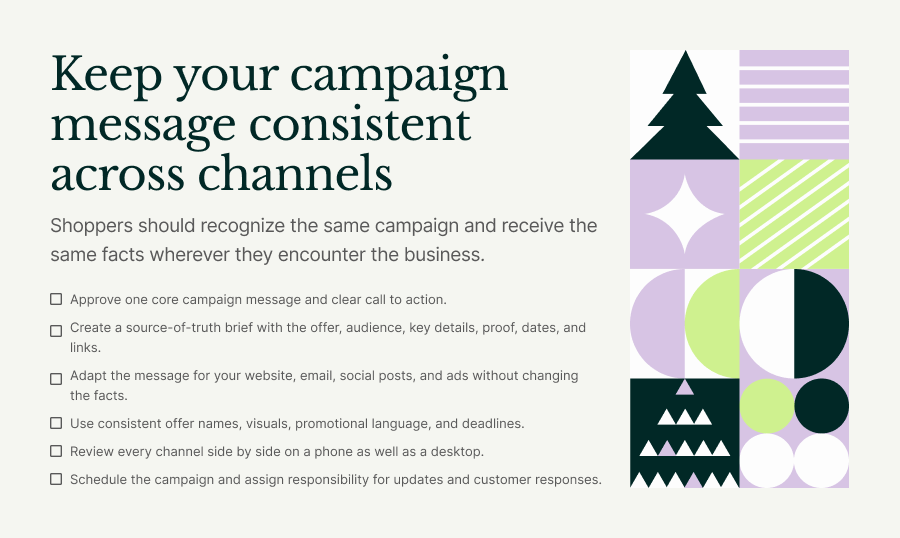
☐ Approve one core campaign message and clear call to action.
☐ Create a source-of-truth brief with the offer, audience, key details, proof, dates, and links.
☐ Adapt the message for your website, email, social posts, and ads without changing the facts.
☐ Use consistent offer names, visuals, promotional language, and deadlines.
☐ Review every channel side by side on a phone as well as a desktop.
☐ Schedule the campaign and assign responsibility for updates and customer responses.
Once the core message and campaign brief are approved, use AI to adapt the material without redefining the campaign. Review the channels side by side before anything goes live. Customers should recognize the same campaign everywhere they encounter it.
Use AI to:
- Shorten the core message for different character limits.
- Create channel-specific versions while keeping the same offer and facts.
- Suggest calls to action that fit each destination.
- Compare drafts and flag inconsistent names, dates, prices, or promises.
Bring your October campaign together
Build and update your holiday pages easily with our AI Website Builder.

What should you do after October?
By the end of the month, you should have stronger visibility, clearer messaging, and real data from your campaigns. You’ll also have a much better understanding of what content, offers, and channels are earning attention.
November is where those insights turn into action. To help you move through the remaining stages of your holiday plan:
- September Holiday Marketing Checklist: Build the foundation that supports everything else.
- November Holiday Marketing Checklist: Execute your promotions, communicate deadlines, and capture holiday demand during the busiest weeks of the season.
- 2026 Holiday Marketing: Read this for context on what changed in consumer behavior this year.
For the complete September-to-November roadmap, download the 2026 Holiday Readiness Playbook for SMBs.
Frequently asked questions
Create content around how people shop during the holidays. Showcase gift ideas, customer favorites, bundles, seasonal offers, and deadlines. Keep your message consistent and include a clear next step.
Start at least 90 days before the holiday rush. September is ideal for building your foundation, October for increasing visibility, and November for executing your campaigns.
Make your business easy to find, understand, trust, and choose. Use a mix of content, email marketing, reviews, local listings, social media, and timely offers to stay visible throughout the customer journey.
Provide clear product information, accurate inventory, shipping deadlines, pricing, reviews, and simple checkout options. The fewer questions shoppers have, the easier it is for them to buy.
Focus on gift guides, product highlights, customer testimonials, holiday tips, limited-time offers, behind-the-scenes content, and important shopping deadlines.
Waiting until November to start. Businesses that prepare early have more time to build visibility, test campaigns, and fix problems before holiday demand peaks.
Stand out and make it simple for shoppers to choose you early
Your goal is to help more shoppers discover your business before the holiday rush peaks. By creating a strong content asset, testing your emails and ads, improving product content, and keeping your messaging consistent across channels, you make it easier for customers to find you, remember you, and choose you later.
The goal is to be clear, visible, and recognizable wherever your customers are already looking. For the complete September-to-November roadmap, download the 2026 Holiday Readiness Playbook for SMBs.
Then continue with the November Holiday Marketing Checklist, where you’ll turn October’s insights into action and focus on converting holiday demand into sales.