


Key takeaways:
- AI is becoming a significant part of holiday shopping and comparison, but search, social, reviews, and stores still matter just as much.
- Shoppers are starting earlier and moving across more channels before they buy, so prepare more paths instead of replacing the ones that already work.
- To win this season, you should make it easy for AI shopping agents and human shoppers to find you, understand your offer, and trust your business.
Every year, the holiday shopping season seems to arrive a little faster. In 2026, the playbook has officially changed, and the holiday shopping sleigh ride has a new route.
And it’s getting smarter, too! AI is now part of how shoppers discover, compare, and decide. But while shoppers move between traditional search, AI tools, social media, reviews, local listings, email, and physical stores, their questions remain the same:
- “Is this for me?”
- “Is it worth the money?”
- “Can I trust this business?”
- “What should I do next?”
All that sounds a lot of ground to cover for a busy small business owner. So, we created the 2026 Holiday Readiness Playbook for SMBs, featuring practical holiday-prep guidance from Alicia Pringle, Senior Director of Online Marketing of Network Solutions to guide you.
As a preview, let’s cover what has changed in 2026, and how your business can adapt to capture more holiday sales.
Build your 2026 holiday plan
Download the 2026 Holiday Readiness Playbook for practical guidance on using AI without losing your brand voice.
What is different about holiday marketing in 2026?
Holiday shoppers still want the same things: the right gift, a fair price, and confidence in their purchase. What has changed is how they reached that decision.
In 2026, three shifts are reshaping the holiday shopping journey:
AI is taking a more active role in product discovery
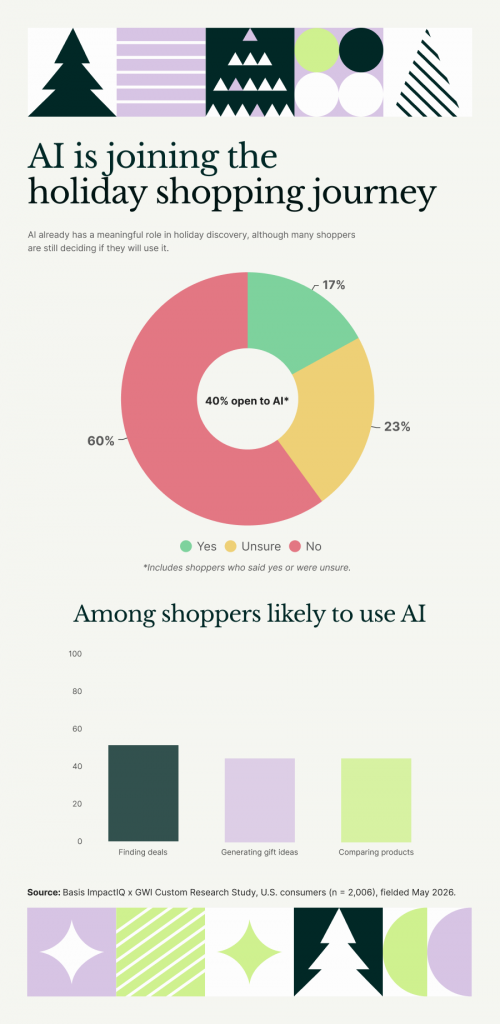
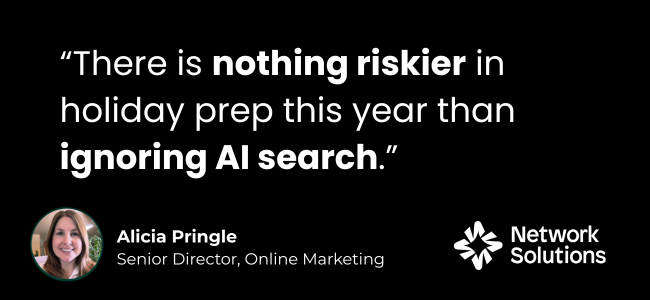
Basis found 17% of consumers plan to use AI tools like ChatGPT for holiday shopping this year, with another 23% still deciding, and nearly 40% open to it as habits keep forming. “There is nothing riskier in holiday prep this year than ignoring AI search,” advises Pringle. Keeping your business information accurate wherever it appears is now part of showing up in AI results, too.
Customers are researching earlier across multiple channels
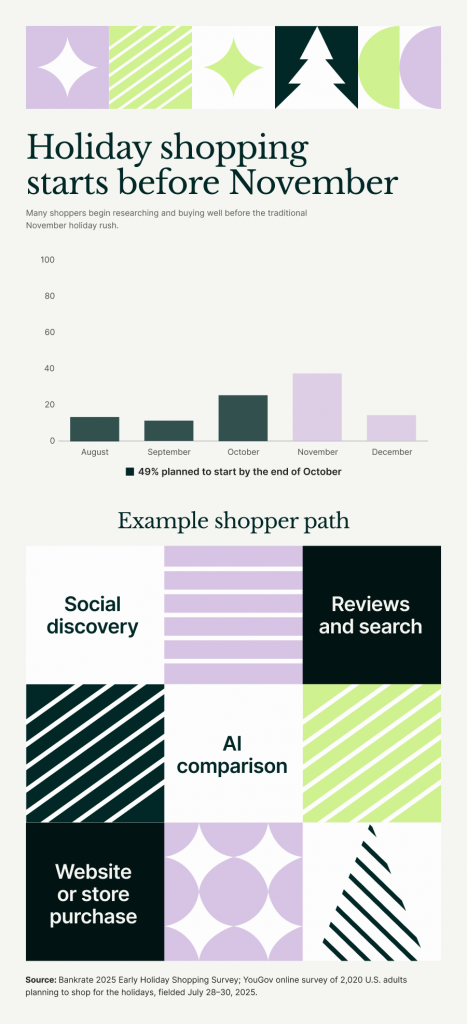
“Holidays start in September now,” Pringle reminds. Nearly half of shoppers planned to start before November last year, including 11% who planned to start in September, according to Bankrate. Many also discover a business in one place but buy somewhere else.
Budget-conscious shoppers want clearer value and stronger proof before they buy
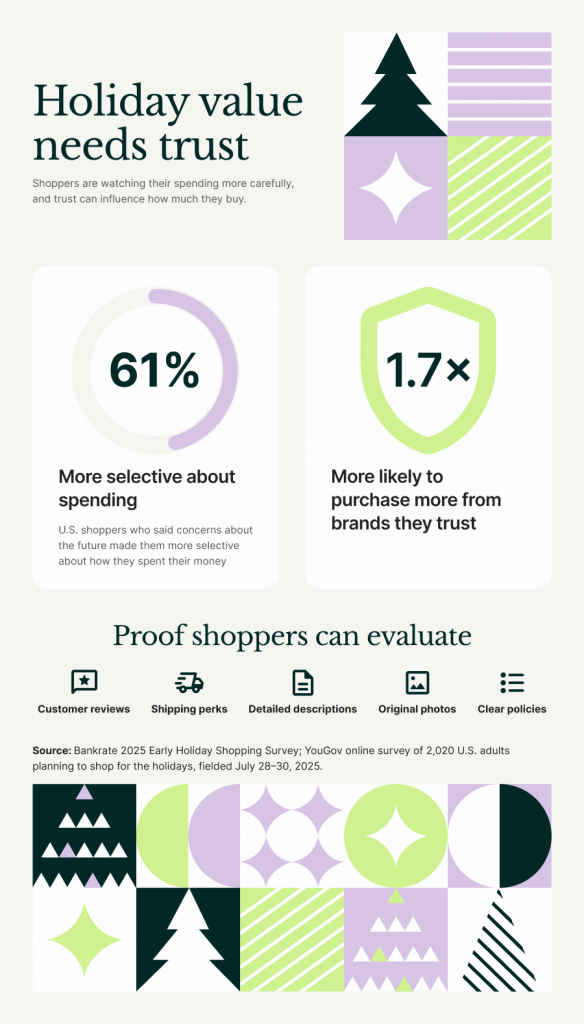
Google found that 61% of U.S. shoppers have gotten more selective about spending. Reviews, real photos, and clear policies now do a lot of the convincing that price alone used to do, and shoppers are 1.7 times more likely to buy from brands they trust.
5 ways to win more holiday customers
Before the first snowflake starts falling, the holiday shopping rush is already in motion. Customers are starting earlier, moving across more channels, and looking for clearer value before they buy. You don’t want to get left behind.
- Make it easy to find you: Keep your hours, pricing, and offers accurate everywhere your business shows up. Google found 64% of U.S. holiday shoppers blended searching, scrolling, streaming, and shopping last season — any gap between those touchpoints can cost you a sale.
- Make your offer and value easy to understand: Clearly state what your offer includes, who it is for, how much it costs, and how to buy or book, so your customer doesn’t have to ask. Value for money doesn’t always have to be steep discounts.
- Give people a reason to trust you: Reviews, real photos, shipping cutoff dates, lead times and cancellation policies go a long way to build trust with first-time buyers. BrightLocal found 74% of consumers check at least two review platforms before choosing a local business, and nearly 9 in 10 would consider one that responds to every review.
- Start early and stay visible: Build your foundation in September, visibility in October, and execute in November. As Pringle puts it, “One strong, very specific piece of content will outperform 10 generic ones almost every time.” Spoiler: Maybe you’d want to create a “gift guide” for your customers.
- Use AI for speed, then make the work human: Use generative AI to help with drafting, editing, repurposing, and research, as a recent study suggested. Just make sure the final version still sounds like you: “Certainly use AI for speed, use it for some topic inspiration, planning your marketing calendar, but don’t let it flatten your voice. The brands that people remember are the ones that still feel unmistakably human,” Pringle reminds.
Watch the full conversation behind our 2026 Holiday Readiness Playbook below.
Turn these ideas into a simple holiday plan
Focus your time and effort where they matter most to make your business easier for AI and shoppers to find, understand, trust, and choose.
Holiday readiness happens in stages, and knowing the trends is only the beginning. For specific steps on what to do next:
- 90-Day September foundation checklist: Strengthen your website, listings, offers, and other digital foundations before shoppers start looking.
- 60-Day October visibility checklist: Build awareness and help more shoppers discover your business across the channels they already use.
- 30-Day November execution checklist: Launch your promotions, respond to demand, and turn holiday interest into sales.
Make it easy to choose your business this holiday season
“If someone finds you, they should never have to guess what to do or how to buy from you,” emphasized Pringle as an important advice on the playbook.
Holiday shopping in 2026 starts earlier, moves across more channels, and increasingly includes AI-assisted discovery. Your strategy should keep pace: understand your customer, publish clear offer information, show value and proof, use AI carefully to save time, and prepare early.
The playbook walks through each of these in detail, with a month-by-month checklist so you know exactly what to do and when.
Take the guesswork out of your holiday preparation. Download the 2026 Holiday Readiness Playbook for SMBs and begin with the September plan.