

Key takeaways:
- Your website is an online asset you own, giving you complete control over your content, customer experience, and brand presence.
- Social media helps people discover your business, engage with your brand, and stay connected through ongoing conversations.
- The most effective strategy is to use both: social media drives awareness and traffic, while your website turns that interest into leads, sales, and long-term business growth.
Website vs. social media: which should small businesses prioritize? A website can give customers a reliable place to learn about your business, while social media platforms can help you connect with new audiences. Both can strengthen your online presence, but they give your business different levels of control over how you market your brand and reach customers online.
A professional website gives you an online space you own and control, while social media platforms place your business on rented space shaped by algorithms and platform restrictions. Understanding this difference, along with other strengths and limitations of each channel, can help you decide where to invest first and how to use both together for business success.
Let’s explore what sets a website and social media apart and how they can work together to support your business.
Find the perfect domain
Ready to register a domain name? Check domain availability and get started with Network Solutions today.
What is a website?
A website is an online space you own where you can share business information, showcase products or services, and provide customers ways to engage with your brand. When you have your own website, you have complete control over its content and how you present your brand online. It can also capture leads around the clock and help people find your business when they search for relevant products or services.
What is social media?
Social media, unlike a website, is built around ongoing interaction. Social media platforms give businesses a place to share updates, join conversations, and connect with potential customers through posts, comments, and messages. A social media presence can also help you express your brand identity in a way that best resonates with your target audience.
For small businesses, these platforms support community building by making it easier to respond to customers and focus on building relationships around the brand.
What’s the difference between a website and social media?
The key differences between website and social media come down to ownership, control, and purpose. A website is an asset your business owns, while a social media platform is rented space governed by another company’s rules. The table below shows how each supports your online presence.
Characteristic | Website | Social media |
|---|---|---|
Ownership | An owned business asset that remains under your control | Rented space owned and managed by the platform provider |
Purpose | Acts as a central hub for information, leads, bookings, and sales | Focuses on audience reach, engagement, and real-time interaction |
Customization | Offers broad control over the user interface (UI) and user experience (UX) | Limits customization to the tools provided by the platform |
Conversions | Supports focused conversion paths through different website elements, such as landing pages and forms | Supports conversions through paid ads, promotional posts, and links to external e-commerce pages |
Control | Gives you full control over your content, design, and collected customer data | Subjects your content and activity to platform rules and restrictions |
Credibility | Provides a dedicated, professional source of information about your business | Builds trust through user sentiment and genuine interactions with your audience |
Visibility | Visitors can access your pages directly, although their visibility in search results still depends on SEO | Reach can change due to algorithm and platform changes as well as social media trends |
Why does your business need a website?
Your business needs a website because it provides customers with a reliable place to learn about your offerings and build trust in your brand. When comparing a business website to social media, a website provides a more stable foundation for long-term growth that is not dependent on any single platform.
Beyond providing stability and brand trust, a website offers several advantages that support business growth:
- Control: You have complete control over your content, design, features, and customer journey. Instead of working within platform limitations, you can tailor every page to your business goals and audience needs.
- Credibility: A professional website helps strengthen your brand’s credibility by providing customers with a trusted source of information. A Verisign survey found that 84% of U.S. consumers viewed a business with a website as more credible than one with only a social media page.
- Direct lead generation: Contact forms, appointment booking tools, newsletter sign-ups, and checkout pages make it easy for visitors to become leads or customers.
- Discoverability: Search-optimized pages can appear in search engine results when people look for products, services, or information related to your business. Using SEO tools can help you identify opportunities to improve your visibility and attract more organic traffic. Publishing valuable content can also help attract organic traffic over time.
- Long-term growth: As your business evolves, your website can grow with it through additional pages, products, services, and features. Over time, it becomes a valuable business asset that continues to support your growth.
Ultimately, a website is more than a marketing channel; it’s a business asset you own and control. As Chris Day, VP of Customer Fulfillment at Network Solutions, puts it:
“Your website is the digital expression of your brand—an extension of your domain and often your first impression.”
Build a website that’s truly yours.
Your website is more than an online presence—it’s a business asset you control. Create one that showcases your brand, attracts customers, and drives sales.
Why does your business need social media?
Your business needs social media to reach new audiences, stay visible, and communicate with customers in real time. A strong social media presence helps build community while creating more opportunities for your brand to stay part of everyday conversations.
Social media can support business growth in several important ways:
- Engagement: Social media platforms make it easy to respond to comments, answer questions, and join conversations in real time. This two-way interaction helps strengthen relationships and makes customers feel more connected to your business.
- Brand awareness: Social media excels at introducing your brand to people who may not discover it through search engines. Consistent posts, short-form videos, and audience engagement can reinforce your brand identity and keep your business top of mind.
- Cost-effective marketing: Organic posts allow you to share content and reach your audience without significant advertising costs. Even small businesses can maintain an active presence and promote their brand without a large marketing budget.
- Real-time analytics: Built-in analytics tools provide insights into how people interact with your posts and campaigns. Metrics such as reach, clicks, and engagement can help you identify what resonates with your audience and refine your strategy over time.
How to integrate social media and your website for maximum impact
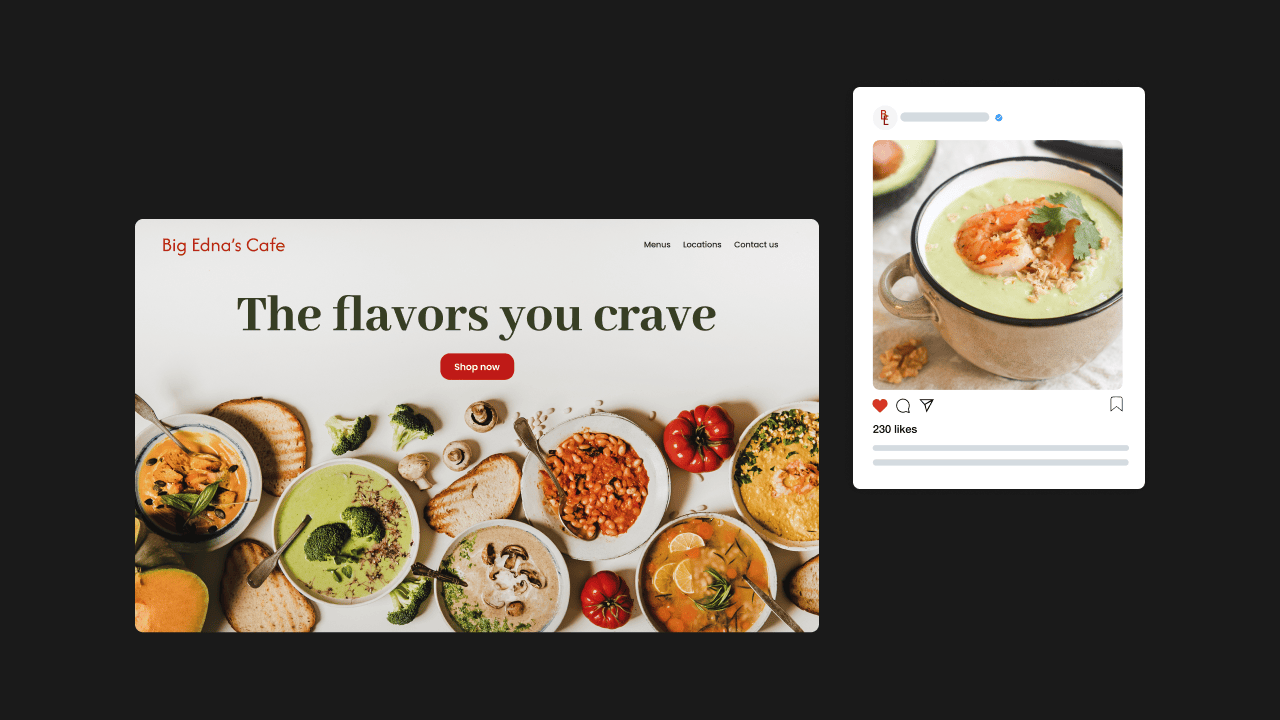
Your website and social media are most effective when they work together with distinct roles. Social media helps people discover your brand and engage with your content, while your website provides a destination where visitors can learn more and take meaningful actions. Together, they create a seamless journey from discovery to conversion.
To maximize the impact of both channels, follow these strategies:
- Align your branding across platforms
- Use social media to drive traffic to your website
- Leverage website content for social media engagement
- Add social media sharing buttons to your website
- Track cross-platform analytics
Align your branding across platforms
Brand consistency helps your website and social media profiles feel like cohesive parts of the same business. Use the same logo, color palette, tone of voice, and key messaging across every channel so customers can instantly recognize your brand. A consistent experience makes it easier for people to move between your website and social platforms without confusion, creating a stronger and more professional online presence.
Use social media to drive traffic to your website
Social media can help guide potential customers to your website, where they can learn more about your business and take meaningful action. Share snippets of blog posts, product updates, promotions, or other valuable content, then include a clear call to action such as “Learn more,” “Shop now,” or “Read the full article.” Keep your profile links up to date so they direct visitors to the most relevant page.
You can increase traffic, generate leads, and create more conversion opportunities by using social media as a gateway to your website.
Leverage website content for social media engagement
Your website can be a valuable source of content for your social media channels. Repurpose long-form web resources into bits of engaging social posts, then link back to your website for the full details. This approach helps extend the reach of your main content while giving people a clear path to learn more. More social engagement can bring more visitors to your website, where they can become leads or customers.
Add social media sharing buttons to your website
Add social media sharing buttons to key pages and content across your website. This makes it easy for visitors to share your content with their own networks, helping you reach a wider audience with minimal effort. Every share can increase your reach and visibility, drive additional traffic to your website, and introduce your business to potential customers who may not have discovered it otherwise.
Track cross-platform analytics
Use analytics tools to understand how people interact with your brand across social media and your website. Start by setting up Google Analytics to monitor website traffic, visitor behavior, and conversions. Then, review the analytics tools available on each social media platform to measure reach, clicks, and engagement. By comparing this data, you can identify which platforms drive the most traffic, which content performs best, and which channels contribute most to your business goals.
Network Solutions’ Social App can also make it easier to create, schedule, track, and manage content from one place, helping your business stay active and consistent online. You can get it free when you register a domain with us.
Frequently asked questions
Yes. Social media helps people discover your business, but a dedicated website gives customers a reliable place to learn about your products or services. It also provides complete control over your content, branding, and customer experience while helping build credibility and trust.
No. Social media is best viewed as a channel you rent, while your website is a digital asset you own. Social platforms are valuable for engagement and visibility, but platform rules, algorithms, and features can change at any time. A website gives you complete control and a dedicated space to generate leads, drive sales, and support long-term business growth.
A successful business strategy uses both. Your website should serve as the foundation of your online presence because it supports lead generation, driving conversions, and building credibility. Social media can then help attract new audiences, engage customers, and drive traffic back to your website. Working together, these channels create a more effective path from awareness to action.
Take control of your online presence with a custom website
Your social media profiles can help people discover your business, but your website is where you can turn that interest into meaningful results. Whether you’re showcasing your services, generating leads, or launching an online store, a professional website gives you a place to grow your brand and support long-term business growth.
Ready to take control of your online presence? Our AI Website Builder makes it easy to build a professional website, promote your services, and grow online—no coding required.
But building a website is only part of the equation. To help you strengthen your presence across channels, every Network Solutions domain purchase also includes built-in tools like Link in Bio, Social App, Marketing Calendar, Customers App, and a customizable Coming Soon Page. Together, these tools help you connect your website and social media presence, stay visible, and create more opportunities for customers to engage with your business.
Build your website with us and create a stronger foundation for what’s next.
Claim your perfect domain name today.
Secure your online identity and get access to tools that help you connect your website, social media, and marketing efforts.