

Key takeaways:
- A second-level domain is the customizable part of a web address that appears immediately before the domain extension.
- A second-level domain differs from a top-level domain, which comes after it, and a subdomain, which appears before it.
- A clear, memorable SLD helps people recognize your website and supports a consistent online identity.
Your web address not only leads people to your website, but it also helps shape how they remember you. Its middle part can represent a business, project, or personal brand, so understanding how a domain is built matters before you register or manage one.
Relevant terms such as second-level domain (SLD), top-level domain (TLD), and subdomain may sound technical at first, but the domain name structure is easier to follow than it seems. Let’s break down each part, compare how they work, and show what to consider when choosing your online identity.
Put your idea on the map
Your second-level domain is the name people remember.
Search for an available domain name that fits your business, project, or personal brand.

What is a second-level domain?
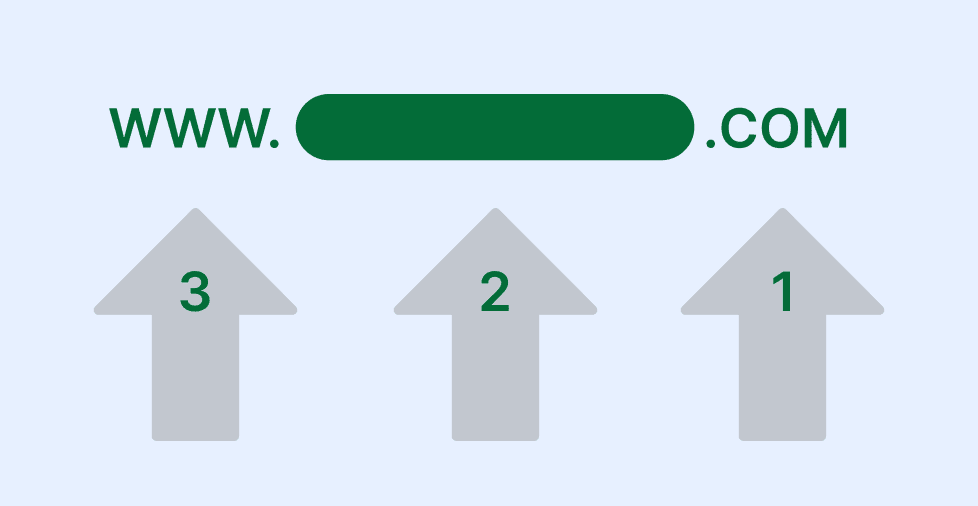
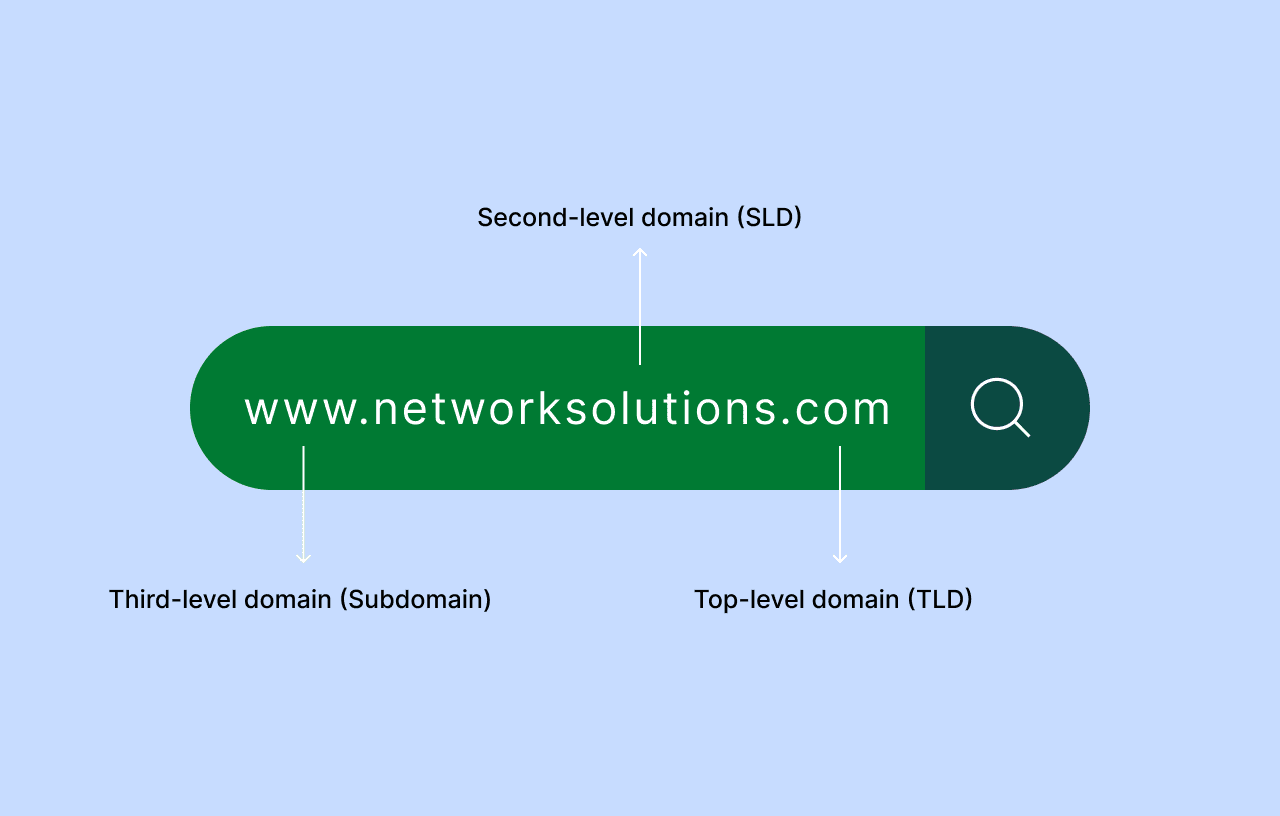
A second-level domain (SLD) is the customizable part of a domain name immediately to the left of the top-level domain. For example, in networksolutions.com, “networksolutions” is the SLD, while .com is the top-level domain (TLD), also called a domain extension.
The SLD is often the name people remember because it can reflect a company, brand, organization, project, or personal website. It gives a web address its distinct identity within the Domain Name System. The DNS translates human-readable domain names into IP addresses that help devices locate the website’s servers.
A second-level domain is only one part of a complete domain name, not the entire URL. A full URL may also include a protocol, subdomain, path, or page name; country-code structures work differently. For example, in example.co.uk, .co.uk is the public domain ending, while “example” is the registrable name.
Technical note: In most domains, such as example.com, the SLD is the registrable name directly before the TLD. However, some country-code systems use structures such as example.co.uk, where .co.uk functions as a public suffix. In these cases, example is the registrable name even though it is not technically the second-level label in the DNS hierarchy. Instead, in these cases, example functions as a third-level domain.
How do I find the SLD in a URL?
To locate the SLD in a URL, start at the far right of the domain name and identify the domain extension, or top-level domain (TLD). The second-level domain is usually the name immediately to its left. In https://blog.example.com/resources, .com is the TLD, and example is the SLD.
The https:// protocol, blog subdomain, www, folders, and page paths are separate parts of the web address, so they are not part of the SLD.
A subdomain is often called a third-level domain when it appears directly before the registrable domain, although deeper levels are also possible. When reading a URL in your browser, remember that country-code structures need an extra check: in example.co.uk, .co.uk is the combined public suffix, while example is the registrable name.
How is a second-level domain different from a top-level domain and a subdomain?
A domain name follows a hierarchy. The second-level domain is the recognizable name, while the top-level domain and subdomain sit on either side of it and serve different purposes.
Top-level domain
The top-level domain (TLD) comes after the second-level domain and forms the final part of a web address. It often signals a website’s general category or intended use. For example, .gov is used by eligible government entities, while .edu is restricted to accredited U.S. postsecondary institutions.
Common generic top-level domains include .com, .org, and .net. A TLD can shape visitor expectations and trust, but the domain extension alone does not determine search rankings.
Subdomain
A subdomain comes before the second-level domain and is also called a third-level domain. In blog.example.com, “blog” is the subdomain, “example” is the SLD, and .com is the TLD. Subdomains help organize a website into separate areas, such as an online store, blog, or support section.
They can also separate services or content while keeping everything under the same domain name and brand, which makes the site’s structure easier for visitors to understand.
Domain part | Position | Purpose | Example |
|---|---|---|---|
Subdomain | Before the SLD | Organizes a website into sections | blog |
Second-level domain | Before the TLD | Identifies the website or brand | example |
Top-level domain | At the far right | Indicates the domain extension | .com |
Role of second-level domains
An SLD offers various benefits and functions for your website and brand. These include:
- Brand recognition
- Credibility and trust
- Consistency
- Memorability
- SEO considerations
It’s important to understand how an SLD adds value to your online presence so you can use it more efficiently. Let’s go over each advantage and purpose:
Brand recognition
Your SLD is the part of your domain name that people are most likely to remember. It acts as your website’s name online. A strong, relevant SLD reinforces your brand identity, helping users recognize your business and connect the domain with your products, services, or content.
Credibility and trust
On the internet, reputation is everything. Your SLD can add to, or take away from, your website’s credibility. A clear, professional, and recognizable name can reassure visitors that they have reached a legitimate business or organization.
Earn your customers’ trust with a well-thought-out SLD. Avoid complicated spellings, excessive hyphens, or unrelated words that may make users question the website’s ownership or authenticity.
Consistency
You can use your SLD across various platforms, such as:
- Social media
- Marketing materials
You can efficiently tie all your online assets together with a consistent SLD. Plus, customers will have an easier time finding you, with the same brand SLDs.
Nicole Cassis, Network Solutions SVP of Content and Communications, even recommends securing matching social handles soon after registering a domain. By doing so, it “protects the brand you’re building, keeps your identity consistent and helps customers find you more easily.”
Memorability
A good SLD is easy to remember and share, making it more likely that visitors will return. Having a simple and catchy domain name encourages word-of-mouth promotion of your site. This helps drive traffic and keeps people coming back to your website.
SEO considerations
The words in your domain name are not considered a major direct ranking factor, but a clear, recognizable domain can improve branding, user trust, and click-through rates. Choose a name that reflects your identity rather than filling it with keywords solely for search engine optimization (SEO).
A clear and recognizable SLD may encourage more clicks from users who recognize or trust the brand. However, keep in mind that modern SEO favors memorable domains over keyword stuffing, so balance is key.
Frequently asked questions
In networksolutions.com, “networksolutions” is the second-level domain, and .com is the top-level domain (TLD). Together, they form the core domain name people enter in a browser to reach the website.
A second-level domain is the registered name directly before the TLD, while a subdomain, also called a third-level domain, appears before it. In blog.example.com, “example” is the SLD, and “blog” is the subdomain.
A country-code second-level domain appears within some country-based naming systems. In example.co.uk, “example” is the registrable name, and .co.uk is the public suffix. Registration rules, including whether direct registrations are permitted, depend on the country-code registry.
You cannot edit the registered second-level domain itself. You must register a new domain, migrate the website, update links and email addresses, and redirect traffic from the old URL. Keeping the old domain supports traffic and user familiarity.
Most website owners can register a second-level domain, but only if the desired name is available and the registry permits it. Some domain extensions have eligibility or usage restrictions, so registration depends on the chosen TLD and registrar rules.
Build your online identity with the right domain
Your second-level domain is the distinctive part of your domain name that people connect with your website or brand. A clear, memorable choice helps keep your online identity consistent.
Need ideas? Try our AI Domain Name Generator. Search for your domain, secure your digital identity, and start building an online presence that helps you break through.