



Key takeaways:
- Voice search is changing how businesses get discovered as more customers rely on spoken searches to find products, services, and local solutions.
- Local SEO plays a major role in voice search, helping businesses capture high-intent users who are ready to take action.
- Strong visibility now depends on how well your content answers real user questions clearly and quickly.
Voice search is changing how people find information online. Instead of typing short queries, users now ask full questions through devices powered by Google Assistant, Siri, and Alexa. In fact, research shows that around 7 in 10 internet users would rather use voice search than type their queries, highlighting how quickly this behavior has become part of everyday life.
This shift is driven by smarter AI and the growing use of voice-enabled devices, such as smartphones, smart speakers, and even cars. As these technologies improve, voice search trends suggest that voice search queries are becoming more conversational, more local, and more immediate.
For small businesses, this change isn’t something to watch from the sidelines. When customers ask for nearby services, product recommendations, or quick solutions, search engines often deliver just one or two spoken results. If your business isn’t optimized for voice search, you risk losing visibility to competitors who are.
To help you stay competitive, this guide explains what voice search SEO is, how it differs from traditional SEO, and the practical steps you can take to optimize your website for voice-driven queries.
What is voice search?
Voice search is a technology that allows users to search the internet by speaking instead of typing. It uses speech recognition and artificial intelligence to understand spoken queries and deliver relevant results in real time.
Today, voice search is built into everyday devices, making it easier for users to find information and get answers hands-free.
The role of voice assistants in voice searches
Voice assistants like Google Assistant, Siri, and Alexa act as the bridge between users and search engines. When someone speaks a query, these assistants process the request, interpret the intent, and pull the most relevant answer from available sources.
Voice searches can happen across multiple devices, including:
- Smartphones
- Smart speakers
- Cars and in-car systems
- Wearables like smartwatches
Each assistant may pull information differently depending on its ecosystem. Here’s a simple comparison:
Voice assistant | Common data sources |
|---|---|
Google Assistant | Google Search results, featured snippets, local listings |
Siri | Google (web results), Apple Maps, selected partners |
Alexa | Bing search results, Amazon ecosystem, third-party integrations |
Understanding how these assistants retrieve information helps businesses structure content to increase their chances of being selected as the spoken answer.
Difference between voice search and typed search
The main difference between voice search and typed search lies in how people phrase their queries. Voice searches tend to be more conversational, while typed searches are usually shorter and more direct.
For example:
- Typed search: “best pizza near me”
- Voice search: “Where can I find the best pizza near me right now?”
This shift in behavior affects how content should be optimized. Voice queries often:
- Use natural language and full sentences
- Include question-based phrases like “what,” “how,” or “where”
- Focus on immediate or local intent
Because of this, businesses need to adapt their SEO strategy to match how people actually speak, not just how they type.
What is voice search SEO?
Voice search SEO is the process of optimizing your website so it can appear in voice-based search results, especially those delivered by popular voice assistants.
It focuses on aligning your content with how people naturally speak, rather than how they type. This means targeting conversational queries, answering questions directly, and structuring content so search engines can easily understand and deliver it as a spoken response.
In practice, voice search SEO builds on traditional SEO but places more emphasis on:
- Conversational and long-tail keywords
- Question-based content that provides clear, direct answers
- Featured snippets and “position zero” results
- Local SEO, especially for “near me” searches
- Mobile-friendly and fast-loading websites
By optimizing for voice search, businesses can improve their search engine rankings and increase their chances of being the answer users hear.
How to do SEO for voice search
Optimizing for voice search means adjusting your SEO strategy to match how people speak, search, and expect answers. Instead of focusing solely on keywords, structure your content to deliver clear, direct responses that voice assistants can easily understand and read aloud.
This involves a combination of technical SEO, content optimization, and local search strategies. By following the steps below, you can improve your chances of appearing in voice results.
- Step 1: Choose the right SEO tool
- Step 2: Research keywords
- Step 3: Aim for position zero
- Step 4: Optimize for local searches
- Step 5: Create voice-friendly content
- Step 6: Optimize for mobile
- Step 7: Target the People Also Ask (PAA) section
- Step 8: Track results and make improvements if necessary
Step 1: Choose the right SEO tool
To optimize for voice search effectively, you need the right tools to guide your strategy and track performance. A good SEO tool helps you understand users’ search behavior, identify opportunities, and measure what’s working.
When choosing an SEO tool, look for features that make your workflow easier, especially if you’re not highly technical. Key considerations include:
- User-friendly interface so you can navigate and use the tool without a steep learning curve
- Built-in keyword research and competitor analysis to uncover conversational and long-tail queries
- Easy integration with platforms like WordPress and tools like Google Search Console (GSC)
- Pricing that fits your budget while still offering essential features
Some popular keyword research tools that support voice-focused optimization include Ahrefs, Semrush, and SE Ranking. These platforms play a key role in modern digital marketing strategies and can help you find the types of questions people are asking, analyze competitors, and track your rankings over time.
Choosing the right tool sets the foundation for the rest of your voice SEO strategy, making it easier to apply the steps that follow.
Step 2: Research keywords
Voice search SEO starts with understanding how people actually speak when they search. Unlike traditional SEO, where users type short phrases, voice queries are often longer, more conversational, and phrased as complete questions.
To align with this behavior, focus on conversational keywords and long-tail phrases that reflect natural speech patterns, since voice search queries tend to be longer and more question-based.
These are the kinds of queries users ask voice assistants in real-life situations.
When researching keywords, aim to:
- Identify question-based queries such as “what,” “how,” “where,” and “why”
- Focus on long-tail phrases that mirror how people talk, not just type
- Look for keywords with local intent, especially those that include phrases like “near me” or specific locations
- Analyze search intent to understand what users expect as an answer
You can use SEO tools like Ahrefs, Semrush, or SE Ranking to discover these types of keywords, along with tools like Google’s “People Also Ask” section and autocomplete suggestions for additional ideas.
By targeting how people naturally speak, you make it easier for search engines and voice assistants to match your content to real user queries.
Step 3: Aim for position zero
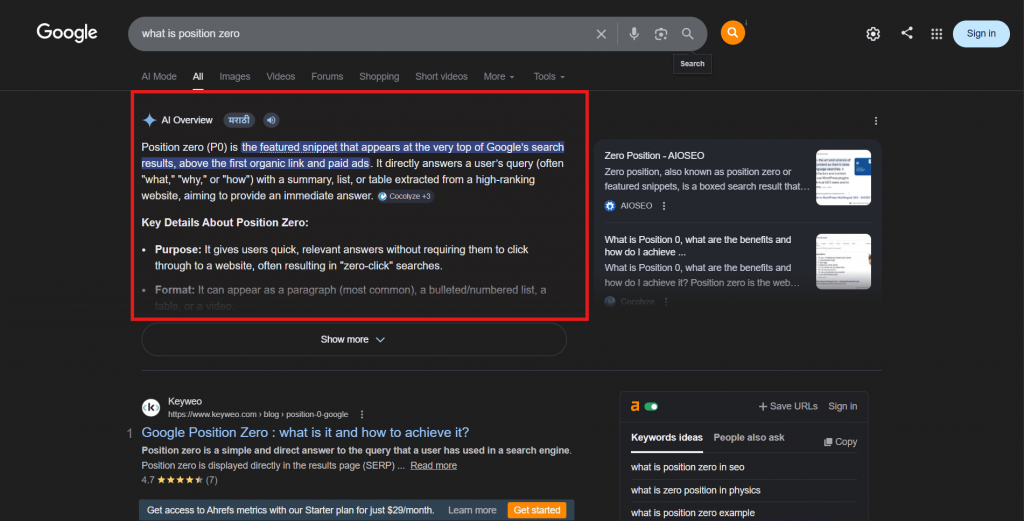
To rank in voice search, your goal is often to appear in position zero, also known as the featured snippet. This is the answer box that appears at the top of Google’s search results, and it’s often the source that voice assistants use when reading answers aloud.
To increase your chances of getting featured, focus on structuring your content so search engines can easily extract clear answers from your web pages.
Here’s how to optimize for position zero:
- Use question-style headings like “What is X?” or “How to do X,” then provide a direct answer within the first 40 to 60 words below the heading.
- Implement the right schema markup, such as FAQ schema or HowTo schema, to help search engines understand your content.
- Ensure strong overall SEO by maintaining fast loading speeds, a mobile-friendly design, and well-structured HTML.
- Organize your content using headings, bullet points, and short paragraphs to improve readability and clarity.
Voice assistants prioritize content that is concise, structured, and easy to interpret. By aiming for position zero, you increase your chances of becoming the answer users hear on voice searches.
Step 4: Optimize for local searches
Many local voice search queries have strong intent, especially when users are looking for nearby businesses, services, or directions. These local queries often signal immediate action, making them a key focus of your local SEO efforts.
To improve your chances of appearing in these searches, focus on strengthening your local SEO presence:
- Claim and optimize your Google Business Profile: Make sure your business information is accurate, complete, and up to date. This helps your business appear in maps, local packs, and voice results. If you haven’t set this up yet, you can follow this guide on how to claim your Google Business Profile to get started.
- Encourage satisfied customers to leave reviews: Positive reviews improve your credibility and can influence how often your business appears in local search results.
- Target location-specific keywords: Include your city, region, or service area in your content to match how users phrase local voice queries.
- Get listed on business directories: Ensure your business is consistently listed across trusted directories to strengthen your online presence and authority.
- Add local business schema: Structured data helps search engines better understand your business details, making it easier to surface your content in local and voice results.
By optimizing for local searches, you position your business to capture high-intent users who are ready to take action.
If you want to go deeper into improving your local visibility, explore this guide on promoting your business locally for more practical tips and strategies.
Step 5: Create voice-friendly content
To rank in voice search, your content strategy needs to focus on making information easy for both users and voice assistants to understand. Since voice queries are conversational, your content should mirror how people naturally speak and ask questions.
Focus on clarity and structure. Voice assistants typically pull short, direct answers, so your content should be easy to scan and interpret.
Here’s how to create voice-friendly content:
- Directly answer frequently asked questions: Identify common questions in your niche and provide clear, concise answers that address user intent immediately.
- Create FAQ pages: Build dedicated sections or pages that clearly answer common questions, making it easier for voice assistants to retrieve relevant responses.
- Use simple words and short sentences: Avoid overly complex language. Write in a way that feels natural and easy to understand when spoken aloud.
- Structure your content with H2s, bullet points, and numbered lists: Organized content makes it easier for search engines to extract key information and present it as a spoken response.
- Keep paragraphs concise (1–2 sentences): Short paragraphs improve readability and increase the chances of your content being featured in snippets.
- Use natural, conversational titles: Write headings that reflect how users phrase voice queries, such as “How do I fix a leaking pipe?” instead of just “Pipe repair.”
Step 6: Optimize for mobile
Most voice searches occur on mobile devices, with studies showing that the vast majority (56%) of local voice queries are made on smartphones, underscoring the importance of mobile optimization for visibility.
Search engines use mobile-first indexing, meaning they primarily evaluate the mobile version of your site when ranking your site.
If your site isn’t optimized for mobile, you risk losing both visibility and potential customers, especially those searching on the go.
To improve your mobile performance:
- Use a responsive design: Ensure your website adapts smoothly to different screen sizes, providing a consistent experience across devices. If you’re not sure where to start, this guide on how to make a responsive website walks you through the key steps.
- Optimize images and videos for mobile: Compress media files and use the right formats so your pages load quickly without sacrificing quality.
- Adopt a mobile-first approach: Design your content and layout with mobile users in mind from the start, rather than adjusting it later. You can also follow this mobile-friendly website checklist to make sure your site meets key mobile optimization standards.
- Use conversational language: Align your content with how users speak during voice searches to improve relevance.
- Answer common questions in your niche: Use clear, direct answers that match user intent, especially for mobile users seeking quick information.
- Use FAQ schema: FAQ schema is a structured data type that helps search engines better understand and display your question-and-answer content in search results. When search engines easily understand your content, you instantly increase your chances of appearing in search results and voice answers.
Optimizing for mobile supports voice search visibility and improves user experience.
Step 7: Target the People Also Ask (PAA) section
The People Also Ask (PAA) section in Google’s search results displays related questions users commonly search for. These questions often reflect conversational queries, making them highly relevant for voice search optimization.
By optimizing your content for PAA, you increase your chances of appearing in multiple search results, even if you’re not ranking in the top organic positions.
To target the PAA section effectively:
- Publish high-quality content: Focus on creating accurate, helpful, and well-structured content that directly addresses user questions.
- Provide real value: Go beyond surface-level answers by offering clear explanations that satisfy user intent.
- Create question-based content: Use headings that mirror common queries, such as “What is…,” “How to…,” or “Why does…”
- Answer questions directly: Provide concise answers immediately after each question to improve your chances of being featured.
- Use schema markup: Implement structured data, such as the FAQ and HowTo schemas, to help search engines better understand your content.
Targeting PAA helps you gain additional visibility and reach users searching for specific answers, especially those using voice search.
Step 8: Track results and make improvements if necessary
Voice SEO isn’t a one-time task. To see consistent results, you need to monitor your performance and adjust your strategy based on what’s working and what isn’t.
Tracking your results helps you understand how users are finding your content and whether your optimizations are driving real actions, such as calls, visits, or conversions.
Here’s what you should focus on measuring:
- Local actions: Track phone calls, directions requests, and clicks from your Google Business Profile to see how voice and local searches drive engagement.
- Query types: Monitor the kinds of search queries bringing users to your site, especially conversational and question-based phrases.
- Featured snippet wins: Check if your content is appearing in position zero or being pulled into voice search results.
- Conversions: Measure whether users are taking meaningful actions, such as making a purchase, booking a service, or filling out a contact form.
You can use tools like Google Search Console and your SEO platform to track these metrics and identify areas for improvement, and use these insights to refine your voice SEO strategy and focus on what delivers results.
If certain conversational queries are driving traffic, create more content around similar questions. If you’re winning featured snippets, double down on that format across other pages. And if local actions like calls or direction requests are increasing, continue optimizing your local listings and content.
Continuously test, adjust, and improve based on real data to strengthen your visibility in voice search, turn more searches into meaningful customer actions, and maintain a strong competitive edge.
Why voice SEO matters for small businesses
Voice SEO matters for small businesses because it helps you reach customers at the exact moment they’re searching for products or solutions using conversational queries.
Voice search in the United States continues to grow rapidly, with projections that over 157 million people will use voice assistants by the end of 2026.
As more people rely on voice assistants for quick answers, businesses that are optimized for voice search are more likely to be selected and recommended.
This shift in search behavior creates new opportunities to attract high-intent users, especially for local searches. By adapting your SEO strategy to match how people speak and search, you can improve your visibility and connect with customers when they’re ready to take action.
Below are some of the key ways voice SEO can benefit your business.
Positively impacts consumer behavior
Voice search changes how people interact with search engines by making queries faster, more natural, and more immediate. Instead of browsing multiple results, users often rely on a single spoken answer, which shortens the decision-making process.
This shift also supports the growth of voice commerce sales, as more users become comfortable making decisions and purchases through voice-enabled devices.
Boosts SEO efforts
Optimizing for voice search strengthens your overall SEO strategy. Many voice SEO best practices, including targeting long-tail keywords, answering questions directly, and improving site structure, also help improve your rankings in traditional search results.
Voice search also has a strong connection to local SEO. Many queries are location-based, meaning businesses that optimize for local keywords, maintain accurate listings, and gather reviews are more likely to appear in searches.
When users quickly find accurate information, directions, or contact details through voice search, it creates a smooth, positive experience, making them more likely to return to the same business next time they search.
Improves user experience
Voice SEO encourages you to create content that is clear, concise, and easy to understand. This not only helps search engines process your content but also improves how users interact with your website.
You create a smoother experience for visitors by focusing on direct answers, simple language, and mobile-friendly design. This makes it easier for users to find what they need quickly, boosting satisfaction and the likelihood they’ll return to your site.
The future of voice SEO
The future of voice SEO is closely tied to advancements in artificial intelligence, wider adoption of voice-enabled devices, and the growing preference for conversational search. As voice assistants become more accurate and integrated into everyday life, search engines will continue prioritizing content that delivers clear, direct, and context-aware answers.
Here are some key predictions shaping the future of voice SEO:
Widespread integration across devices
Voice search is no longer limited to smartphones. It is now integrated into smart speakers, TVs, cars, and wearables, allowing users to search from almost anywhere. Voice technology adoption is widespread, with 72% of consumers who are familiar with voice-enabled products having used them at least once in their daily activities.
Growing accessibility for different user groups
Voice search makes it easier for people of all ages and abilities to access information, especially those who prefer hands-free or faster interactions. In fact, adoption is being driven by younger consumers, households with children, and higher-income households, underscoring its appeal to a wide range of users. This wider adoption means businesses can reach a broader audience beyond traditional search users.
Advancements in natural language processing (NLP)
Modern search and voice systems support dozens of languages, with leading platforms like Google offering voice search across a wide range of languages and regions. As AI continues to improve, search engines can deliver more accurate and personalized answers, making it even more important to create content that matches how people naturally speak.
Consistent growth in voice search usage
Voice search adoption continues to rise year over year. Reports estimate that the number of voice assistant users will continue to grow steadily, with millions more expected to adopt the technology in the coming years. This steady growth reinforces the need for businesses to adapt early and stay competitive.
As voice technology continues to evolve, the way people search and interact with information will keep shifting alongside it. These changes point to a more conversational, accessible, and device-driven search experience, where quick, accurate answers matter more than ever.
Understanding these trends helps you stay aligned with how users search today and how that behavior is likely to develop in the years ahead.
Frequently asked questions
Yes. Voice search is often used for local, high-intent queries, which can directly impact how customers find and choose nearby businesses. Optimizing for voice search helps you stay visible where decisions happen quickly.
Avoid focusing only on short keywords, ignoring local SEO, and writing overly complex content. Not structuring answers clearly or skipping mobile optimization can also reduce your chances of appearing in voice results.
Ahrefs, Semrush, and SE Ranking are all strong options. They help with keyword research, competitor analysis, and tracking performance. The best choice depends on your budget, ease of use, and the features you need.
Voice search focuses on delivering concise, spoken answers to conversational queries, often pulling from featured snippets. AI Overviews and LLMs go further by generating summarized responses from multiple sources, requiring more comprehensive and context-rich content.
Be the answer when customers ask
Voice search is changing how people find businesses, and it’s not slowing down. Customers are already asking conversational, often local questions on their phones and smart speakers, expecting quick and accurate answers. Search engines are responding by prioritizing content that delivers exactly that.
For small businesses, this creates a real opportunity, an opportunity to show up at the right moment, when customers are ready to act.
Your next move is simple: take what you’ve learned and put it into action. Whether that means improving your keyword strategy, strengthening your local presence, or creating content that answers real customer questions, each step moves you closer to being the answer users hear first.
If you want to stay competitive in search, guessing won’t cut it. You need clear data, the right insights, and tools to act on them. Network Solutions’ SEO tool gives you exactly that, from uncovering keyword opportunities to tracking performance and improving your visibility where it matters.
And if you’re ready to take it further, our SEO services help you turn strategy into results. Instead of figuring it out on your own, you get expert support to optimize your site, strengthen your rankings, and build a presence that keeps you ahead as search continues to evolve.
Stop guessing. Start ranking.
Get expert support to optimize your site, improve rankings, and stay competitive in search.