


Key takeaways:
- The .com top-level domains are the most well-known and recognized extension, with millions of registered domains.
- It can work well for a variety of websites, ranging from e-commerce stores to personal blogs.
- Alternatives like .co and .store work for specific purposes if a .com domain isn’t available.
The .com domain name is one of the most well-known and regarded top-level domains (TLD), with over hundreds of millions of active websites on the internet. The Domain Name Industry Brief cited a total of nearly 163 million .com registrations as of Q1 2026.
The .com TLDs remain the most sought-after domain extensions because of four factors:
- Long-standing recognition
- Perceived trust and credibility
- Universal familiarity
- Strong brand association
Here, you’ll learn about .com, the advantages of using the extension, some alternatives, and how to secure your own .com domain name.
Find the perfect domain
Ready to register a domain name? Check domain availability and get started with Network Solutions today.
What is .com?
As a business owner, you might wonder, “What is .com going to do to make my website thrive and stand out online?” Here’s what you need to know about the .com domain suffix and how it can help your web address.
The .com top-level domains are the most popular and widely recognized domain extension online. The “.com” stands for “commercial. ” It was originally created in 1985 for businesses and commercial organizations. Over time, it grew beyond its original purpose, becoming the most widespread and recognizable generic TLD. It is the go-to choice for all kinds of websites—from global corporations to personal blogs.
The first .com web address was symbolics.com, registered on March 15, 1985, by Symbolics Inc., a Massachusetts computer company that specialized in computer workstations and programming languages for artificial intelligence research. While Symbolics no longer operates, the domain remains online as an internet landmark.
Verisign currently manages the .com top-level domains. It’s responsible for maintaining the domain registry, ensuring stability, and keeping millions of .com websites accessible. Since taking over in the 1990s, the company has made .com the most secure, reliable, and popular domain extension.
Who should use the .com domain name?
The .com extension is an excellent fit for almost anyone. Because it’s the most familiar and widely trusted domain name, people naturally type “.com” in the address bar. That makes it especially valuable if you want your brand to be memorable.
It’s ideal for:
- Businesses and startups
- Personal brands
- Blogs and portfolios
- E-commerce stores
Businesses and startups
For businesses and startups, trust is everything. A .com domain name instantly signals credibility because it’s the extension people know best. Clients are more likely to click, remember, and return to a .com site than other extensions.
It also gives startups a competitive edge—investors, partners, and clients want results, and it’s easier to build authority from the start with .com. Since many successful global brands use .com, aligning your business with this standard can help you appear more established.
Personal brands
If you’re building a personal brand, a .com domain name helps you stand out and express a professional image. It makes your brand identity easy to remember, whether you’re a freelancer, content creator, or influencer.
Having a .com also builds brand credibility with potential clients, employers, or followers who may be discovering you for the first time. Since .com is so widely recognized, it signals that you’re serious about your online presence and makes it simpler for people to find and trust you.
Blogs and portfolios
For blogs and personal portfolios, a .com domain name makes your work more discoverable and memorable. It also gives your content extra credibility. Whether you’re sharing articles, photography, or design projects, a .com signals professionalism and can help your site feel more established. This is especially helpful if you want to grow your audience, attract collaborations, or even monetize your work in the future.
E-commerce stores
When selling online, trust is key, and a .com domain instantly makes your store look more reliable. Shoppers prefer a site that feels familiar and professional, and .com has that built-in recognition.
Visitors who see your store once are far more likely to remember and return to a .com address than an unfamiliar extension. If you aim to grow sales and build long-term customer loyalty, choosing .com as your generic top-level domain gives your e-commerce site a strong foundation.
Building an e-commerce site shouldn’t be more complicated than riding a bike. Our guide on building an e-commerce store can help you take the training wheels off.
How does a .com domain name benefit me?
The .com domain name remains the most popular for a reason. It offers several advantages that make it the go-to choice for businesses, creators, and individuals alike:
- Global recognition: People worldwide know and trust .com, making it easier to connect with international audiences.
- Credibility and trust: A .com instantly signals professionalism, which can influence how visitors, clients, or readers perceive you.
- Memorability: Most people default to typing .com. It’s easier for visitors to remember and return to your website.
- SEO value: Search engines don’t favor .com over other domain names. However, its familiarity often leads to higher click-through rates, which can indirectly support your visibility.
- Resale value: Short, brandable .com names are in high demand, giving them substantial long-term value compared to other TLDs.
- Universality: The .com works for almost any website, from blogs to global enterprises.
- Email professionalism: A custom email like [email protected] looks more polished than alternatives with lesser-known TLDs.
- User trust in transactions: Customers perceive e-commerce and service-based websites with .com as safer for online payments.
- Proven track record: The domain extension withstood the test of time as the most reliable extension.
- Easier word-of-mouth sharing: Listeners will almost always assume a website ends in .com when someone discusses a website they visited.
Are there downsides to a .com domain name?
While .com is the most popular domain extension, it comes with a few drawbacks worth considering:
- High competition for names: Established brands have already claimed many short or catchy .com domains, making it harder to find the perfect fit with your desired name.
- Potentially higher cost: Premium .com names can be more expensive and in higher demand than newer and different TLDs.
- Less availability for niche branding: The .com domain may feel too generic if you want your domain name to reflect your industry, unlike other domain extensions like .tech or .travel.
- Domain squatting issues: Most owned domains sell at inflated prices because .com domains are valuable.
What are the alternatives to a .com domain?
Is your preferred .com domain owned by someone else? You’re not out of luck yet. Other domain extensions are viable based on your needs:
- .org: Used by nonprofits, charities, and organizations. This TLD carries a sense of trust and community, but isn’t always the best fit for businesses.
- .net: Initially meant for network-based companies, the TLD is still common among tech-related pages. However, it doesn’t have the same recognition power as .com.
- .co: Popular with startups because of its short length and availability. The TLD can be an alternative to .com, though some users may accidentally type .com instead.
- Industry-specific TLDs: Great for branding because they instantly show what your site is about.
- Country-code TLDs: Useful if your business mainly serves a local market in specific countries.
Extension | Recognition | Trust level | Availability | Best for | Potential drawback |
|---|---|---|---|---|---|
.com | Very high | Very high | Limited (many taken) | Businesses, personal brands, ecommerce, blogs | Premium names can be costly |
.org | High | High | Moderate | Nonprofits, charities, organizations | Less suited for commercial use |
.net | Moderate | Moderate | Better than .com | Tech companies, networks | Less memorable than .com |
.co | Growing | Moderate | Good availability | Startups, entrepreneurs | Users may confuse it with .com |
.store/.tech/.design | Niche-specific | Moderate to high (depends on industry) | High | Industry-specific branding | Less familiar to general audiences |
ccTLDs (.uk/.ca/.us/.au) | High locally | High in local markets | High in respective countries | Local businesses and services | Limited global appeal |
How do I register a .com domain?
Registering a .com domain is a fairly straightforward process, though the exact steps may vary slightly depending on your chosen registrar.
Here’s a general overview of how it works:
- Brainstorm your domain name: Choose a name that’s short, memorable, easy to spell, and closely tied to your brand or business. If possible, avoid numbers, hyphens, or unusual spellings that may confuse customers. Our guide on when to use numbers in a domain name can help you learn more about when they help and when they don’t.
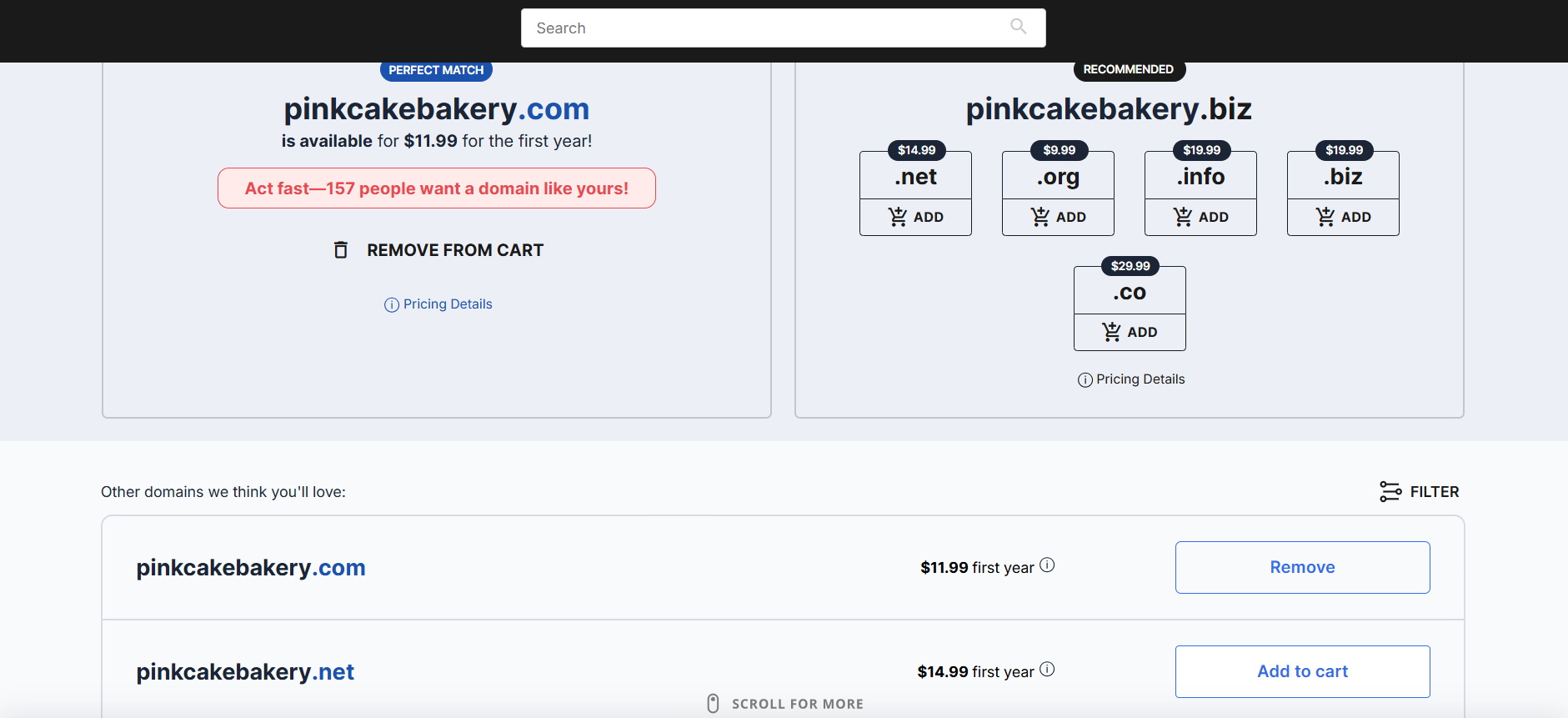
- Check if the domain is available: Use a domain registrar’s search tool to see if your preferred .com domain is still available. If it’s already taken, explore close variations while keeping your branding clear and recognizable.
- Look for potential conflicts: Before registering, run a quick trademark search and check social media handles to ensure the name doesn’t create branding or legal issues later. Consistency across your website and social platforms can also make your business easier to find online.
- Choose a domain registrar: Compare registrars based on pricing, renewal rates, customer support, security features, DNS management tools, and extras like WHOIS privacy protection.
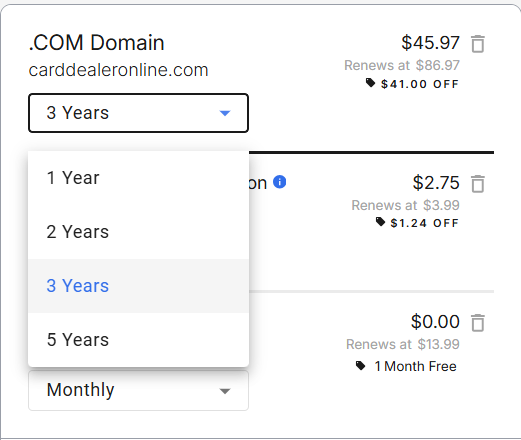
- Select your registration term: Once you’ve found an available domain, choose how long you want to register it for. Most registrars offer registration periods of one to 10 years. Many business owners choose to spread payments over multiple years to reduce the risk of accidental expiration.
- Add domain privacy protection: Many registrars offer WHOIS privacy, which helps keep your personal contact details hidden from public WHOIS databases.
- Create your account and enter your contact details: You’ll need to provide accurate registration information, including the registrant, administrative, and technical contact details. ICANN requires domain owners to maintain valid contact information for active domains.
- Complete payment and verify your email: After payment, your registrar will usually send a verification email. Confirming your email address is important because unverified domains can become suspended or inactive.
Once your domain is registered, the next step is setting up your website, email, and other online essentials. If you’re unsure where to begin after purchasing your domain, our guide on what to do after buying a domain can help you plan your next steps.
Additionally, if you’re interested in our services, our guide to buying a domain provides a step-by-step breakdown. You can also learn more from our YouTube channel:
How much does a .com domain cost?
A .com domain typically costs $10 to $25 per year for a standard registration, though the exact cost can vary depending on the registrar, the desired domain name, and any add-ons included with the purchase.
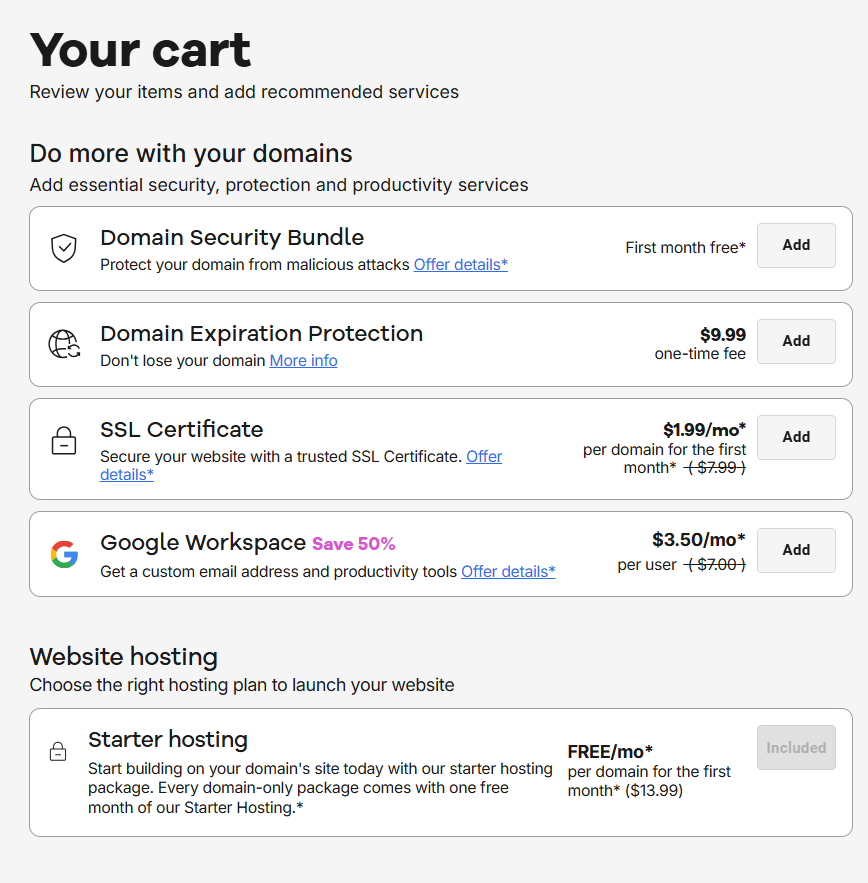
For example, many registrars offer optional services that can increase the total cost, such as WHOIS privacy protection, SSL certificates, email hosting, domain security bundles, automatic renewals, or website-building tools. While some providers include certain features for free during the first year, others charge separately for them.
The type of .com domain you purchase also affects pricing. A brand-new registration is usually the most affordable option, while renewal pricing may be slightly higher after the initial term ends. Transfer fees can also vary between providers.
In some cases, you may come across a premium domain. These are domain names considered especially valuable because they contain short phrases, common words, or high-demand keywords that businesses actively want. A premium domain can cost anywhere from hundreds to thousands of dollars, depending on its popularity, branding potential, and market demand.
If your preferred .com domain is already taken, some registrars may also offer the option to purchase it from the current owner at a negotiated price.
Because pricing structures vary, it’s worth comparing registrars carefully before purchasing your com domain. You can explore available options, features, and pricing through our domain registration services.
Find a domain name that reflects and enhances your brand!
Our premium domain names help leave a mark on your audience and keep your website memorable.

Is .com right for me?
Choosing a domain depends on your goals, but .com is often the safest bet. If you want global reach, brand credibility, and a name people can easily remember, .com is hard to beat. It works well for almost any type of website—businesses, personal brands, blogs, or online stores.
That said, if your focus is local, industry-specific, or nonprofit-driven, other suffixes such as .org, .net, or a country-code domain might serve you better.
Frequently asked questions
It depends. While .com domain is the most recognizable TLD, other top-level domain names might work better for your brand. For instance, .org might work better for charitable organizations.
No, search engines don’t give direct SEO benefits for .com websites. However, most users will likely click on pages with a .com extension.
.com stands for “commercial” and is intended for businesses and other commercial organizations. However, it became the most widely used domain extension for websites of all types, including personal brands, blogs, online stores, and startups.
For many businesses, yes. A .com domain is still considered the most recognizable and trusted domain extension online. Customers often assume a business website ends in .com, which can make your brand easier to remember and appear more credible.
No. Domain names are rented rather than permanently owned. You register a domain for a set period, usually one to 10 years, and renew it to keep ownership active.
Some .com domains are considered premium domains because they contain high-demand keywords, short phrases, or highly brandable names. These domains often have higher prices due to their marketing value and demand.
If your desired domain name is unavailable, you can try variations, alternative wording, or different brand-focused combinations. In some cases, you can buy a domain from the current owner through a broker or marketplace. The domain aftermarket can also help you acquire occupied domains.
WHOIS privacy protection is optional, but many business owners choose it to help keep personal contact information out of the public WHOIS database and reduce spam or unwanted contact.
Yes. Most .com domains can be transferred to another registrar if you decide to switch providers. The process usually involves unlocking the domain and obtaining an authorization code from your current registrar.
Build your online brand with .com
The .com domain remains one of the most recognizable and memorable generic TLDs. It offers numerous benefits, including increased trust, higher resale value, and universal recognition. You can’t go wrong with building a website on the back of a .com extension.
Here, we have a huge selection of .com domains to build your website with. Our Domain Name Generator can help you decide on your brand name, and our Website Builder can help you launch your webpage in a jiffy. Your new domain also comes with a customer app and social app to help you monitor and interact with your customers.
That’s all the tools you need to grow your brand and break through.